

Why the Argument Keeps Coming Back
Every year or two, a fresh wave of articles appears about people who have traded smartphones for basic phones — devices that make calls and send texts without internet, social media, or an app ecosystem. The writers tend to report the same handful of outcomes: less anxiety, better sleep, more presence in physical situations, and less time lost to automatic scroll patterns.
The argument recurs because the underlying problem recurs. Smartphones are built to capture and hold attention, and the business model of the apps they carry depends on time spent inside them. Notifications, recommendation systems, and endless feeds are all tuned for engagement rather than for the user's benefit. Switching to a basic phone removes that system wholesale instead of trying to manage it from inside — which is why the idea keeps drawing people who have already tried, and tired of, managing it.
What a Basic Phone Does and Doesn't Do
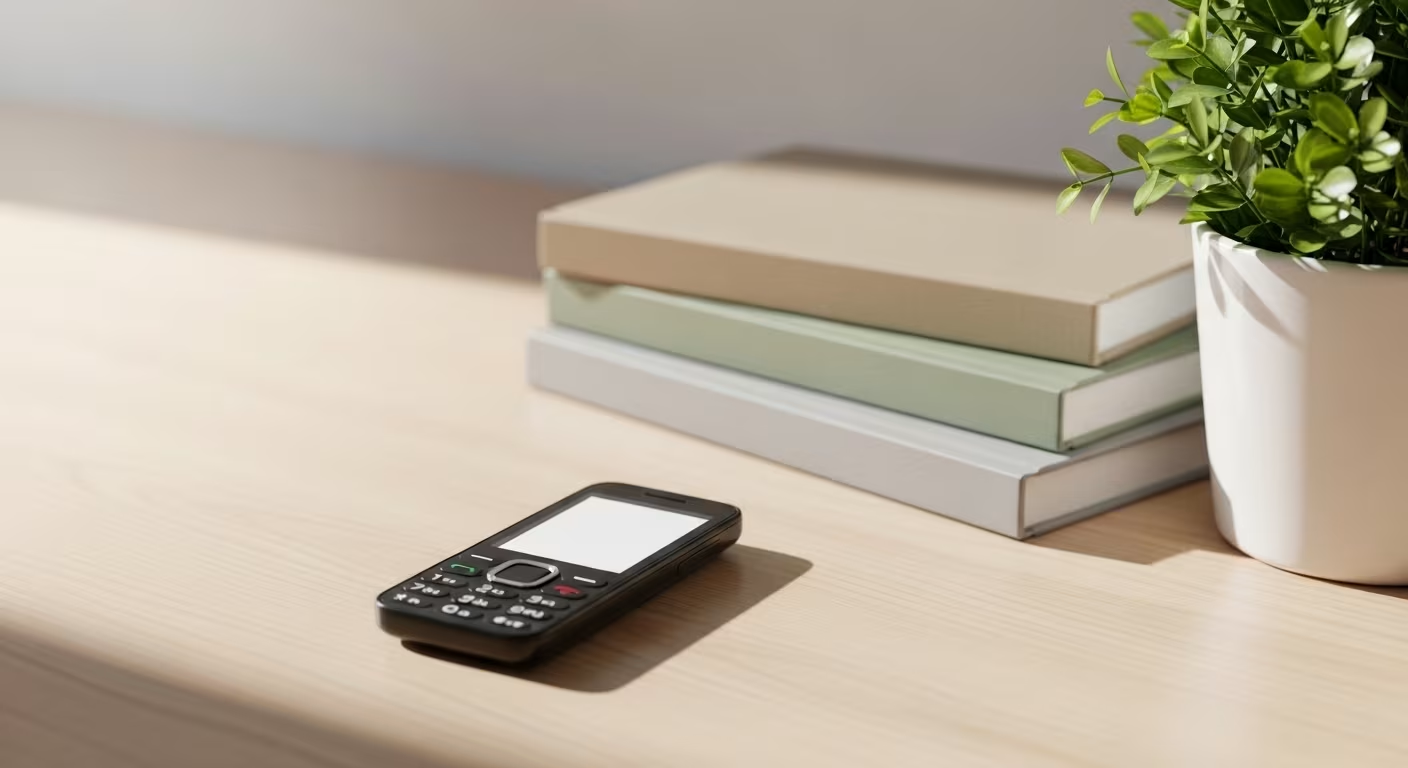
A basic phone — often called a dumb phone despite being fully functional at its actual job — handles voice calls, text messages, and on some models basic email. It usually does not run third-party apps, does not offer social media, carries at most a rudimentary camera, and provides no practical web browsing. Whether that is a limitation or the entire point depends on what you currently do with a phone.
The honest way to decide is to list every distinct function your smartphone handles and sort each one: which genuinely require a smartphone, which could move to another device, and which you could simply drop. The table below shows how that sorting tends to shake out.
| Function | Works on a basic phone? | Workaround if not |
|---|---|---|
| Calls and texts | Yes | — |
| Turn-by-turn navigation | Rarely | Standalone GPS, or memorize the route first |
| Camera | Basic only | Point-and-shoot or a dedicated camera |
| Two-factor authentication | SMS codes only | Hardware token, or an authenticator on a home tablet |
| Banking and contactless payment | No | Physical card, web banking on a computer |
| Social media, news, browsing | No | Access on a computer at home |
For someone whose phone is mostly calls, texts, and the occasional map lookup, a basic phone covers the core and drops the distractions. For someone whose phone is the family's navigation system, authentication hub, wallet, and work terminal, each of those functions needs a substitute mapped out before the switch is realistic. For a deeper reference, see NIH News in Health.
The Transition and What It Reveals
People who switch typically go through an adjustment period of one to two weeks, reaching for the phone reflexively in moments of boredom, waiting, or mild discomfort and finding nothing to open. The stretch is uncomfortable and revealing in equal measure: the phone-reaching reflex becomes impossible to miss once there is nothing to reach for. After it passes, most people describe settling into a different relationship with unoccupied time — a five-minute queue at a coffee shop becomes an ordinary pause rather than an automatic cue to pull out a device.
People land in roughly three places after the trial. Some keep the switch permanently, having found the basic phone solved the problem outright. Others switch back after a defined stretch — a month, a season — using the separation to pinpoint the specific behaviors they wanted to change, then returning to a smartphone with clearer intentions. A third group settles on a hybrid: a smartphone kept at home or reserved for specific contexts, paired with a basic phone for everyday carrying. None of these is a failure; the trial did its job in all three cases by making the habit visible.
The camera is the most common practical objection, and a fair one. Recent smartphone cameras are genuinely good and have replaced dedicated cameras for most people; a basic phone camera is meaningfully worse. The answer depends on use. Snapshots for documentation or family sharing come out fine on a basic camera. Photography as a creative practice, or images shared professionally, are better served by a dedicated camera — one a switch might finally prompt someone to buy, or to dig out of a drawer unused. The deeper trade-off is convenience: the best camera is the one you have on you, and a dedicated camera has to be carried on purpose.
The Middle Path: A Smartphone Stripped Down
Most of the benefit is available without changing hardware at all. Delete the most compulsive apps from a smartphone — social media, news — and move the browser off the home screen onto a secondary one, and the device starts behaving more like a basic phone than most people expect, while keeping the navigation, camera, and payment functions a basic phone lacks.
This approach is reversible in a way that selling a phone is not, and it leaves connected infrastructure like authentication and banking apps untouched. The one condition is that it works only if you actually delete the apps rather than just hiding them from the home screen. Deletion, with the option to reinstall, creates a real friction point that interrupts automatic access; a hidden icon is still two taps away and still opens on reflex. For many people this middle path delivers the distraction reduction they were after without the adaptation cost of a full switch.
Mapping the Infrastructure First
Whichever direction you go, the practical questions are worth working through before, not during, the switch. Two-factor authentication tied to the phone needs an alternative — a hardware token, SMS codes, or an authenticator moved to a home tablet. Banking apps, transit passes, and contactless payment may need a fallback or simply a return to physical cards. None of these are insurmountable, but each is easier to solve at a desk on a calm afternoon than in a checkout line.
Map every phone-dependent function, decide its substitute, and only then commit. The week spent solving these logistics is a one-time cost; the reduced distraction, if the change sticks, operates every day after. And if it does not stick, you will still come away with an unusually clear inventory of exactly which phone functions you rely on and which you were only reaching for out of habit — which is worth the experiment either way.


Comments
No comments yet.