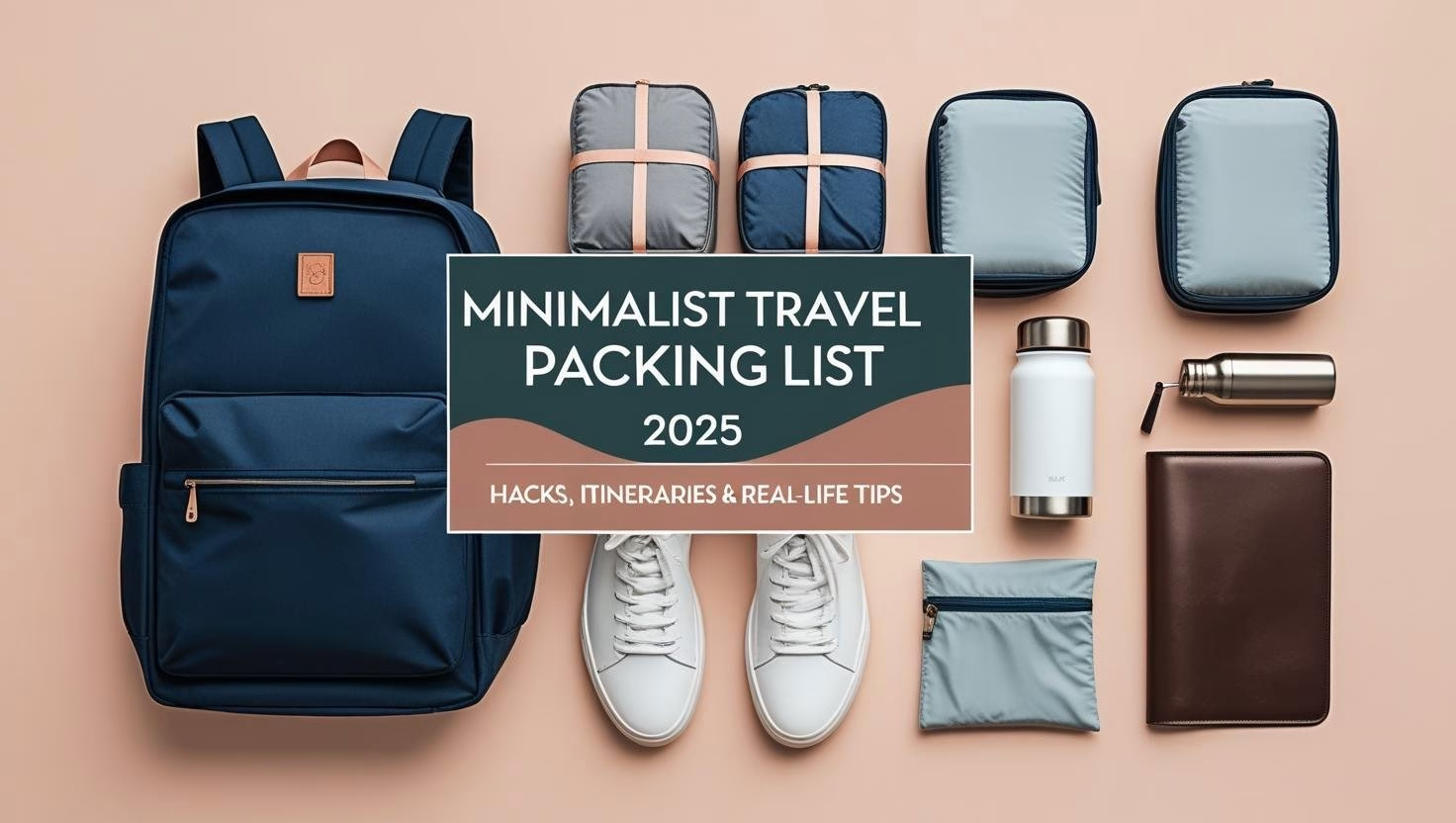

The point of a minimalist packing list is not to bring as little as possible. It is to bring only what earns its space — items used consistently, with nothing left untouched in the bag at the end. Most travelers get home having never worn 20 to 30 percent of what they packed. That unused fraction is the whole target, and everything below is aimed at shrinking it.
The Bag and a Five-Day Rotation
A 22-to-26-liter bag with a clamshell opening fits most overhead bins and personal-item limits, and opening flat like a suitcase lets you reach anything without unpacking the rest. Confirm the airline's carry-on dimensions before buying, since a bag sized for one carrier can be an inch too big for another.
A five-day rotation covers a two-week trip as easily as a five-day one, because the variable is laundry, not quantity. A small tube of travel detergent turns a sink into a wash station, and neutral colors mean any top pairs with any bottom, so the same handful of pieces produces a week of combinations that do not read as repeats. Packing more clothing to avoid doing laundry usually backfires: the extra weight rides along untouched while a fifteen-minute sink wash every third night would have covered it.
Clothing works on one principle: five to seven days of neutral pieces that mix, layer, and hand-wash for a second wear. For most trips that means three or four tops — merino wool covers the widest temperature range, quick-dry synthetic suits active days — two pairs of pants or one pant plus shorts, five to seven pairs each of underwear and socks, and one light sweater or fleece for cool evenings. Cold-weather trips add three compact pieces: a packable down jacket, a rain or wind shell, and a merino base-layer set worn under the day's clothes. What stays home is a full pajama set (an old T-shirt does the job), a dressing gown, more than two pairs of shoes, and formal wear for an occasion that is not confirmed.
Footwear and Toiletries
Two pairs of shoes cover nearly every trip. The first is a broken-in walking shoe comfortable for 8 to 10 miles of pavement, which does most of the work. The second is one alternative — sandals for warm climates and showers, or a slightly nicer shoe for dinners and evenings. A third or fourth pair almost never justifies its space: beach flip-flops cost $3 to $5 at the destination, and hiking boots for an unplanned hiking day can be rented at most popular trailheads.
Toiletries stay within the 3.4-ounce carry-on limit in travel containers refilled from home: shampoo, conditioner, body wash, and face wash, since most trips use only two or three applications a day. Add a toothbrush and travel toothpaste, a solid or small roll-on deodorant, sunscreen in a reusable container, any prescriptions in their labeled bottles, and a universal adapter for international travel. Skip full-sized products, a full first-aid kit for developed-country destinations where pharmacies are everywhere, and a hairdryer that hotels already provide.
Documents, Cards, and Tech
The essential documents are a passport valid at least six months beyond the trip, a credit card with no foreign transaction fees, a debit card that reimburses international ATM fees, and digital copies of the passport, insurance, and bookings stored in email and the cloud. An international driver's permit from AAA is useful if you plan to rent a car abroad. Paper printouts of everything are rarely needed — digital works at most modern airports, with a paper backup only for the few that still require it.
Tech comes down to a phone with offline maps downloaded and a local SIM or eSIM active, one universal adapter rather than one per device, one cable per connector type since USB-C now covers most gear, a 10,000-mAh power bank good for two full phone charges on travel days, and earphones — noise-cancelling for long flights. What to leave: a tablet and a laptop both, a camera and a phone camera both for non-photography trips, and the pile of device-specific adapters a single universal one replaces.
Keeping the small tech in one flat pouch is worth the minor effort, because loose cables are what turn an organized bag back into chaos by day two. Everything charging-related in a single zip case means one thing to grab at security, one thing to repack at the gate, and no forgotten adapter left plugged into a hotel wall. The phone earns its central place precisely because it collapses so many separate devices — map, camera, guidebook, boarding pass, flashlight — into the one item you were always going to carry anyway.
The Test Before You Pack
Lay out everything you plan to bring, then walk away for an hour. Come back and remove three items. Those three are the ones you were least certain about, and the things you are least certain about are almost always the things you will not use. The bag that survives this test is the right bag. If you want to dig deeper, Recreation.gov's trip-planning tools is a good starting point.
One category never gets cut: socks and underwear. They see the most use per trip, matter most to comfort on long walking or travel days, and are the cheapest thing to pack adequately — five to seven pairs minimum for any trip over five days, plus the pair you are wearing, with merino socks for multi-day wear between washes. The traveler who under-packs everything except socks and underwear is doing it right; the one who brings a single good shoe but seven pairs of shoes has it backwards.
Adjusting for Specific Trip Types
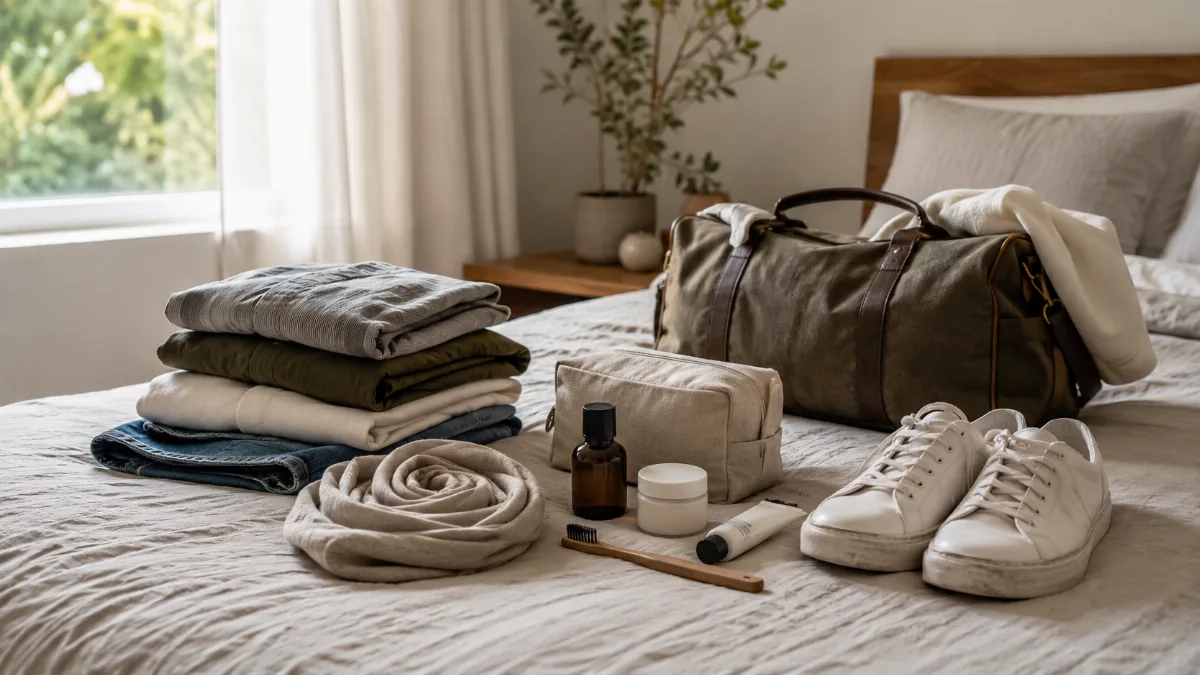
The core list flexes by trip type with small swaps. A beach trip trades the down jacket and base layer for a rashguard, a second swimsuit that dries while the first is worn, and a coverup that doubles as light clothing, with sandals as the primary shoe. A winter city trip leans on the layering system — one base layer, one packable down, one rain shell compress into about half the volume of a single heavy coat — plus a scarf and cheap hand warmers bought on arrival. A hiking trip swaps the city walking shoe for broken-in trail runners, merino for faster-drying synthetic, and adds a rain cover for the bag, with poles rentable at most popular trailheads. Business travel adds two dress shirts, one pair of dress trousers, and a blazer that formalizes any combination layered under it.
See also: minimalist travel gear for every season and 25 budget travel tips.