


What the Research Actually Shows
Gratitude has been studied seriously since the early 2000s, when Martin Seligman's positive psychology work pushed it from a virtue into a research subject. The findings hold up fairly well across different study designs, as Harvard Health's review of the gratitude research lays out: people who keep some regular gratitude practice tend to report higher life satisfaction, better sleep, less envy and resentment, and stronger relationships than people who don't.
The effect is real and worth taking seriously. What the research does not show is that the effect scales with elaboration. Longer journals, more prompts, and fancier frameworks don't appear to beat simple approaches. The benefit seems to come from the plain act of deliberately noticing what's going well — not from any particular format wrapped around it.
That matters for how you design a practice. The goal is consistency across months, not sophistication of format. The simplest practice you can actually keep will outperform the most elaborate one that collapses under its own weight by week three.
The Minimal Viable Practice
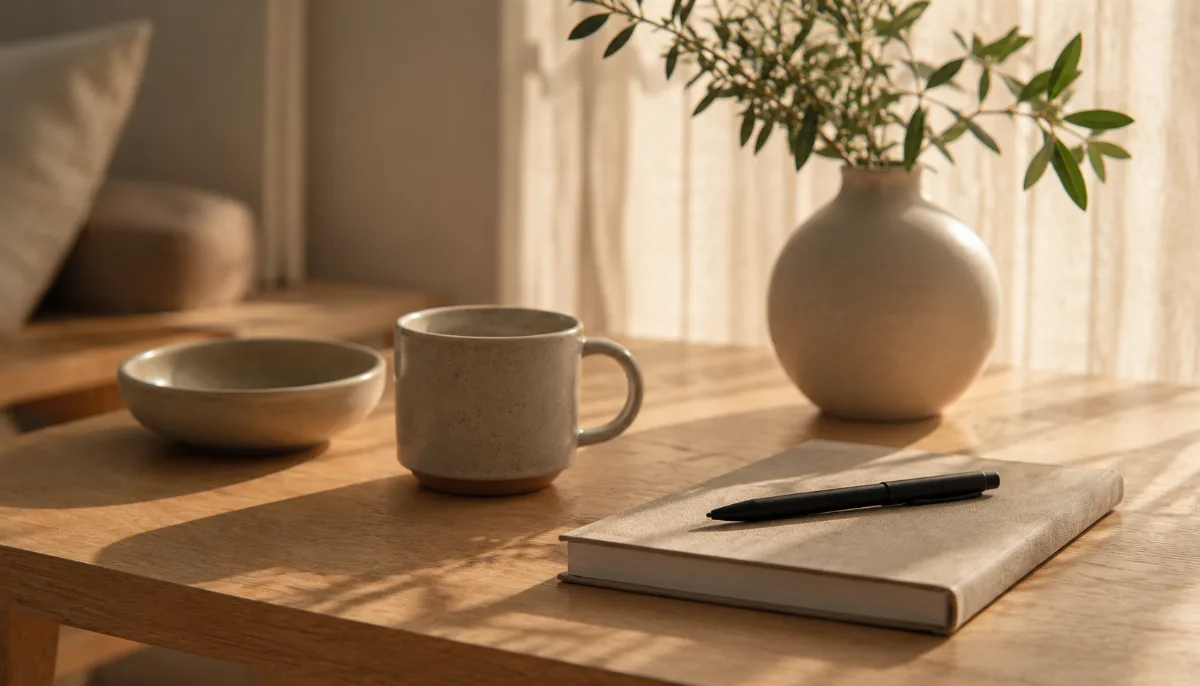
The most reliable version is one written sentence, once per day, about something specific that was good about the day. That's it. One sentence, specific rather than generic, written rather than merely thought. Nothing else is required, and adding more tends to make it harder to keep, not more effective.
The specificity requirement carries more weight than it looks. "I'm grateful for my health" is generic and does almost nothing — you can write it without recalling a single thing that happened. "I'm grateful the conversation with my colleague went better than I feared this morning" is specific, and it does the work, because producing it forces you to actually replay the day. That act of attention is the mechanism; the sentence is just its residue. Writing rather than thinking matters too, though less: the pen creates a small deliberate pause that a passing thought doesn't. The sentence doesn't need to be saved — the writing is the practice, not the archive.
Formats, Side by Side
There isn't one correct form. There's the form you'll still be doing in a year, which depends on how much effort it asks against how much friction you'll tolerate. Laid out plainly, the trade-offs look like this:
| Format | Effort per entry | Sustainability | Evidence strength |
|---|---|---|---|
| One written sentence, daily | About a minute | Moderate — daily quota can wear thin | Strong |
| Three good things, weekly | A few minutes, once | High — low pressure, easy to keep | Strongest in several studies |
| Spoken thanks to a person | A short exchange | High, and doubles as connection | Good |
| Silent mental review | Seconds, no tools | Highest — nothing to maintain | Weaker than written forms |
No row is the winner for everyone. The point of the table is to pick honestly: if a daily quota will quietly become a chore you skip, the weekly or mental version that you'll actually keep beats the daily one you'll abandon.
Why Weekly Often Beats Daily
Daily gratitude practice tends to fall apart within a few weeks — not because a minute of writing is hard, but because the pressure of finding something fresh every single day turns an observation into an obligation. The moment it feels like homework, quality drops and the habit dies.
A weekly version — one specific written sentence per week — takes that pressure off without giving up much benefit. Some of the strongest effects in the research came from people writing a few good things once a week rather than daily; the daily versions sometimes showed smaller effects, possibly because a daily quota erodes the very attention the practice depends on. Once a week, on the same day, one specific sentence: that's easy to keep for a year. And a modest practice sustained for a year beats an ambitious one that folds after three weeks — every time.
Specificity Is the Whole Mechanism
The reason specificity matters is attentional. Generic statements — health, family, a roof — are true for most people most of the time and can be produced on autopilot, without recalling any actual experience. They ask nothing of you, so they give nothing back. Specific statements require memory: you have to scan the recent past for something genuinely good, which means attending to the real texture of the week instead of reciting a category. That scanning is the practice.
A prompt that reliably produces specifics: what's one thing that happened this week I'd be sorry to have missed? The answer is almost always concrete and often small — a particular conversation, a good meal, a moment with someone, a task finished cleanly. Small specifics deliver the same benefit as grand ones. The size of the thing isn't what counts; the quality of attention you bring to it is.
A second guardrail keeps the specifics from going stale: avoid repeating yourself. If "grateful for my morning coffee" appears four weeks running, the practice has quietly slid back into a generic habit wearing a specific costume. Naming a different thing each time forces a fresh scan of the actual week rather than a reach for the reliable stand-by. This is also why the weekly cadence tends to keep quality higher — a week holds more distinct, nameable moments than a single day, so finding something genuinely new to point at is easier, and the entry stays an observation instead of hardening into a template.
When Gratitude Practice Backfires
The practice has a failure mode worth naming. For someone in genuine hardship — depression, grief, serious illness, a financial crisis — a prompt to find the good can produce the opposite of the intended effect. The gap between what the exercise asks for and what's actually being lived can feel like a dismissal of real suffering, and that's a legitimate objection, not a lack of discipline.
It isn't a reason to avoid the practice, but it is a reason to hold it honestly. Gratitude doesn't require pretending things are better than they are. It asks you to notice what's genuinely present and good even when much isn't — and on a hard week that sentence might be very small and entirely minor. That's enough. If the practice consistently produces discomfort rather than any flicker of recognition, take a break or change the format. It's meant to serve wellbeing, not to demand a performance of positive emotion.
What to Do With the Archive
If you write on paper, you eventually have a stack of these sentences, and reading back through three months or a year of them is a different experience from any single entry. The accumulation shows patterns — what keeps recurring, what mattered most, what shifted over time. That's a genuine, if optional, reward of the written form.
It's a feature, not the point. The archive isn't the goal; the practice is. If keeping the pages starts to feel like a burden, let the writing happen and then let the paper go. The sentence did its work in the writing; what becomes of it afterward is secondary, and no one is grading the collection.
Beyond the Journal
Gratitude practice takes more shapes than the journal that gets most of the attention. Some people do it out loud — telling a specific person one thing they appreciated about them or about an exchange. That version folds the practice into the relationship itself, so noticing and expressing happen in one move and the benefit compounds. Others run a brief internal review inside something they already do — the commute, a walk, the first minutes awake — writing nothing at all. The mental form has thinner evidence behind it than the written one, but it's far easier to keep, and consistency is what determines whether any practice works.
Pick whichever you'll actually repeat, and start this week at the smallest scale that counts — a single specific sentence about one good thing. On a hard week it might be one conversation that went well or a meal you enjoyed, and that's sufficient. The practice never asks for proportional enthusiasm. It asks only for honest attention to what is actually present and actually good.



Comments
No comments yet.