


The link between a physical space and how a person feels in it is one of the better-documented findings in environmental psychology. The room you sit in affects your mood, your stress, your ability to concentrate, and the quality of your rest — and much of that effect runs below conscious notice. You do not have to feel bothered by a cluttered room for the clutter to be working on you. This is why clearing a space so often produces a change that goes past the practical. The room does not just become easier to clean; it starts to feel different, because it is acting on the person in it differently.
Why a Cleared Room Actually Feels Different
A tidy room is not only more organized in some abstract sense. It changes what the space demands of you while you are in it. The difference people report after clearing a surface — lighter, calmer, able to think — is not imagination or the glow of an accomplishment. It is the removal of a load that was there the whole time, quietly drawing on resources you needed for other things. Understanding where that load comes from makes it easier to spend effort on the clutter that actually matters rather than chasing a magazine version of tidy.
What Clutter Does to Attention
Studies in environmental psychology have linked visually busy, cluttered homes to higher measured stress than organized ones — an effect that shows up even when the person is not consciously thinking about the mess or reporting any distress about it. The visual complexity registers whether or not you decide to notice it.
Part of the mechanism is attention. The brain's visual system is always processing what sits in front of you, and a field crowded with objects takes more processing than a clear one. That work runs in parallel with whatever you are actually trying to do — write, talk, rest — and quietly reduces what is left over for it. Trying to work at a desk buried under paper costs more than working at a clear one, even if neither person could tell you why. For anyone prone to anxiety, a cluttered space adds fuel: more to scan, more ambiguous objects that might or might not need dealing with, more to keep half an eye on. For evidence-based guidance here, see NIH News in Health.
The Weight of Unfinished Tasks
There is a specific way clutter presses on the mind, named after the psychologist who first described it: the Zeigarnik effect, the tendency of unfinished tasks to hold more attention than finished ones. A pile of papers to sort, a drawer to organize, a room half-cleaned — each keeps a low background claim on your attention that does not switch off just because you have walked away from it.
A home full of these small open loops carries an ongoing load that eats into the mental room available for rest and recovery. The person who has free time in the evening but still cannot relax is often feeling exactly this: the unfinished jobs in the environment refusing to release their grip. Actually completing them — finishing the sort rather than deferring it another week — does more than clean the house. It frees the attention that was tied up in tracking and avoiding the task, and that attention becomes available for the rest you were trying to get.
Fewer Decisions, Less Fatigue

Decision fatigue is well established: the quality of your choices tends to slip over a day as the cumulative weight of decisions wears down the resource that deliberate choosing draws on. And it is not only the big calls that draw on it — deciding what to wear from an overstuffed closet pulls from the same pool as the consequential decisions later in the day.
Minimalism trims that daily burden by simplifying the environment. A pared-down wardrobe removes the morning clothing decision. A kitchen with the right amount of equipment removes the daily hunt for a usable pan. A clear desk removes the where-does-this-go assessment before you can start work. Each cut is tiny on its own; together they preserve a meaningful amount of mental energy for the decisions and activities that genuinely deserve it. This is one of the most practical connections between a simpler home and a steadier mind — not a dramatic transformation, just a daily reduction in pointless depletion that adds up over weeks.
The mechanism is repetition rather than difficulty. Deciding what to wear, what to cook, which of four similar tools to use — each is trivial, and each occurs daily. A wardrobe of 30 items presents fewer of these than one of 120, and the difference accumulates across a week rather than a moment.
Three reductions are worth making because they recur most often: a smaller wardrobe where most items combine, a fixed weekly meal rotation so dinner is a lookup rather than a decision, and one designated place for keys, wallet and phone. The last one removes a search that happens twice a day, which over a year is the largest of the three despite being the smallest each time.
The Home as a Place to Recover
A steady mind depends not only on fewer stressors but on genuine recovery from the demands the day makes. Sleep, rest, and real downtime are the main repair mechanisms, and the space they happen in shapes how well they work. A home that acts as a visual and mental stressor during the very hours meant for recovery undercuts the recovery those hours should deliver — the person who comes home from a hard day to a chaotic house never gets the shift from demanding to restful that real decompression needs.
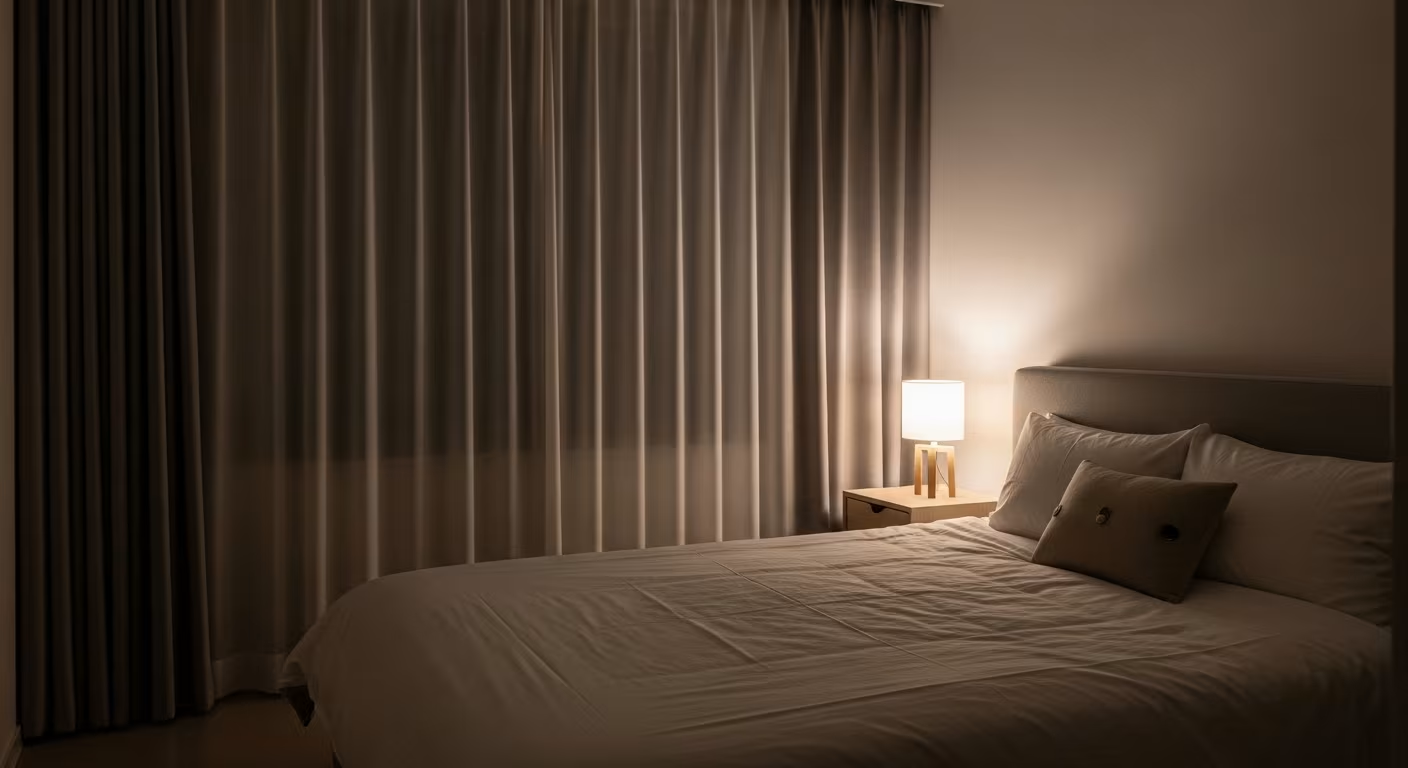
A home arranged to function as a recovery environment — clear surfaces, sensible order, visual quiet — provides the contrast to the day that lets rest actually take hold. The bedroom benefits most directly of all: as the primary place you sleep, it gains the most from stripping back visual and mental stimulation, because the quality of that room feeds straight into the quality of the rest it makes possible.
Start With One Surface
For anyone in the middle of depression, anxiety, or burnout, clearing a whole home sounds like one more impossible item on an already impossible list. The environment-mind link points to a gentler entry: one small area, cleared completely, as a single anchor of calm in the house. A desk, a nightstand, a bathroom counter — one surface, done in a short session — produces an immediate, felt result that can carry you to the next one. The mechanism works even at that scale, because clearing one thing in your daily line of sight removes one live source of stress and creates one small island of order in the disorder around it.
Over time the islands join up. The guide to minimalism for beginners lays out the full run of small, concrete starting points that build momentum without demanding the energy a big organizing project would. Whatever keeps a home in that calmer state afterward — a daily reset, a regular clear-out, a one-in-one-out rule for new arrivals — is worth more to your mental health than any single deep clean, because the benefit lives in the maintenance, not the one-time effort.
One surface is a genuine starting point rather than a motivational device, and it works because it is bounded. Choose the surface you see most often — for most people the kitchen counter, the bedside table or a desk. Clear it completely, then return only what is used daily. A kitchen counter usually settles at under 5 items, a bedside table at 2, a desk at 3 plus a lamp.
Keep it clear for 2 weeks before touching anything else. The point of the wait is information: you find out which items genuinely return because they are needed, and which were there through habit. That distinction is what makes the second surface faster than the first.
The numbers behind the calm:
| Surface | Settles at | Note |
|---|---|---|
| Kitchen counter | under 5 items | — |
| Bedside table | 2 | — |
| Desk | 3 + a lamp | — |
| The experiment | one surface, 2 weeks clear | before touching anything else |
| Wardrobe | 30 items vs 120 | fewer micro-decisions, compounding weekly |


Comments
No comments yet.