
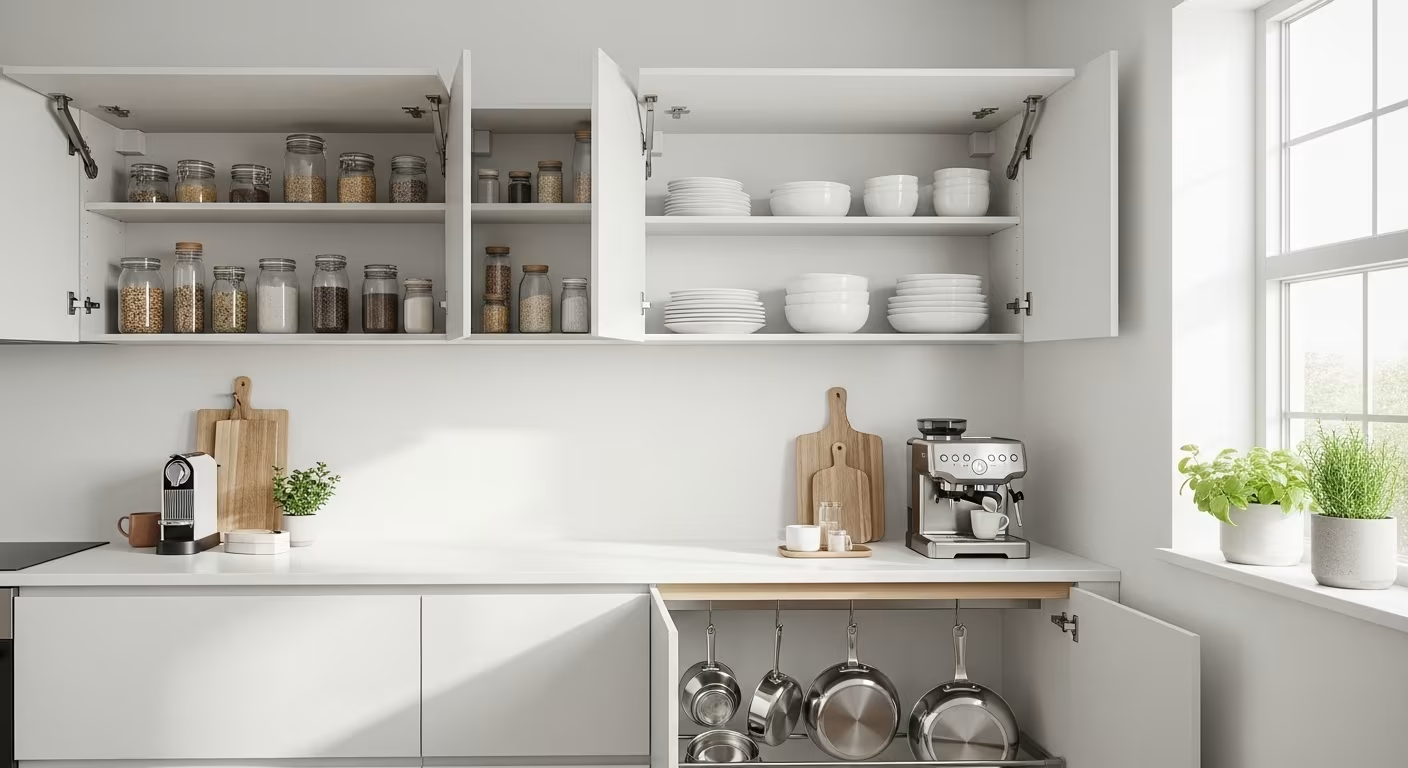

Most kitchen organization problems are volume problems wearing a costume. A cabinet is hard to organize because it holds more than it can comfortably fit, not because it lacks the right shelf riser. Buy the riser, load it up, and you get organized excess: neater, but no easier to cook in. The volume never changed. A kitchen with a third fewer items in its cabinets does not need better organization — it needs less of it, because what remains has room to sit in plain sight and come out without an excavation.
Reduce the Volume Before You Buy the Bins
The order of operations decides everything. Pull a category out completely — say, every pot and pan you own — and put it on the counter before deciding how to store it. Seeing eleven pans in a pile makes the edit obvious in a way that opening a crowded cabinet never does. A two-person kitchen cooks nearly everything it cooks with one 10- or 12-inch skillet, one saucepan, one stockpot or Dutch oven, and a sheet pan. Everything past that core four should have to point to a real, recent use, not a recipe you might attempt.
Do the same pass with storage containers, the category that quietly breeds. Match lids to bases, recycle anything orphaned, and keep a set you can count — eight to ten containers covers a household that packs lunches. The rest is just plastic taking up a drawer.
The gadget drawer is where the count balloons fastest, because single-task tools are cheap and easy to justify one at a time. The avocado slicer, the egg separator, the cherry pitter, the garlic press bought for one recipe in 2023 — each cost a few dollars and each earns its keep about twice a year. Run every gadget through the same test you gave the pans: used in the last ninety days, or gone. A good chef's knife and a Y-peeler quietly replace half the drawer, and the drawer that survives the pass is the one where you can actually find the can opener.
The Countertop Earns Its Keep
The counter is the only surface you actually cook on, which makes it the most expensive real estate in the kitchen. An appliance earns a permanent spot there on two conditions: it runs at least three or four times a week, and it is heavy or awkward enough that hauling it out is a genuine chore. The daily coffee maker in a coffee-drinking house clears that bar. The stand mixer used twice a month does not — it lives in a cabinet, and the minor cost is thirty seconds of retrieval on baking day.
Held to that standard, most counters are badly over-stationed. The blender used on Sunday, the toaster used on weekends, the slow cooker used once a fortnight, and the knife block are all sitting out full-time to save a few seconds a week, and together they turn eight feet of prep space into two. Move them, and the counter becomes a work surface again instead of a shelf. The knife block is worth calling out on its own: a magnetic wall strip or an in-drawer blade tray holds the same knives, protects the edges better, and hands back the biggest single footprint on most counters.
Retrieval feels like friction the first week. By the third it is automatic, and the permanent clear surface is worth far more than the twenty seconds a day you spend lifting a mixer out of a low cabinet. The mistake is optimizing for the rare heavy-use morning at the cost of every ordinary one. It is worth cross-checking against Purdue Extension's FoodLink.
How Much Is Enough: A Two-Person Baseline
Dishes and glassware are where the "just in case" instinct does the most damage. A household of two does not need twelve place settings; it needs enough for daily life plus a realistic guest margin. The table below is a starting point for one or two people who host a small dinner a few times a year — adjust up modestly for a bigger household, not by multiplying.
| Item | Daily use (1–2 people) | Reasonable ceiling with guests |
|---|---|---|
| Dinner plates | 2–4 | 6 |
| Bowls | 2–4 | 6 |
| Drinking glasses | 2–4 | 6–8 |
| Mugs | 2–4 | 6 |
| Everyday flatware sets | 4 | 6–8 |
| Food storage containers | 6–8 | 10 |
Anything a household hosts at true holiday scale — the extra platters, the punch bowl, the second set — can live outside the daily cabinet, boxed on a closet shelf, so the prime space holds only what an average week uses.
Organizing What Survives the Edit
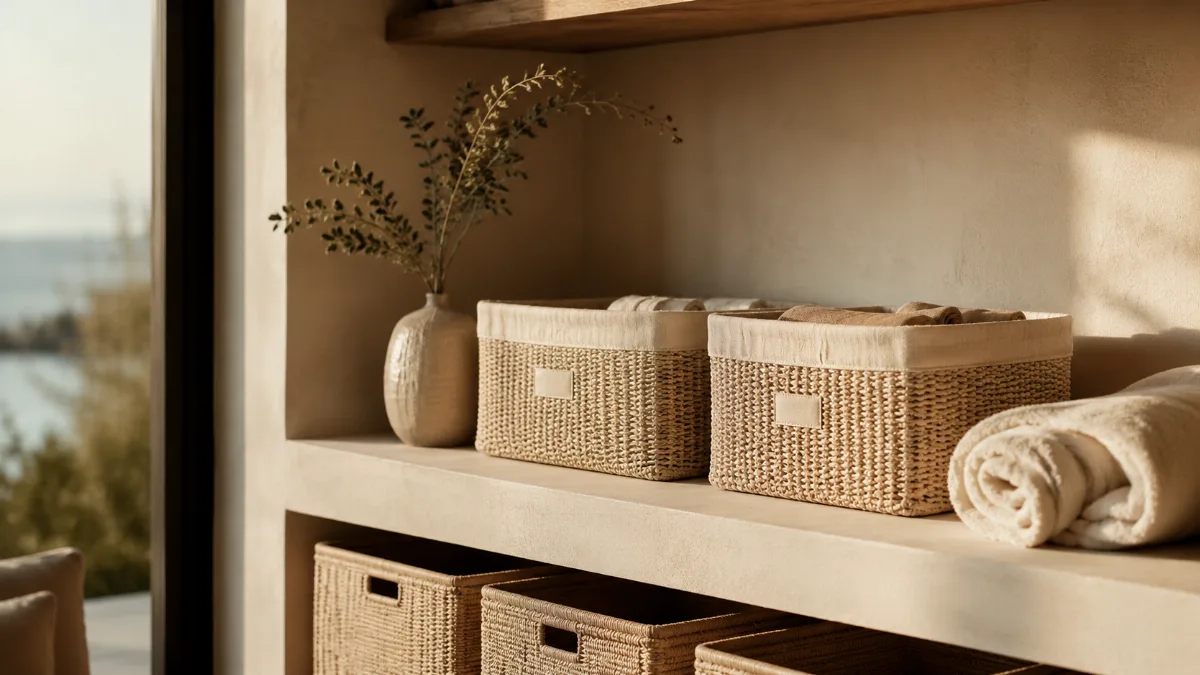
Now organization becomes easy, because the volume finally fits. Put the most-used items at eye level and nearest the front; push the monthly items higher or lower; bury the truly seasonal in the least-reachable corner. Then group by task, so gathering for a job happens in one reach rather than five. All the baking gear together. All the oils and vinegars together. The plates and glasses in the cabinet closest to the dishwasher, so unloading is a half-turn instead of a lap around the room.
This is also the point where a shelf riser under $15 or a lazy Susan actually pays off. Applied to a curated set of a dozen spices, a spice organizer is a genuine help. Applied to forty-seven jars, half of them older than the appliances, it is just a tidier version of the same mess. Reduce first; the product comes second. For the full reduction pass before any of this, our guide to decluttering a kitchen walks through it category by category.
The Junk Drawer, Kept Honest
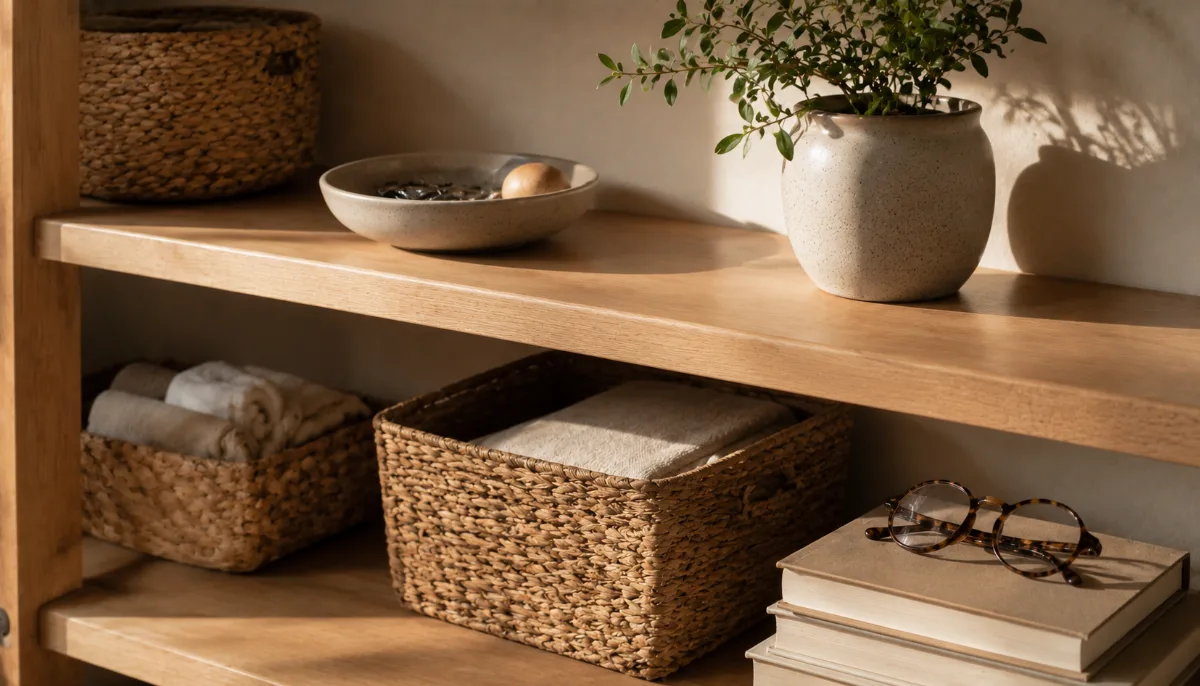
A junk drawer is a legitimate feature, not a failure — a catch-all for the small, useful, homeless things: a tape measure, a few rubber bands, a mini screwdriver, batteries, the takeout menus. The same minimalist approach that governs the garage applies here — the point is not to abolish it but to bound it. One drawer, sorted every few months, with anything that drifted in without a reason removed. The moment it stops closing easily, it gets ten minutes of attention. A junk drawer that overflows into its neighbors and holds receipts from three years ago has stopped being a catch-all and become a storage unit for indecision.
Serving Dishes and the Occasion That Never Comes
Serving pieces accumulate through a single mechanism: an occasion calls for a big platter, you buy the platter, and it is stored indefinitely against the next occasion — which may be years off. Over a decade the cabinet holds a roasting pan, a turkey platter, a giant salad bowl, a punch bowl, and a tiered stand, each earning its keep two afternoons a year while blocking daily access the other 363 days.
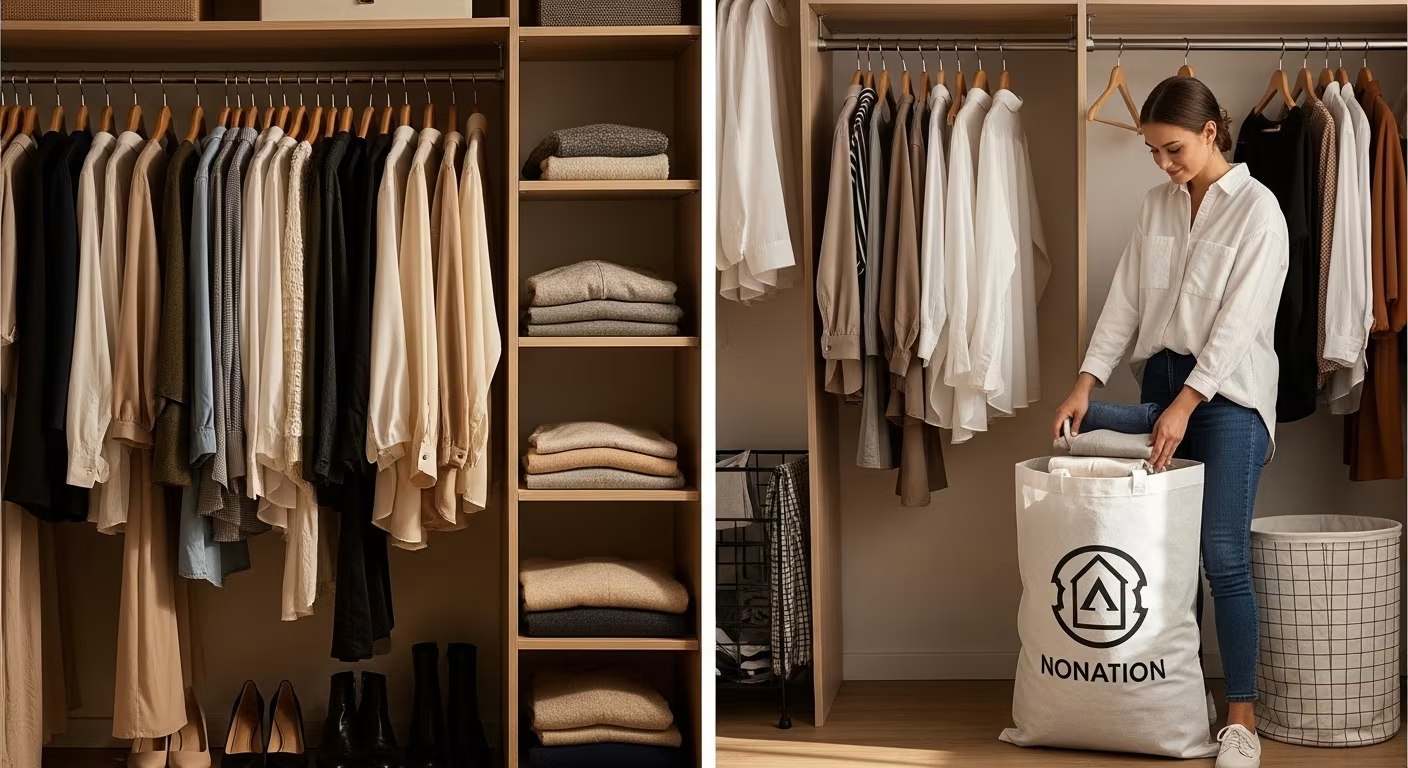
Keep the three or four you genuinely reach for, store the rest outside the kitchen if you host at that scale, and release the equipment for a party you have not thrown since you bought it. A kitchen edited this way — clear counters, right-sized dish counts, cabinets with room to breathe — pays you back at every single meal, in seconds not spent searching and drawers that no longer fight back. The work of getting there is one hard afternoon; the return arrives every day you cook after it.


Comments
No comments yet.