
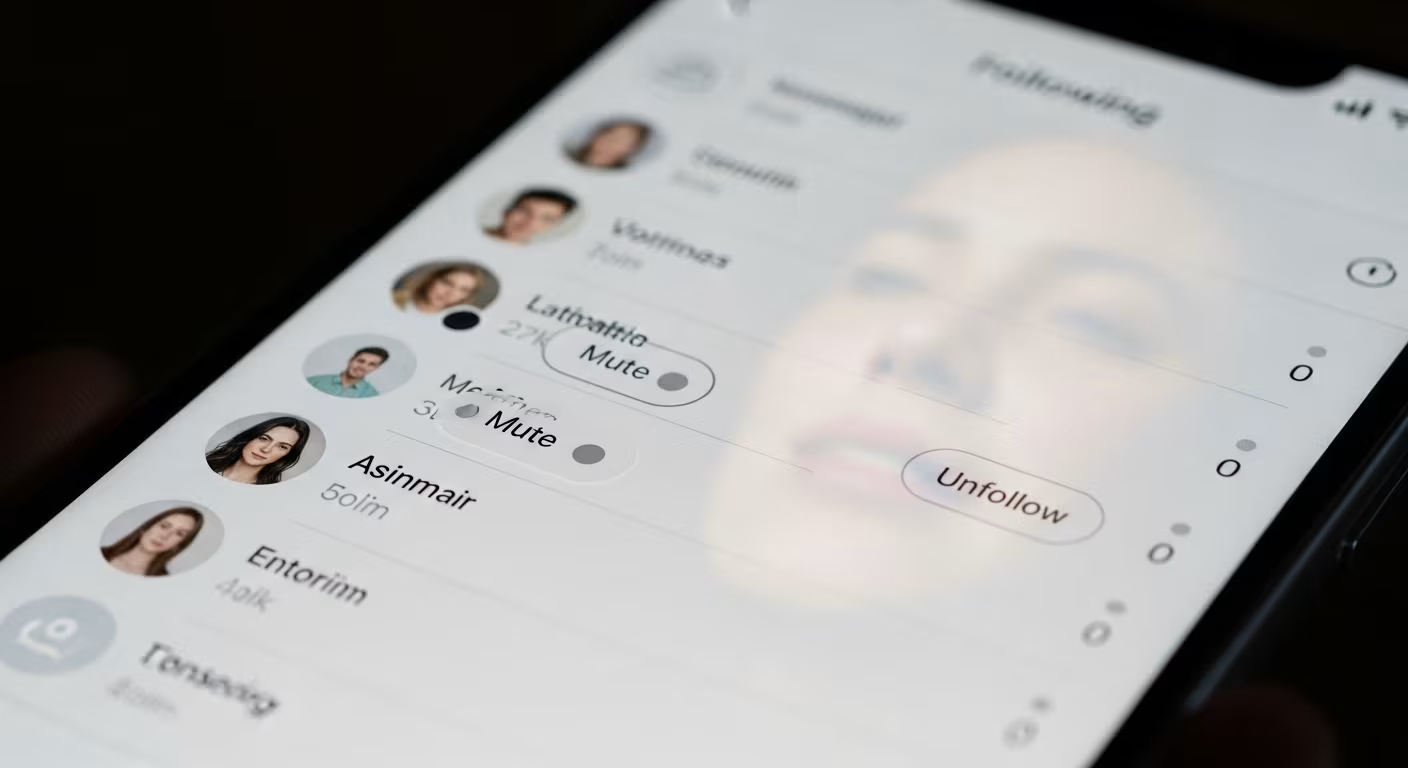

What Unmanaged Social Media Produces
Left in their default state, social platforms are built to maximize time on the app, not your satisfaction with that time. The algorithms deciding what lands in your feed are tuned for engagement — clicks, reactions, one more scroll — rather than for value to you. The predictable result is a feed that surfaces whatever produces the strongest emotional charge: outrage, anxiety, social comparison, the fear of missing out. Those reactions drive more engagement than content that merely informs or entertains, so the system learns to serve more of them.
Most people feel the effect without naming it. The half hour of scrolling that leaves you a little worse than before. The feed that quietly cranks up unease. The comparison against other people's edited highlight reels that turns into dissatisfaction with your own ordinary day. The vague sense of having spent time that produced nothing. The minimalist question for physical clutter applies cleanly here: does this serve my current life, and in what proportion? The content is infinite and the platforms are engineered to resist reduction, but the assessment still works.
The Follow Audit
The first concrete step is a follow audit: go down the list of every account you follow and ask honestly what each one gives you. It's the same question you'd ask of a crowded wardrobe. Is this account reliably delivering something you genuinely enjoy or use, or is it here because you followed it once and never reconsidered?
Accounts that produce real enjoyment, useful information in an area you actually care about now, or connection with people who matter to you earn their spot. Accounts that produce comparison, unease, FOMO, or content you thumb past without a flicker of interest are candidates for the unfollow button. The audit tends to be as revealing as a closet clear-out: the number of accounts you follow with genuine ongoing interest is usually a small fraction of the total, and most of what fills the feed comes from follows added for reasons that stopped applying long ago.
A structured audit takes about 30 minutes for a typical account and works one platform at a time. Go through the following list and sort each account into three groups: this improves my day, this is neutral, this makes me feel worse. The third group is unfollowed or muted immediately. Neutral accounts are the ones worth examining — most feeds are 60 to 80 percent neutral, and that is where the time goes without anything being gained.
Muting is often better than unfollowing for people you know personally, since it removes the content without the social consequence. Most platforms also allow muting specific words and hashtags, which handles topics rather than accounts — useful for news cycles and product categories that reliably produce the urge to buy something.
Platform Selection and Time Limits
The same honesty belongs one level up, at the platform itself, not just the accounts inside it. For each app in your life: what does this actually give me, and at what cost in time and mood? Some platforms genuinely serve specific people — professional contacts for those who use them for work, a lifeline to distant family for those whose people are scattered, real entertainment for those who treat it as such. Others are open out of pure habit, or out of a fear of being absent from a place you don't actually enjoy.
Platform-level decisions carry more weight than account-level tidying because they fix the structure rather than the contents. Leaving an app that serves no current need, or cutting one down to the single function that does deliver value, changes more than any amount of unfollowing within it. Time limits — through the app's own settings or your phone's built-in usage controls — handle the gap between valued use and habitual use. If you find real value in thirty minutes a day but habitually spend two hours, a hard limit pulls the total back toward what's actually worth it and away from what habit and platform design produce on their own.
Time limits are set at the operating system rather than in the app, because in-app limits are dismissible by design. On iPhone: Settings → Screen Time → App Limits, which can be set per app or per category. On Android: Settings → Digital Wellbeing → Dashboard, then the timer icon beside each app. Both reset at midnight.
A limit works better when it is paired with a placement change: remove the app from the home screen so it must be found by search, and turn off its notifications entirely. The limit handles the deliberate use, the placement handles the automatic use, and the automatic use is the larger of the two for most people.
Notification Management

Notifications exist to pull you back throughout the day. Each one is a prompt for a quick check that can unfold into a browsing session you never meant to start, and the aggregate of dozens of these pull-backs is a serious tax on sustained attention and a lot of unintended time on the app.
The minimalist move is to switch off all social notifications by default, then restore only the handful that carry genuine value. A direct message from someone you actually want to hear from promptly may earn a notification; a like from an account you don't know does not. The number of social alerts that are truly time-sensitive is tiny. The number designed purely to manufacture a visit is enormous. Sorting one from the other and muting the rest reclaims the attention those interruptions were quietly draining.
The Comparison Effect and How to Reduce It

Comparison — measuring your own ordinary life against other people's curated presentations of theirs — is one of the most reliably documented ways social media sours mood. The comparison isn't even between two lives. It's between your lived experience, which includes boredom, difficulty, and dull Tuesdays, and someone else's presentation, which is built to exclude exactly those by design. You're losing a contest that was never fair to begin with.
Reducing it means either cutting exposure to the accounts that trigger it or changing your relationship to that exposure. For most people the strongest comparison comes from the accounts they engage with most — the travel photographer, the immaculate interior-design feed, the life that appears to lack nothing. Muting or unfollowing those specific accounts shifts the emotional temperature of the whole platform more than any general resolution to "compare less." The feed can only make you feel behind if it keeps showing you the finish line.
The Intentional Use Pattern
The alternative to habitual scrolling is intentional use: defined sessions, for specific reasons, at chosen times, with a clear sense of what you opened the app to do. Someone who opens a platform to see whether a particular person posted, checks, and closes it has had an intentional session. Someone who opens it out of reflex and scrolls with no aim until they set the phone down has had a habitual one. The two can occupy the same ten minutes and produce completely different outcomes. This lines up with the Getting Things Done method.
The shift from habitual to intentional doesn't require quitting. It requires adding two questions: what am I opening this for, and have I gotten what I came for? Asked consistently, they realign your usage with genuine value instead of platform-designed behavior. Most of the wasted time evaporates not because you forced yourself to stop but because you noticed you'd already finished.
The Passive Consumption Problem
For most users, the largest single chunk of social media time is passive: scrolling without engaging, watching without interacting, observing without taking part. Passive consumption is exactly the pattern platforms are built to stretch — through infinite scroll, autoplay, and the algorithmic feed — because it's the pattern that keeps you there longest. It's also the pattern that returns the least for the time it eats.
Active use — messaging specific people, following specific accounts for specific reasons, taking part in communities around genuine interests — produces clearer value and more real connection than passive scrolling ever does. The minimalist question for any use of time applies directly: what is this time actually producing, at what cost, and is that ratio one you'd accept if you saw it clearly? For most people, an honest look at what an hour of passive scrolling yields against what the same hour spent otherwise would is a strong argument for structural change. For the broader approach across every digital tool, not just social platforms, our guide to digital decluttering lays out the full framework.
Rebuilding Habits After a Break
The most effective reset for a genuinely stuck habit is a defined break — a stretch of complete non-use that lets both the reflex and the emotional pull settle. Even a short one, a week or a month, changes your relationship to platforms that had become automatic, and makes deliberate use easier to establish afterward. The apps stop being the default thing your thumb reaches for when there's a spare thirty seconds.
What makes the break stick is what you do coming out of it. Reinstalling everything the moment it ends and sliding back into old patterns wastes the reset entirely; returning instead to intentional, chosen use is what gives the pause a lasting effect. Treat re-entry as a decision rather than a default, and the break buys you a genuinely different relationship rather than a brief interruption in the same one.
The 30-minute feed audit:
| Group | Share | Action |
|---|---|---|
| Clearly good | small | keep |
| Clearly bad | small | unfollow now |
| Neutral | 60–80% of most feeds | this is where the time goes — judge each |



Comments
No comments yet.