


Easter accumulates commercial overlay the same way most modern holidays do — baskets stuffed with plastic grass, individually wrapped candy in quantities no child needs, and decorations that come out for one week and then require storage for eleven more. The holiday's simpler core — eggs, spring, time with family, a few traditions specific to your household — is available without any of that.
What Easter Actually Requires
Easter's core, for religious households, is a specific observance with its own traditions and meaning that don't require commercial participation. For secular households that observe Easter as a spring celebration and family occasion, the question of what it requires is genuinely open — there's no institution defining what secular Easter must include, which means the defaults are all commercial and none are obligatory.
The defaults: a basket for each child containing candy and small gifts, an egg hunt, new clothing, a large meal. None of these is intrinsically required for the holiday to be meaningful. All can be scaled, simplified, or dropped if they're not producing value proportional to the effort and cost they require.
The Easter Basket, Simplified

Easter baskets marketed to children are often overloaded with individually wrapped candy, small plastic toys with short useful lives, and novelty items that appeal in the store and on the morning but contribute nothing by the following afternoon. The plastic grass that fills baskets is particularly impractical — it scatters, sticks to everything, and contributes nothing functional.
A restrained Easter basket has three to five items chosen deliberately: one or two foods the child actually enjoys, one small object with genuine play value, and perhaps something consumable — a book, art supplies, a craft kit — rather than a toy that requires eventual storage. This produces a basket a child engages with rather than a pile of candy and plastic to sort through.
For children accustomed to large baskets from previous years, the transition to a smaller one is worth managing with an explanation beforehand about what it will contain and why, rather than presenting it as a reduction without context.
The Egg Hunt Done Well
The egg hunt is the Easter element that most children find genuinely engaging, and it requires almost no spending to execute well. Hard-boiled eggs dyed with food coloring costs very little and produces a hands-on, slightly messy, genuinely participatory activity. Plastic eggs filled with candy are faster to set up but less memorable — the dyeing process on Saturday afternoon is often what children actually recall, more than the hunt itself.
A dye kit from a grocery store, a dozen eggs, and an hour the day before Easter produces a more engaged experience than a bag of plastic eggs. The objects made by the household matter differently than the objects purchased for it.
For households that want to include treats without the excess of bulk candy, placing three to five pieces of genuinely good candy inside each egg rather than a handful of assorted miniatures gives children something specific to look forward to. The quality-over-quantity principle applies to Easter candy as much as it does to anything else.
A Meal Worth Making

Easter dinner is worth executing well. A meal that the household would genuinely want to eat — rather than one assembled to match a normative list of Easter foods — is the goal. Ham if people actually like ham. A lamb dish if someone enjoys making it. An entirely different protein if neither applies to your household.
The side dishes most worth preserving are the ones that would be specifically missed — the particular deviled egg preparation, the vegetable dish that appears once a year. These carry genuine meaning. The rest of the table can be filled with what people actually want to eat. Three dishes done well produce a better meal than eight done under time pressure.
Making part of the meal a shared activity — an adult and a child making something together, a recipe passed down that requires teaching — extends the value of the meal beyond the eating itself and into the time of preparation.
Decorating for Spring Rather Than the Holiday

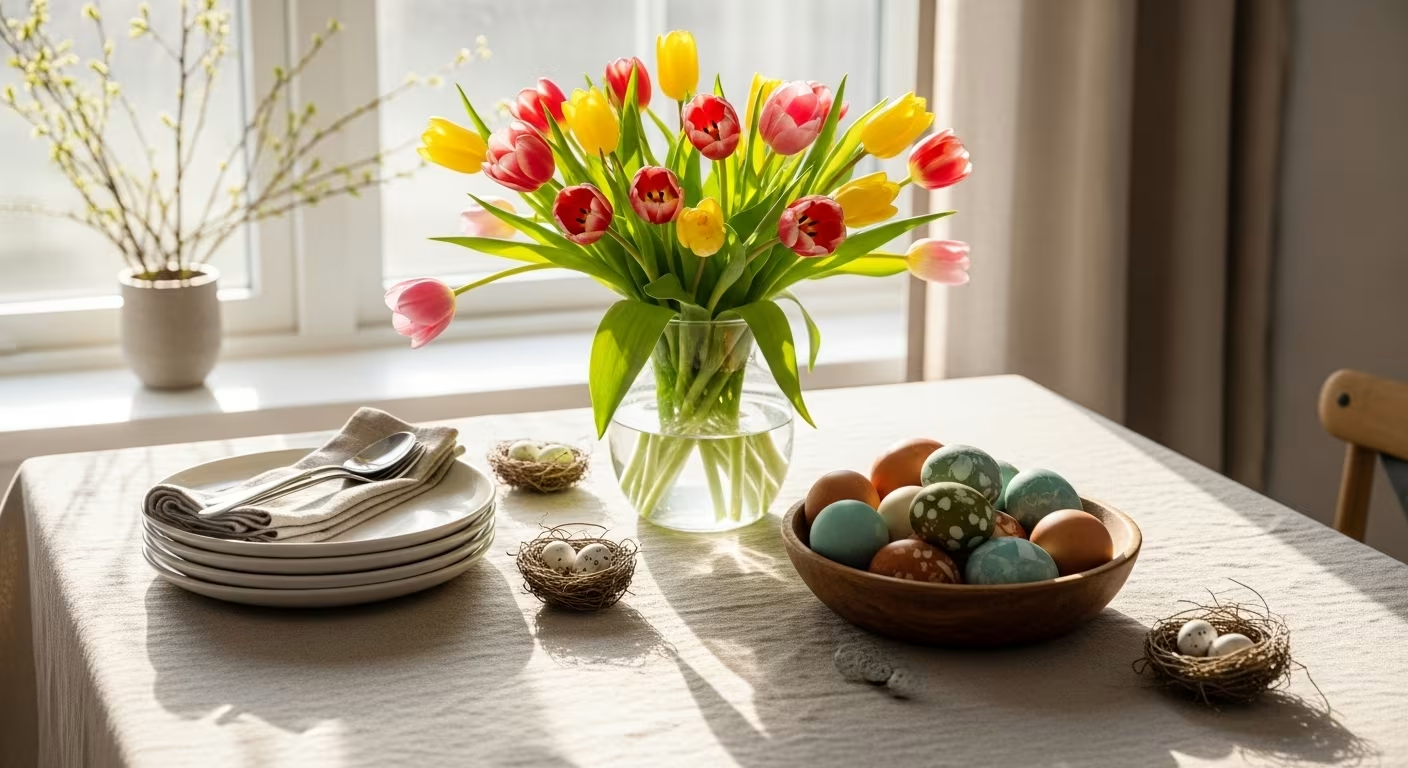
Easter decoration doesn't need to be Easter-specific to feel appropriate for the season. Seasonal spring elements — potted bulbs, cut tulips, branches in bloom, a bowl of dyed eggs — produce a table or entryway that reads as genuinely spring without requiring any storage after the holiday is over.
Plants and flowers compost or continue growing. Dyed eggs can be eaten or composted. The impulse to buy seasonal Easter decorations made from plastic or resin produces objects that require storage for eleven months of every year, accumulate over time, and eventually become difficult to justify keeping.
Creating Traditions That Are Yours
The most durable Easter traditions are specific to a household rather than generic to the holiday. A particular walk taken every Easter morning. A specific game played after the meal. A recipe made only in April. A film watched together in the afternoon. These traditions are valuable because they're particular — the household's version of Easter rather than a generic category.
Creating traditions intentionally — deciding what we want to do every year on this occasion — is more likely to produce genuine meaning than inheriting traditions without examining them. Some inherited traditions are worth keeping because they produce specific connection and memory. Others continue because no one decided to stop. The distinction is worth making at least once.
The Week Before

Easter preparation often becomes a task list — baskets to assemble, food to plan and shop for, decorations to arrange — that crowds out the week before the holiday. Treating the days before Easter as a time of some intentional slowing down, rather than a time of accelerating activity, changes the quality of the holiday itself.
A household that arrives at Easter Sunday having spent the week in low-grade stress catching up on preparations experiences the day differently than one that kept the week simple. The specific activities of Easter — egg dyeing, one meal cooked with some attention, a walk outside in spring weather — are better experienced with some energy available for them.
Spring Activities That Don't Cost Much
Easter weekend in spring weather is worth using for something more than the indoor meal. A family walk — somewhere specific, a trail or a park that's accessible in your area in April — produces the kind of unstructured outdoor time that doesn't happen enough during the rest of the year. The walk doesn't need to be Easter-themed to be part of Easter.
Gardening is particularly well-timed at Easter in many climates: the soil is workable, spring bulbs are active, and there's genuine seasonal work to do. Getting a child involved in planting something on Easter Sunday — a small vegetable, a flower — produces a living record of the day that extends well beyond it. The plant becomes a marker of the holiday in a way that no purchased decoration does.
Other outdoor activities that align with the season and the holiday: searching for early wildflowers, visiting a farm that has spring animals, flying a kite somewhere open. None of these require purchasing anything specific to Easter, and all of them use the season rather than the commercial holiday as the organizing principle.



Comments
No comments yet.