
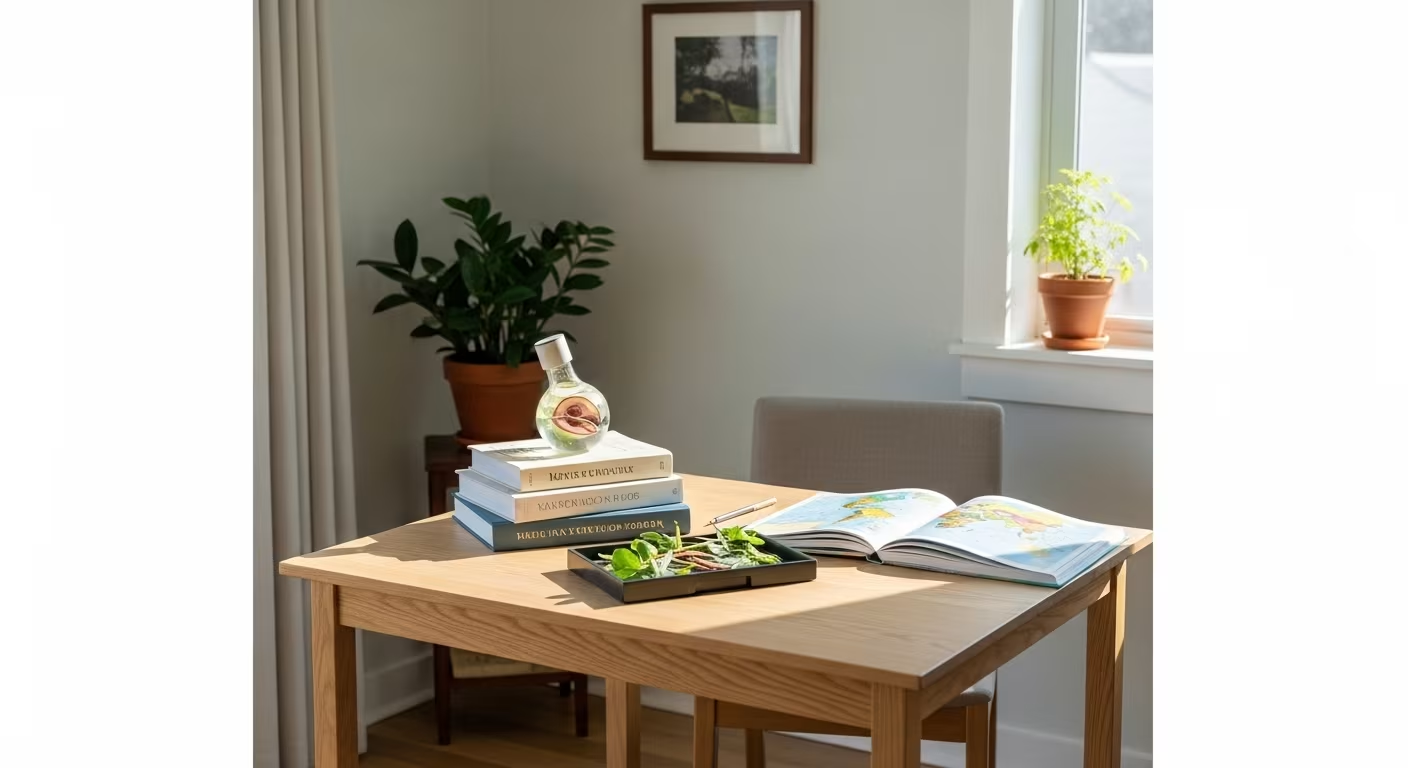

Homeschooling families are unusually prone to educational resource accumulation, and the reason is emotional. Carrying full responsibility for a child's education generates anxiety, and that anxiety often expresses itself through buying. Each curriculum, workbook, manipulative, and supplement is an attempt to make sure the child isn't missing something. The end state in many homeschool homes is a room full of materials used inconsistently or not at all, and a learning space that overwhelms more than it invites focus.
Applying minimalist thinking to homeschooling doesn't mean doing less. It means doing what genuinely works, in more depth, and releasing the materials and obligations that pile up without a matching educational return.
Fewer Subjects, Done Well
The worry about covering everything pushes many families to attempt more subjects per week than anyone can engage with meaningfully. Nine subjects spread across five days produces shallow exposure to all nine rather than real depth in any of them. A child who spends a month on a single historical period — through primary sources, related novels, the relevant geography, and a hands-on project or two — comes away with a far richer understanding than one who reads a single paragraph on that period inside a survey of world history.
Choosing the handful of subjects and topics that genuinely matter for this child at this stage, and going deep on them, is harder than following a boxed curriculum exactly, because it demands judgment. It is also more effective. Three subjects taught with attention beat nine taught by the clock. A practical rhythm for younger children is a stable core — reading, writing, and math most days — plus one rotating deep topic that runs for a few weeks before the next takes its place. Science, history, and the arts don't each need their own daily slot; they take turns being the thing the family digs into, and each gets real attention when its turn comes.
The Library Over the Shelf
The single most powerful minimalist tool for homeschooling is the public library. Books borrowed for a specific topic, used for the length of the unit, and returned — rather than bought, used once, and shelved for a decade — cut resource accumulation dramatically while opening access to a far wider range of materials than any family could own. A library card also gives most households free access to research databases and educational streaming that would cost hundreds to assemble privately. Reading Rockets' guidance on building learning at home makes a similar point.
The borrowing model enforces natural transitions, too. When the books are due, the unit ends and the next topic begins on its own. Owned books tend to linger in the rotation past their usefulness because moving on takes an active decision; borrowed books make that decision for you. Interlibrary loan extends the range further still, pulling in specialized titles a local branch would never stock, so even an unusual unit rarely justifies a purchase. For families already holding a lot of curriculum, an honest audit of what has actually been used — with the unused material donated to other homeschoolers who can put it to work — clears both the shelves and the mental clutter.
Unstructured Time Is Not Empty Time
Unstructured time — hours without a set educational agenda — supports learning by letting a child integrate what was formally taught, pursue a genuine interest in depth, and get the mental rest that focused work requires. Many homeschool schedules overschedule exactly the way conventional school does: every hour booked, every subject given a slot.
The afternoon a child spends chasing something they're currently absorbed in — reading down a rabbit hole, building something that demands problem-solving, making something that needs planning — isn't a gap in the day. It's consolidation. Homeschooling's structural advantage over a classroom is the freedom to build this time in without it feeling like a failure to hit a schedule. Using that advantage, instead of copying the classroom's hour-by-hour density at home, is one of the clearest applications of minimalist principles to teaching.
One Good Book, One Calm Space
For any subject, one genuinely excellent book read thoroughly produces more durable learning than three adequate books read partway. Accumulating multiple resources "for variety" or "in case one doesn't work" usually results in every resource being skimmed and none engaged with. Find the one strong book or program for a topic — through recommendations from other families, library browsing, or a careful look yourself — and use it fully. If it truly fails a particular child, replace it with a different single resource rather than piling on supplements.
The physical space matters alongside the materials. A cleared learning area holding only the current unit's materials, with everything else stored out of sight, supports focus far better than a room where the entire collection is always on display. The practical rule is simple: what isn't being used this month gets stored, not shelved in view. That takes some organizing for the off-season material, but it produces a calm space centered on the work actually happening now.
Releasing What You've Already Bought
Families that have already amassed a lot of curriculum have a clear path forward: audit what's genuinely used, then deliberately let the rest go. Curriculum holds real resale value — it moves quickly through homeschool curriculum sales, online marketplaces, and local community exchanges — and the proceeds are often enough to fund the smaller, better-chosen set that will actually get used, making the swap financially neutral or better.
There's a quieter benefit, too, in stepping out of the comparison that fuels the accumulation in the first place. The worry that other families are covering more or using better materials drives buying the same way social comparison drives any consumption. A more useful benchmark is an honest look at what your own child is actually learning and how deeply — a child genuinely engaged with a few topics is learning, while a child moving through many superficially is only covering. See our guide to minimalist home organization for the broader principles that apply to a learning space as much as to any other room.
The rhythm that produces depth:
| Element | Plan | Why |
|---|---|---|
| Stable core | reading, writing, math — most days | the non-negotiables |
| Rotating deep topic | one at a time, a few weeks each | science, history, arts take turns |
| Depth test | a month inside one historical period | beats a survey paragraph every time |
| Three vs nine | 3 subjects with attention | beat 9 taught by the clock |
| The shelf | borrow for the current topic | the library outperforms owning |


Comments
No comments yet.