
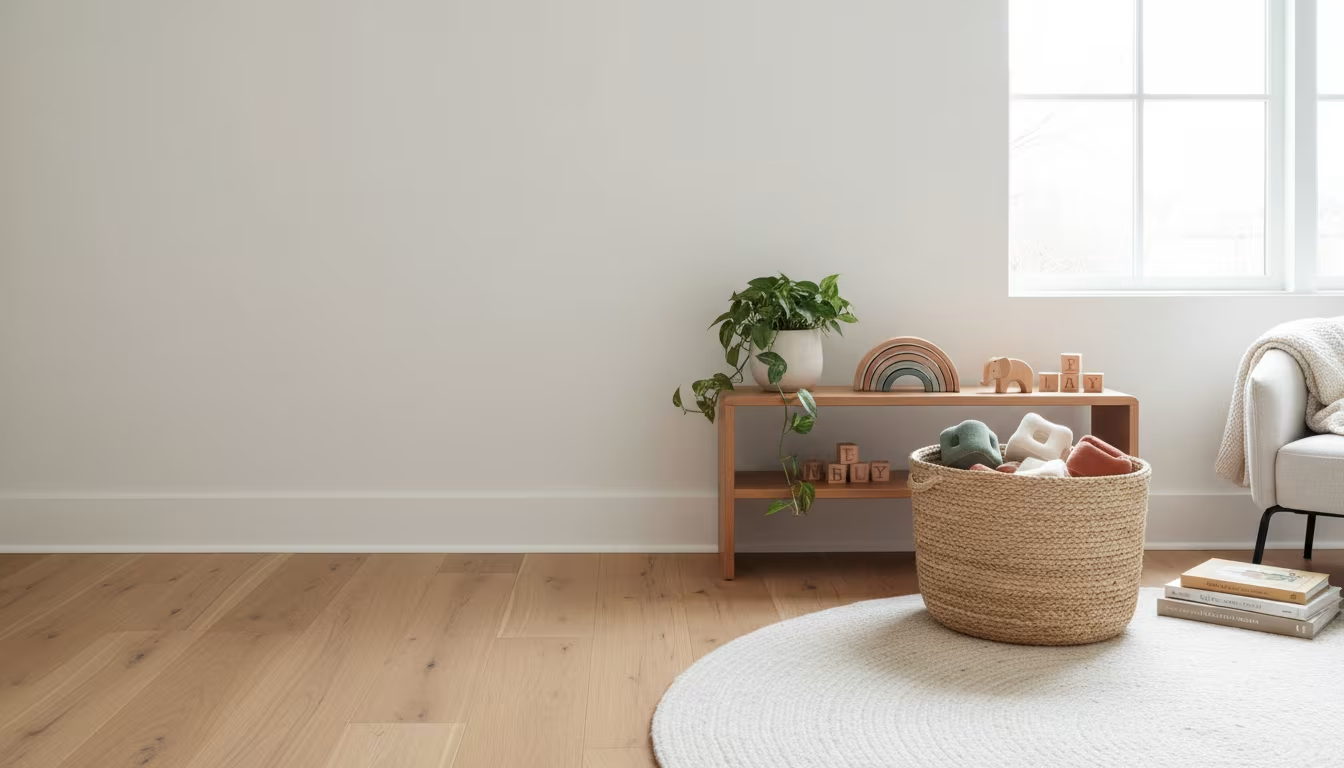

The idea that a minimal room has to feel cold is worth testing. Warmth doesn't come from the number of objects in a room — it comes from a few well-chosen materials, the right scale, and enough open space to let the eye rest. What follows is how to get there on a tight budget, mostly by choosing carefully and removing what's working against the effect.
Why Cozy and Minimal Aren't Opposites
The rooms that feel uncomfortable are usually both too empty and too random: a mattress on the floor, a folding table, furniture arranged with no logic. That isn't minimalism — it's incompleteness. Rooms that read as genuinely cozy share a different set of traits: warmth in the materials (wood, textiles, soft light), a scale that fits the human body, and enough breathing room to feel uncluttered. A handful of good textiles — a wool blanket, a rug with texture, cushions in natural fabrics — creates more warmth than a room packed with cheap decorative objects.
The other half is visual calm. A room full of competing objects gives the eye nowhere to settle and quietly demands mental effort to occupy. Coziness is partly a sense of ease and safety, and a room that doesn't clamor for attention delivers exactly that, even when it isn't conventionally styled to look "warm."
The Minimum Furniture Set
A living room needs seating, a surface or two, and light. Everything past that is optional. For seating, one sofa or two armchairs — sized to the room rather than the biggest version that fits. A sofa that fills a small room makes it feel cramped, not furnished; one that fits with space to spare makes the room feel larger and calmer. For surfaces, a coffee table (or a low stool at that height) plus one side table per seating area is enough. For light, overhead fixtures alone almost never make a room feel warm at night — a floor lamp and one table lamp per seating area throw the lower, warmer light that changes the whole mood. Warm-toned bulbs, around 2700K, push any lamp further in that direction.
Buying Well on a Budget
Secondhand furniture isn't a compromise — it's often the fastest route to the quality that makes a room feel good. Solid wood from twenty or thirty years ago is frequently built better than new furniture at the same price. A secondhand solid-wood coffee table at around $40 will outlast a new particleboard-and-laminate version at twice the price and look better doing it. Secondhand pays off most on large wooden pieces — tables, shelves, side tables — plus wooden frames and lamp bases; a fresh lampshade over an old base makes it look current. Buy new where it matters for hygiene or fit: cushion inserts and covers, and warm-toned bulbs, a five-dollar swap that transforms a room after dark. The furniture-before-decor rule matters most when money is tight — decor is easy to add later, so one correct piece of furniture beats three decorative objects every time.
Textiles and Lighting Do the Work
In a room with little furniture, textiles carry most of the weight, and they're the most forgiving element on a budget — washable, movable, and accumulated gradually rather than all at once. Three do the heavy lifting: a rug in a warm neutral covering most of the seating zone (bare floors are one of the biggest sources of that cold, sparse feeling, so buy as large as the budget allows); a throw on each seating surface for immediate visual warmth and actual use; and one set of floor-length curtains, which make ceilings feel higher and windows larger in a way short panels never do.
Two placement details decide whether these read as intentional or accidental. A rug wants to sit under at least the front legs of the seating, not float as a small island in the middle of the floor — an undersized rug makes a room feel smaller, which is the opposite of the goal, so a 5×8 under a small setup or an 8×10 in a larger room is usually the right reach. Curtains want the rod mounted close to the ceiling and the panels grazing the floor, not hung at the top of the window frame; the higher mount is what draws the eye up and adds the height. Both fixes cost nothing beyond doing it right the first time, and both matter more than the price of the fabric.
Lighting returns the most per dollar when the starting point is poor. A floor lamp in the corner behind a sofa creates ambient warmth overhead lighting can't, because it bounces light off the ceiling and walls instead of down onto faces. Secondhand lamp bases are cheap and everywhere — a $10 base with a new $15 shade is a $25 change that shifts a room's atmosphere more than most furniture. And warm 2700K bulbs are worth swapping across the whole room if the current ones are cool or daylight-toned: cooler light signals alertness, warmer light signals rest, so the cheapest transformation available is often a five-dollar pack of bulbs. It helps to cross-check ideas like these against a university extension guide to budget-friendly home decor.
Improve by Removing, Not Buying
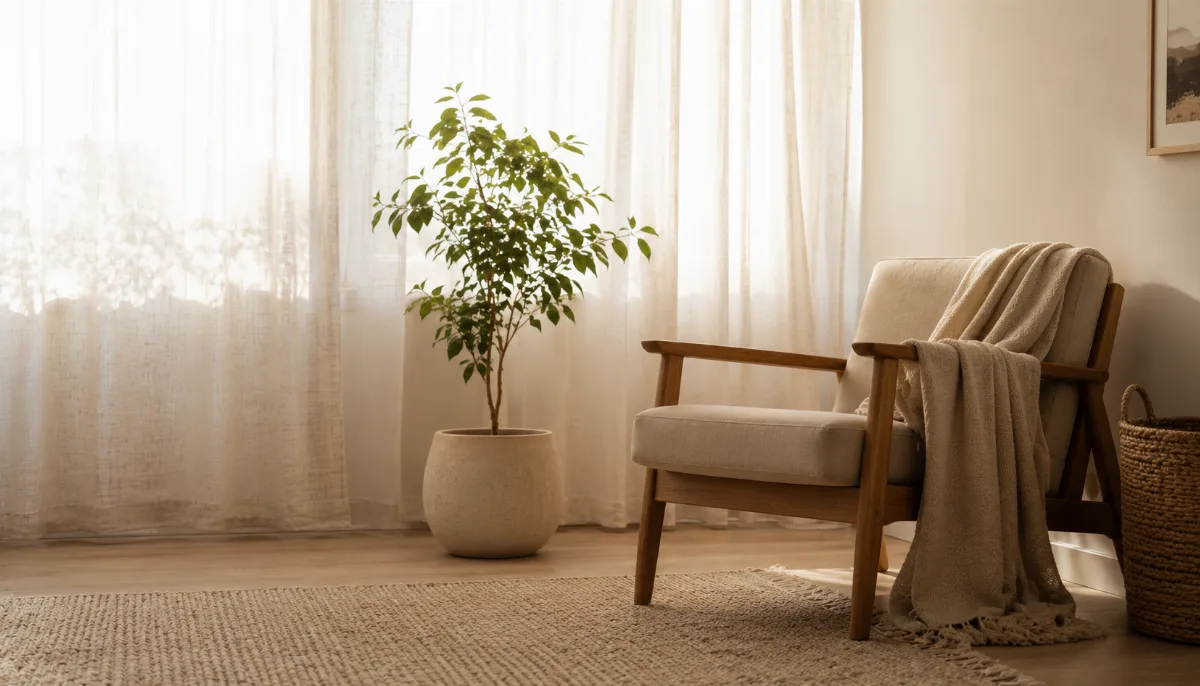
The fastest improvement in most living rooms costs nothing. It's removing what accumulated without intention: the extra objects on every surface, the second side table nobody needs, the shelf of things no one reads, the visible tangle of cables. A room cluttered with fifty objects that now holds thirty feels noticeably calmer and larger; adding a new lamp to the cluttered version barely registers. A quick audit that works: stand in the doorway, name the three things most disturbing the visual calm, and remove all three before buying anything.
The budget minimalist room has one specific risk — the slow pile-up of small, cheap decor that seems harmless one piece at a time but collectively rebuilds the clutter the whole approach was meant to avoid. Candles, vases, little sculptures, framed prints, pillows past the functional count: each is a low-cost "improvement" that adds visual noise. A simple guardrail keeps it in check — for every decorative item that comes in, one leaves — so the room's object count holds steady instead of drifting back toward clutter.
The under-$100 warm-up list:
| Change | Cost | Effect |
|---|---|---|
| Warm bulbs everywhere | 2700K | cool/daylight bulbs are why it feels cold |
| Secondhand solid-wood table | ~$40 | outlasts $80 particleboard |
| Lamp base + new shade | $10 + $15 | a $25 atmosphere change |
| Rug placement | under the front legs of seating | never a floating island |


Comments
No comments yet.