

Why Children Resist Toy Removal
The child who won't part with a single toy during a declutter is not being irrational. From where they sit, an adult has decided which of their belongings are allowed to stay — an exercise of power over the child's own property, and pushing back against that is a reasonable response whether or not any given toy is actually used. Recognizing that the fight is usually about control, not the objects themselves, changes how you approach the whole session.
This reaction is different from genuine attachment to a specific toy. A child who protests the removal of everything, including things untouched for a year, is usually resisting the process rather than valuing each item. Give the same child more say in the decisions and they typically let go of far more than a top-down sweep would ever pry loose. The approach that works is collaborative and gradual: it respects the child's ownership without handing over every decision to a five-year-old.
Start With What the Child Loves
The best entry point is not "what can we get rid of?" — that question triggers the defensive keep-everything reflex instantly. Ask instead what they genuinely love: the toys they actively play with and would miss if they vanished. The positive framing produces a shorter, more honest list. A five-year-old will often name six or eight things without hesitation, which tells you most of the bin is negotiable.
If the child struggles to choose, cap it with a number: "Pick your ten favorites." A hard limit is easier for a young child to work with than an open field, and ten genuinely loved toys is already a full, playable collection at most ages. Once the loved items are set aside, everything else sorts into three piles: things the child is indifferent to but not ready to release, things they've outgrown but feel attached to, and things they genuinely don't want but haven't said so. Naming the three piles out loud keeps the process transparent rather than something being done to them.
The Holding Box for the Maybes
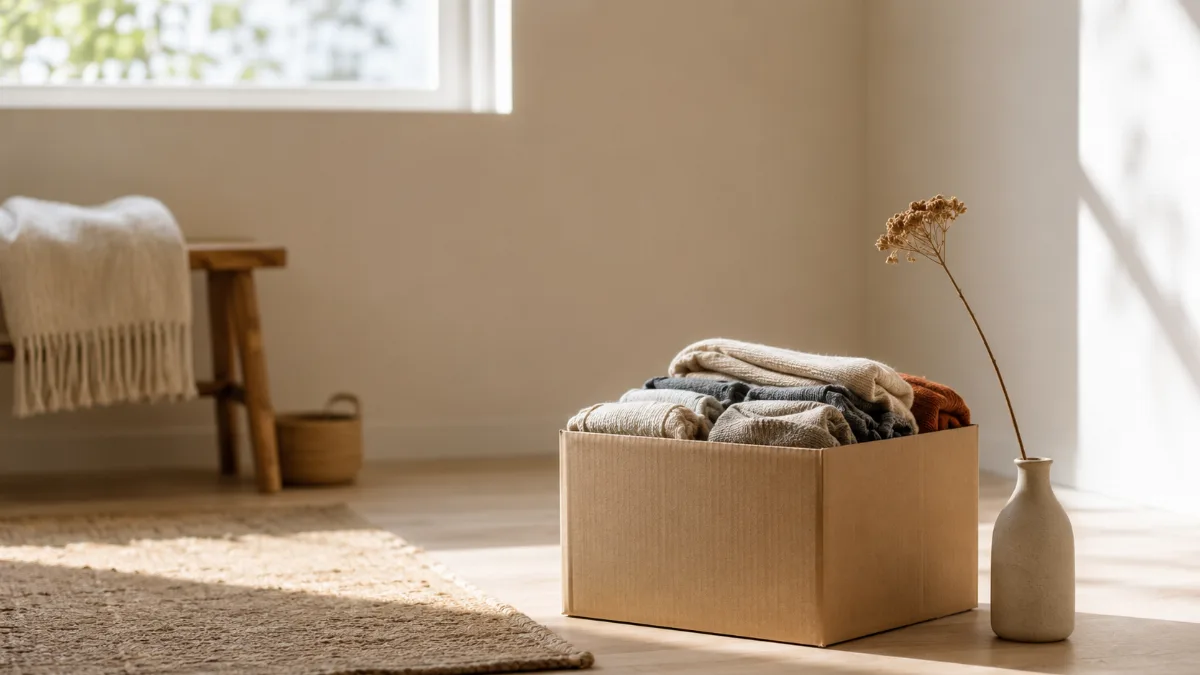
The indifferent-but-not-ready pile is where a holding box earns its keep. Anything the child is unsure about goes into a box, which gets taped shut and dated for thirty to sixty days. At the end of the window, the child is invited to pull back anything they missed. In practice most children retrieve nothing — the items they couldn't decide on turn out not to have been missed at all — and the sealed box leaves the house without another negotiation.
The holding box works because it converts a permanent, high-stakes decision ("give this away forever") into a reversible, low-stakes one ("put this away for a while"). That reframing lowers the emotional temperature enough that a child who would fight a donation will happily agree to storage, and the passage of time quietly makes the real decision for them. For a toddler who won't grasp a sealed box, do the same thing out of sight — a bin in the garage or the top of a closet — and check in after a month.
The mechanism is simple and it works because nothing is thrown away in front of the child. Put the maybes in a box, store it out of sight — a loft, a garage, a high cupboard — and mark the date. Review after 3 months. Toys asked for during that period come back; toys never mentioned leave without a conversation.
Two details make the difference. The box must be genuinely out of sight, since a visible box is simply another shelf. And the review is done without the child present, because opening it together restarts the attachment for every item in it. Most parents find that under a fifth of the box gets requested during the three months.
Rotation Instead of Purging
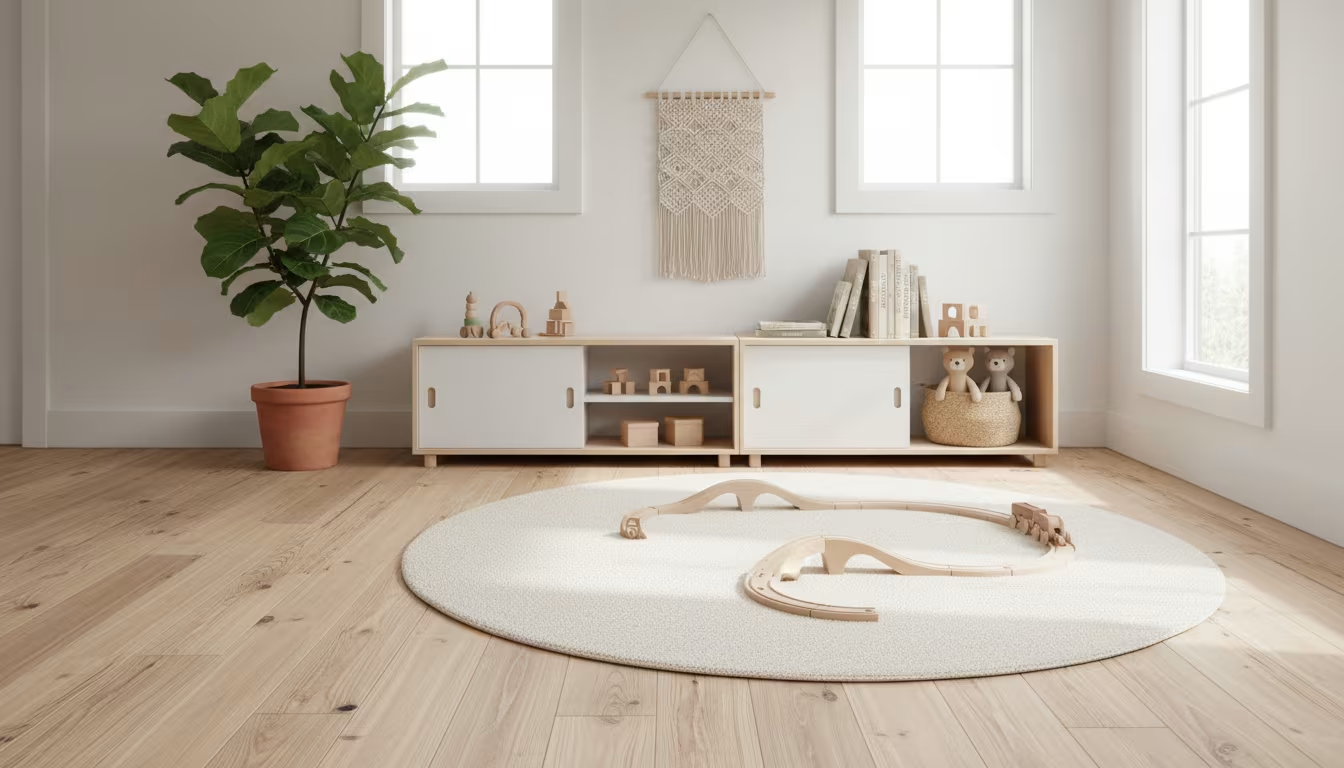
For households where every declutter turns into a standoff, rotation offers a middle path that cuts visible toy volume without demanding any permanent removals. Divide the collection into three or four groups, keep one group out, and store the rest. Every three to four weeks the active group goes into storage and a stored group comes out. A practical setup uses four labeled bins in a closet and a reminder on the first of the month; the swap takes ten minutes and needs no input from the child, which is part of why it survives busy weeks.
Rotation does two useful things at once. It raises engagement, because a group that reappears after a month feels almost new and pulls the child back into play with toys they had stopped noticing. And it quietly surfaces declutter candidates: the toys that spend a full rotation in the closet without being asked for are, by demonstration, not missed — which makes them far easier to release later, because the child has already lived without them and felt no loss.
Rotation avoids the confrontation entirely. Keep roughly a third of the toys accessible and box the rest, swapping every 4 to 6 weeks. Children typically play longer and more inventively with a smaller accessible set, and a rotated-in box produces the interest of something new without anything being bought.
Some categories should stay out permanently rather than rotate: building blocks, art materials, figures and anything open-ended, because these are the ones used differently each time. What rotates well is the opposite — single-function toys, puzzles already completed, and anything with one obvious way to play with it.
The Gift Problem
Children often resist letting go of toys that were gifts — not because they play with them, but because passing on a gift feels like rejecting the person who gave it. This is worth naming directly rather than steamrolling: "We're not getting rid of Grandma's love by passing this along. We're making room for the things you actually play with, and another kid gets to love this one now." The distinction between honoring the giver and storing the object matters to a child more than adults tend to expect.
The reframe most families find useful is that donated toys go to children who will use them. The child isn't discarding something; they're handing a toy they've outgrown to someone who doesn't have it yet. Shifting the emotional weight from loss to generosity changes how the whole decision feels — and a child who won't "throw away" a toy will often gladly "give it to a kid who needs it." For more detail, it is worth checking PBS Parents' advice on decluttering toys with children.
Broken Toys and Incomplete Sets
Broken toys and games missing pieces are the easiest category to clear and, paradoxically, often the last to go, because they sit in a mental "to repair" bucket that never empties. The board game missing three pieces hasn't been played in a year precisely because of the missing pieces, and it won't be. The toy that cracked three months ago and has been "waiting to be fixed" has, in fact, just been waiting.
A workable standard: if a repair hasn't happened within thirty days of the break, it isn't going to. The broken toy leaves. The incomplete set leaves unless the missing pieces can be found or ordered within two weeks. It sounds strict, but it produces real simplification and clears out the low-grade guilt of a repair that was never actually coming. Doing this pass without the child present is usually kinder — few children mourn a broken toy they'd forgotten was broken.
Make It a Habit, Not an Event
A toy declutter staged once a year as a concentrated session will always meet more resistance than a continuous, low-pressure practice. A version of the one-box method adapted for kids works well: keep a donation box accessible in the playroom or bedroom that children can drop toys into whenever they decide they're done with something. It normalizes letting go and removes the pressure of one high-stakes sorting day.
Children who grow up adding to a donation box regularly build a different relationship with their possessions than those who only experience periodic large-scale purges. The ongoing practice teaches them to notice when something has served its purpose — which is the underlying skill the whole exercise is meant to develop, far more than any single cleared shelf. A box that fills and goes out every couple of months keeps the collection roughly level without a single dramatic session.
The Parent's Job After the Declutter
A declutter that successfully shrinks the collection still needs maintenance, or it quietly undoes itself. The usual failure mode is simple arithmetic: new toys arrive faster than old ones leave, and within twelve months the collection is back where it started. Birthdays, holidays, party favors, and well-meaning relatives all feed the inflow.
A one-in-one-out rule holds the line: each new toy that enters is matched by one that leaves. For birthdays and holidays this takes a conversation before the occasion, not after — telling gift-givers in advance that the household manages toys through rotation heads off the flood, and letting the child choose which toy makes room for a new arrival hands them ownership of the trade rather than making it a punishment.
It helps to put a rough ceiling on the collection — a specific shelf, a single bin, a toy box that actually has to close. When the container is full, something comes out before anything new goes in. A physical boundary does the deciding for you and spares the household the recurring argument about whether there's "room for one more," because the answer is visible: the lid either shuts or it doesn't.
What Fewer Toys Does for Play
Children with fewer toys available at any one time tend to play more deeply and inventively with what they have. The child surrounded by thirty options often cycles through them without settling, while the child with eight to twelve — especially if those include open-ended materials like blocks, art supplies, and figures — tends to sink into longer, more imaginative play. This is not an argument for deprivation: eight to twelve well-chosen toys is a generous collection. The point is that a child's attention is finite, and thirty competing options tend to fragment it rather than enrich it.
The open-ended toy approach that many minimalist families use as a curation guide naturally lands on a smaller collection that supports richer play: wooden blocks, art materials, a set of figures, a few vehicles, and building pieces like Magna-Tiles or LEGO occupy more of a child's imagination than the same number of single-function gadgets. The pared-down, curated collection is genuinely more valuable to a child's development than the large, varied one — which is what makes the whole slow, collaborative process worth the patience it demands.
The no-fight system:
| Rule | Number |
|---|---|
| Accessible share | about a third of the toys |
| Rotation | every 4–6 weeks |
| Disputed items | boxed, reviewed after 3 months |


Comments
No comments yet.