
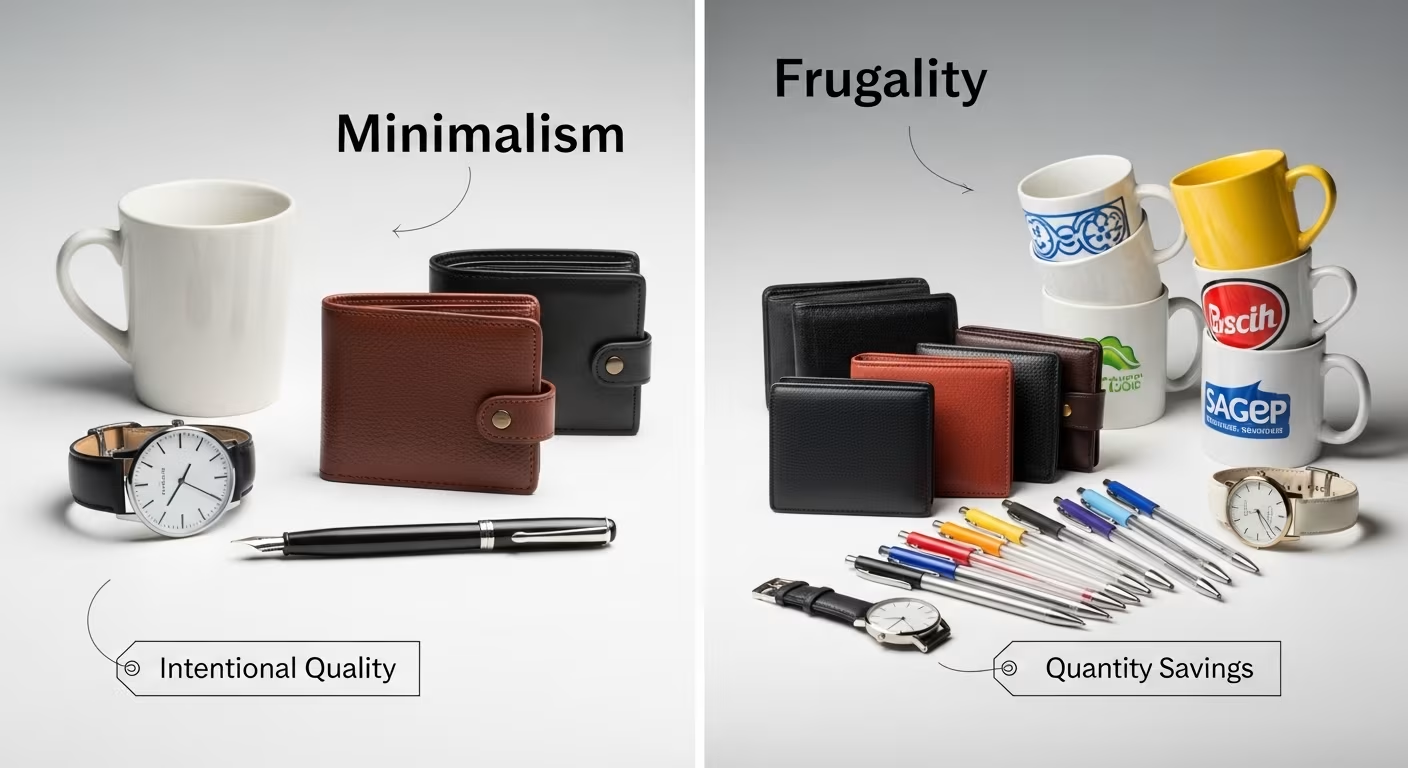

Where the Two Practices Meet
Minimalism and frugality get talked about together so often that they start to sound like the same thing. They aren't. They answer different questions and, often enough, produce different decisions. Seeing where they overlap and where they split makes both more useful in daily life.
The overlap is real. A minimalist approach to possessions cuts spending on new stuff almost as a side effect, so it looks frugal without frugality being the point. A frugal approach to buying tends to produce less impulse accumulation, so it looks tidy without minimalism being the point. But they start from different places. Minimalism opens with: what do I want to keep in my life and home? Frugality opens with: how do I spend my money well? A minimalist might drop $300 on one Dutch oven that serves every need and release a cabinet of cheap pots. A frugal shopper might buy those same cheap pots in a bundle because the per-unit price was unbeatable. Both are being deliberate; they're optimizing for different things.
What Minimalism Is Not About

Minimalism is not primarily about spending less, even though it usually ends up there. Someone can apply it by spending more on fewer, better things. The person who owns a single high-quality knife that handles every task in the kitchen — and who has released the eight lesser knives that used to crowd the drawer — is being minimalist even though the knife was expensive. The object passes the test that matters to minimalism: it serves a genuine current need and earns its spot. Whether it was the cheapest route to that outcome is a separate question entirely. Much of this echoes the SEC's Investor.gov basics.
It's also not about deprivation. The practice is about keeping what serves the life you're actually living rather than what piled up by default. For some people that includes a lot of gear in one category they care deeply about. A serious home cook with a well-used collection of pans and tools isn't breaking any rule as long as each piece genuinely gets used. The count isn't the test; the use is.
What Frugality Is Not About
Frugality is not primarily about keeping fewer things — and it can actively produce accumulation. Buying in bulk to lower the unit cost, taking anything offered for free, and holding on to items well past their useful life because "they still work" are all financially conservative moves that pile up volume. The household that keeps twenty years of plastic bags, washes and reuses takeout containers for storage, and never replaces a struggling appliance is making frugal decisions. Those decisions can produce exactly the clutter a minimalist would clear.
Frugality's yardstick is money: is it being spent well? Accumulation is a byproduct, not the focus. Sometimes the frugal choice happens to be the minimalist one, and sometimes it points the opposite way.
Where the Combination Gets Strict

Run both filters at once and the standard tightens. What enters the home has to clear two gates: it serves a genuine current need, and the money spent to bring it in is sound. Fail either and it's out. A $5 impulse item at the register fails the minimalist gate even though it passed the frugality gate. A $200 appliance that genuinely serves fails the frugality gate if a $60 one would have done the same job.
Applied together, the two push toward buying fewer, well-chosen, fairly priced things and releasing whatever doesn't serve, regardless of what it originally cost. The combination also checks the classic minimalist trap of justifying an expensive purchase purely by its quality. Quality matters when the item genuinely performs better than the cheaper option; it is not a license to accumulate well-made things that don't serve the current life. For the purchasing discipline that satisfies both filters at the point of sale, our guide to buying less and buying better lays out the routine.
Secondhand: The Natural Intersection

Secondhand buying is where the two practices land in the same spot. A used item clears the frugality gate on price — often 40 to 70 percent below new — and clears the minimalist gate by meeting a specific need without triggering new production. Furniture, clothing, kitchen equipment, hand tools, electronics, and books all turn up secondhand in condition that serves the purpose perfectly well. And the loop closes on itself: the minimalist who donates or resells what no longer serves is feeding the same market that supplies the next person's frugal, well-chosen replacement.
The Environmental Dimension They Share

Both practices carry an environmental upside that grows when they run together. Buying less spares the resources that would have gone into producing what you didn't buy. Keeping things longer cuts the waste generated by replacing them before they're actually spent. Choosing a $120 pan that lasts fifteen years over a $25 one replaced every couple of seasons reduces the total volume of goods moving through your household over a decade — and does it while costing less across that span, which is exactly where the two practices agree.
Neither is environmentally motivated for most people. Minimalism is driven by wanting a functional home; frugality by wanting financial control. But the environmental benefit rides along regardless, and it's larger when both filters are applied at once, because fewer, better, longer-kept things is precisely the pattern that consumes the least.
When They Point Different Ways
The sharpest split shows up with items that are old or worn but still working. The frugal read says keep using it until it genuinely can't do the job — replacing a functional thing because a better one exists is money spent for no reason. The minimalist read may argue for replacing it anyway: when the aging item creates daily friction, when keeping it running takes effort out of proportion to its value, or when a better-suited version would meaningfully improve the job it does. Take a ten-year-old blender that still runs but leaks, takes three tries to start, and lives at the back of a low cupboard. The frugal ledger says keep it; the minimalist read says the daily friction has already outweighed the $40 a replacement would cost. These are simply not the same calculation, and two thoughtful people will land in genuinely different places on the very same worn-out blender.
There's no universal answer; you apply the framework that matches your priorities on that item. For someone new to both, starting with the possessions question — what do I actually want in my home — tends to motivate better than starting with the ledger, because the cleared shelf and the easier-to-use closet are visible today in a way a spreadsheet isn't. Once the possessions habit sticks, the financial payoff shows up on its own: the purchases skipped because what you own already serves, the storage unit never rented because the household is right-sized. For the framework that integrates both into everyday decisions, see our guide to living with less and spending with intention.
The two gates:
| Purchase | Frugality gate | Minimalist gate |
|---|---|---|
| $5 register impulse | passes (cheap) | fails (unneeded) |
| $200 appliance that truly serves | fails if $60 does the job | passes |
| $120 pan, 15 years | passes on cost-per-year | passes on volume |
| Used items | 40–70% below new | both gates at once |



Comments
No comments yet.