
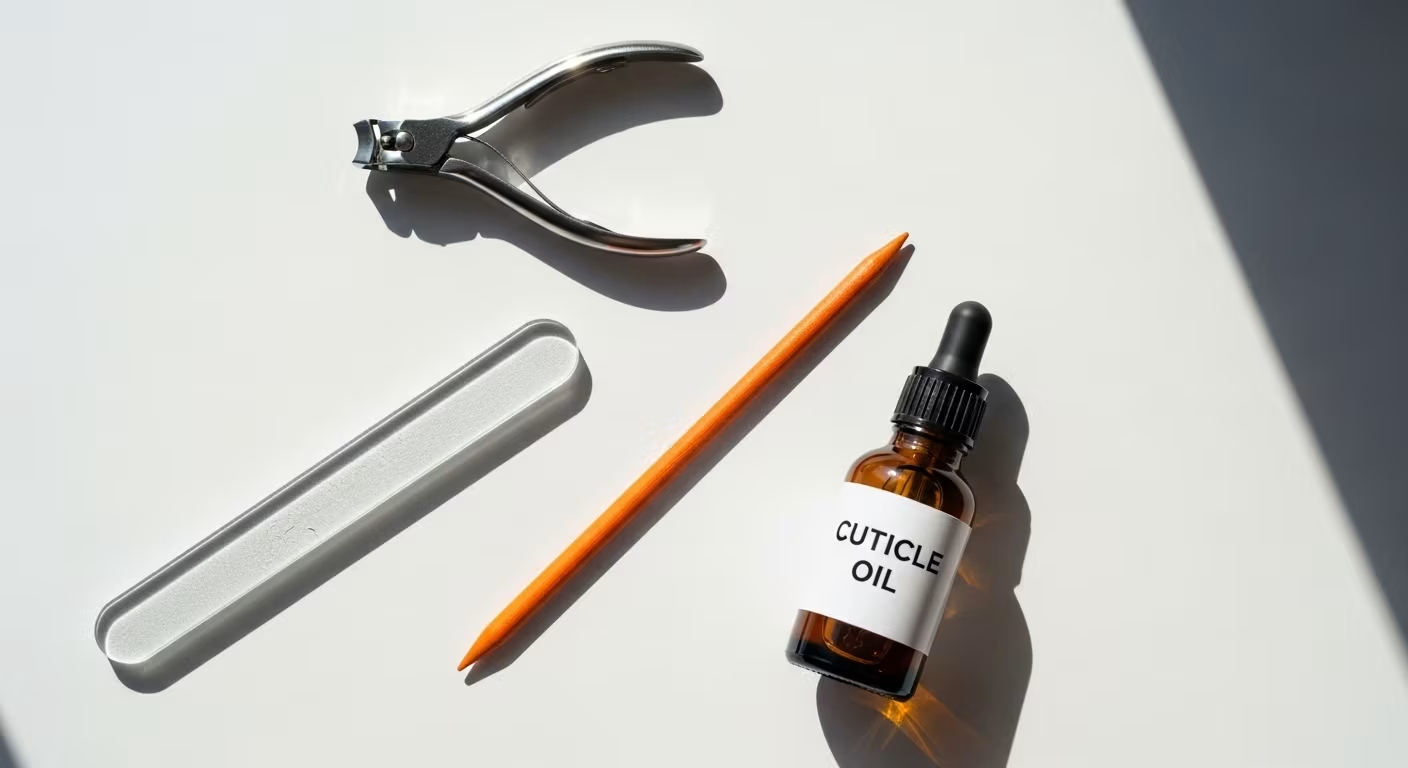

Nail care has accumulated a product category around it that's disproportionate to the actual maintenance required. A drawer full of polish colors, base coats, top coats, cuticle tools, nail wraps, strengthening treatments, and growth serums suggests that keeping nails in good condition is a complex ongoing project. It isn't. Healthy nails require four tools, one or two products, and fifteen minutes every one to two weeks.
What Healthy Nails Actually Need
Nails are dead protein — specifically, sheets of keratin produced in the matrix below the visible nail plate. What affects their condition is primarily internal (nutrition, hydration, and overall health) and secondarily mechanical (how they're filed, what they contact regularly, whether cuticles are maintained). Products applied to the nail surface affect appearance more than structural health.
The genuine needs: regular filing to maintain a shape that doesn't catch and tear; cuticle maintenance to prevent dryness and cracking; moisturizing the hands and nail area, which keeps the skin around the nail bed healthy and prevents brittleness at the nail edge; and protection from repeated water and detergent exposure, which weakens nails more than any other common factor.
The Four Tools Worth Having
A glass nail file is significantly preferable to emery boards for one mechanical reason: a glass file's surface seals the edge of the nail as it shapes it, rather than roughing it. Emery boards, particularly lower-quality ones, create micro-tears in the nail edge that become the starting point for splitting and peeling. A glass file costs $8–$15, lasts indefinitely with proper cleaning, and is the single highest-value tool swap available in nail care.
Nail scissors or a quality nail clipper with a straight or slightly curved blade. The choice between them is personal preference; both work. The key variable is sharpness — dull clippers crush the nail rather than cut it cleanly, creating compression damage at the tip that leads to splitting. Replace or sharpen when cutting requires significant force.
A soft buffer block — the four-sided type with different grits on each face — smooths the nail surface and can remove minor ridges. Buffing once every two to three weeks is sufficient; more frequent buffing thins the nail plate over time.
A cuticle pusher — wood, rubber, or metal — to gently push back the cuticle after soaking or bathing, when the skin is soft. Cuticle nippers are unnecessary for most people and increase the risk of damage and infection; pushing the cuticle back regularly makes cutting it unnecessary.
The One or Two Products That Actually Help
Cuticle oil is the highest-impact product in nail care. The cuticle (the thin skin at the base of the nail) and the surrounding skin benefit from regular oil application, which prevents dryness, cracking, and the small tears that lead to hangnails. Any light oil works — jojoba oil, almond oil, coconut oil — applied with a small brush or dropper once daily or every other day. Dedicated cuticle oil products are convenient but not required; the active ingredient is just oil.
Hand cream applied consistently does the same work as cuticle oil for the broader hand area and supports nail health indirectly by keeping the skin around the nail bed supple. A cream applied after handwashing and before sleep is the routine that makes the most difference for most people.
That's the product list for genuinely healthy natural nails: oil for the cuticles, cream for the hands. Polish, base coat, top coat, and strengthening treatments are all optional — effective for specific goals, but not contributing to baseline nail health.
The Basic Maintenance Routine

Every one to two weeks file nails to desired length and shape after a bath or shower (nails are slightly softer and easier to shape when hydrated), push back cuticles gently with the pusher while the skin is still soft, buff the nail surface lightly if needed. The whole process takes ten minutes.
Daily apply cuticle oil or hand cream, particularly before bed. This part of the routine takes under a minute and makes the difference between nails that look maintained and ones that look dry and brittle at the edges.
What Weakens Nails
Repeated immersion in hot water and contact with detergents — dishwashing, frequent handwashing without moisturizing afterward — is the primary cause of nail weakness for most people. Water causes the nail to expand; drying causes it to contract. Repeated expansion and contraction, accelerated by detergents that strip natural oils, weakens the nail plate over time.
Wearing gloves for extended dishwashing is the most effective protective measure. Applying hand cream after each handwashing session replaces oil stripped by soap. Neither of these requires purchasing anything beyond a basic pair of rubber gloves and a hand cream.
Picking or peeling at nails, cutting cuticles rather than pushing them, using nails as tools for scraping or prying, and filing in a sawing back-and-forth motion (which creates friction damage) all cause structural damage that no product corrects after the fact.
When Nails Don't Respond to Basic Care
Nails that remain brittle, peel consistently, or have persistent ridging or discoloration despite adequate hydration and nutrition may be indicating a nutritional deficiency (biotin, iron, and zinc all affect nail health) or an underlying condition. Nail changes that appear sudden, affect multiple nails asymmetrically, or are accompanied by skin changes are worth discussing with a doctor. Basic nail care maintains healthy nails — it's not a substitute for addressing an underlying issue if one exists.
Nails as Indicators of Overall Health
Nails change in response to nutritional status, hydration, and certain medical conditions, which means they can function as early indicators worth paying attention to. Horizontal ridges (Beau's lines) across multiple nails often appear after significant physical stress — illness, surgery, nutritional deficiency — and reflect disruptions in nail growth during that period. Vertical ridges running the length of the nail are extremely common and typically benign, associated with aging.
Pale or white nail beds, spoon-shaped nails (koilonychia), pitting, and persistent yellowness are changes worth mentioning to a doctor, as they can be associated with nutritional deficiencies, thyroid conditions, or other systemic issues. Changes that appear suddenly in multiple nails simultaneously are more likely to be meaningful than gradual changes in one nail. Basic nail care — filing, moisturizing, maintaining cuticles — won't address these underlying causes, but it does make the nails easier to observe clearly.
Color, Polish, and Personal Choice
The minimalist framework for nail care is primarily about health and maintenance, not about color or finish choice. Wearing polish is a separate decision from having healthy nails — the two aren't in conflict.
If wearing polish is something you enjoy, a simple system keeps it manageable: one or two shades used in rotation rather than a large collection most of which is rarely used. Most people return to the same two or three shades repeatedly and have ten or fifteen others that get one use before sitting in a drawer. Keeping what's actively used and releasing the rest is the same principle applied to nail products as to any other category of belongings.
Clear polish or a simple buff for people who prefer a no-color option still benefits from a base coat if the nails are prone to staining, and a top coat if you want the finish to last. Otherwise, well-maintained natural nails are a complete answer to the question of what to do with nails — not an absence of a decision but an affirmative one.

Comments
No comments yet.