


The washing step is almost never where laundry breaks down. Loading the machine and pressing start takes under a minute, and then it runs on its own. Pile-ups happen in the gaps between steps: the wet load that sits in the drum until it sours, the dry load that lives in a basket for four days, the half-full hamper that keeps justifying one more day of waiting.
Each delay looks harmless on its own. Stacked over a week, they turn a routine chore into a Saturday backlog of four loads and a basket that has been on the bedroom floor since Tuesday.
Finish What You Start the Same Day
One rule prevents most of the pile-up: do not start a load you cannot finish today. Starting a load is a commitment to move it to the dryer when the wash ends and to fold it that evening. If the day is already full, or you are heading out for hours, or you will be asleep before the cycle finishes, wait until tomorrow. Penn State Extension makes a similar point.
This feels strict, but it kills the most common failure. A wet load left overnight often has to be rewashed because it smells musty. Meanwhile a second load waits in the dryer and last week's folded shirts still sit in the basket. One complete cycle, fully finished, beats three half-cycles spread across three days.
Pick Fixed Laundry Days
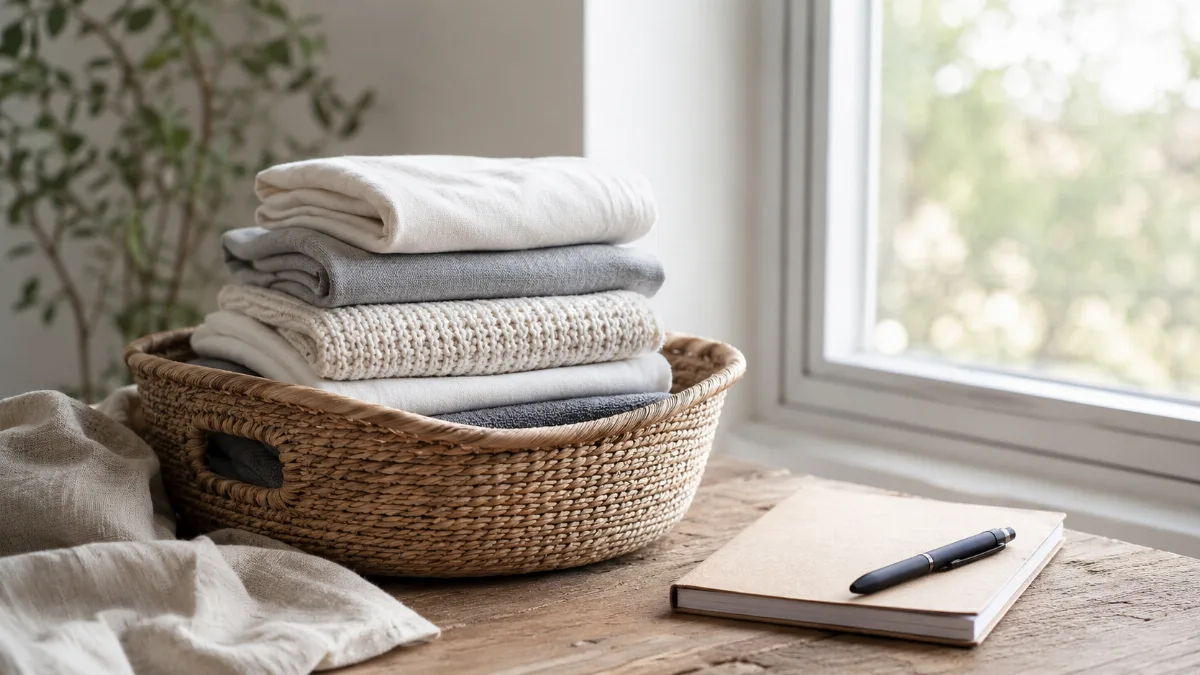
Washing only when the basket overflows makes laundry permanently reactive. The hamper fills at different rates depending on the week, so you end up re-deciding when to do laundry over and over. Two fixed days a week remove that decision. A household of four often settles on something like Tuesday and Friday, or Monday and Thursday. The task now happens on a schedule instead of on demand.
If the basket is light on a laundry day, run a smaller load or push the day back once by twenty-four hours. If it overflows before the scheduled day, that is a signal the schedule needs a third day, not a reason to abandon the structure and slide back to washing whenever panic sets in.
The Real Work Is the Transfer and the Fold
Washing is five minutes of active effort. Drying adds another five. Everything that actually eats time and stalls the cycle is in the transfer and the fold, so both deserve a low-friction habit.
Move the wet load the moment the washer stops. Not after the next errand, not once the current episode ends. Walking over and shifting it straight into the dryer takes about ninety seconds; leaving it two hours means wrinkled or resoured clothes and a possible rewash. Then fold while the load is still warm. A warm load folds in roughly eight minutes and comes out nearly wrinkle-free. The same load left to cool and compress in the basket for two days takes longer and needs a fight with the creases. The warm fold is simply the fastest version of the job.
Sorting is the other place people waste effort. Elaborate systems with separate hampers for darks, lights, colors, delicates and synthetics usually cost more time than the problem they solve. For most homes a two-way sort — colors and darks in one, lights and whites in the other — run cold on both loads handles the vast majority of clothing without bleeding or damage. Modern cold-water detergents clean lightly to moderately soiled clothes well, so you get two categories instead of five and a much simpler hamper. Genuine delicates and handwash items are the exception, but in a smaller, more deliberate wardrobe there are few enough of them to handle as one small load every week or two.
Put Away in the Same Session, Even With a Full House
A load that gets washed, dried and folded but then lives in a basket on the floor is not finished. The basket turns into furniture, people pick clothes from it instead of from drawers, and the whole system loses its clarity. Build the put-away into the fold: shirts to the closet, socks and underwear to the drawer, towels to the linen shelf, all in one pass. Fold, sort and put away runs twelve to fifteen minutes for a typical load and ends with an empty basket.

Extra people strain any routine — the pile grows faster and the put-away now spans several rooms. Two adjustments help. Give each person their own basket rather than sharing one, so a basket's contents wash together, come back together and go to that person's room without inter-person sorting. And let anyone over about age eight run their own laundry from basket to drawer. A few supervised sessions is the whole learning curve, and it spreads the work instead of parking it on one person.
Wardrobe Size Sets the Pace
How many clothes the household owns quietly decides how often you wash. A large wardrobe can coast for two weeks before anyone runs low, but that means bigger loads and heavier put-away when the day finally comes. A smaller, capsule-oriented wardrobe runs out sooner, so laundry comes more often — but the loads are small, fast, and carry fewer decisions about what to wear. Most people who have tried both find the smaller wardrobe easier once the rhythm is set, because laundry becomes a small predictable task twice a week rather than an occasional weekend project. Pick your two days, finish every load you start, and the basket stops being a fixture.
The routine, rule by rule:
| Rule | Spec | Failure it prevents |
|---|---|---|
| Finish same day | never start a load you can't fold tonight | the soured drum rewash |
| Fixed days | two a week (Tue/Fri or Mon/Thu) | re-deciding when, forever |
| Overflow signal | add a third day | not a reason to go reactive |
| The transfer | ~90 seconds, the moment the washer stops | the four-day basket |



Comments
No comments yet.