


The full closet with nothing to wear is not a storage problem. It is a selection problem: too many options, most of them wrong in some specific way — wrong fit, a color that clashes with everything else you own, bought for a life you don't actually live. A capsule wardrobe fixes it by shrinking the selection down to the pieces you genuinely wear, that work together, and that match the real shape of your days. The idea isn't new: the term traces to London boutique owner Susie Faux in the 1970s, and Courtney Carver's Project 333 later popularized a concrete version — 33 items worn for three months. You don't have to hit anyone's number. You have to know what you own, wear most of it, and get dressed without decision fatigue.
Start With an Honest Inventory, Not a Purge
The instinct is to pull everything out and start throwing things away. That is usually the wrong order. Before deciding what to remove, you need to know what you actually wear — and a Sunday-afternoon gut call is a poor guide, because the shirt you like the idea of owning is not the shirt you reach for on a Tuesday.
A more reliable start: for the next two to four weeks, pay attention to which items you reach for repeatedly and which you skip over. The clothes you consistently bypass, even when they are clean and hanging in plain sight, are the ones that don't work for you — regardless of what you paid or how good they look on the hanger. After a month you have real data. You know which fifteen shirts you never touched and which three you cycled through constantly, and releasing the fifteen becomes an easy decision instead of an agonizing one.
A simple tracking trick makes the data concrete: turn every hanger backward at the start, and turn it the normal way only after you wear the item. At the end of the month, everything still facing backward is something you didn't reach for once. Folded items can get the same treatment with a marked bin or a rubber band that comes off on first wear. The point is to replace "I feel like I wear this" with a record of what actually left the closet, because the two rarely match.
Read Your Week Before You Count Pieces
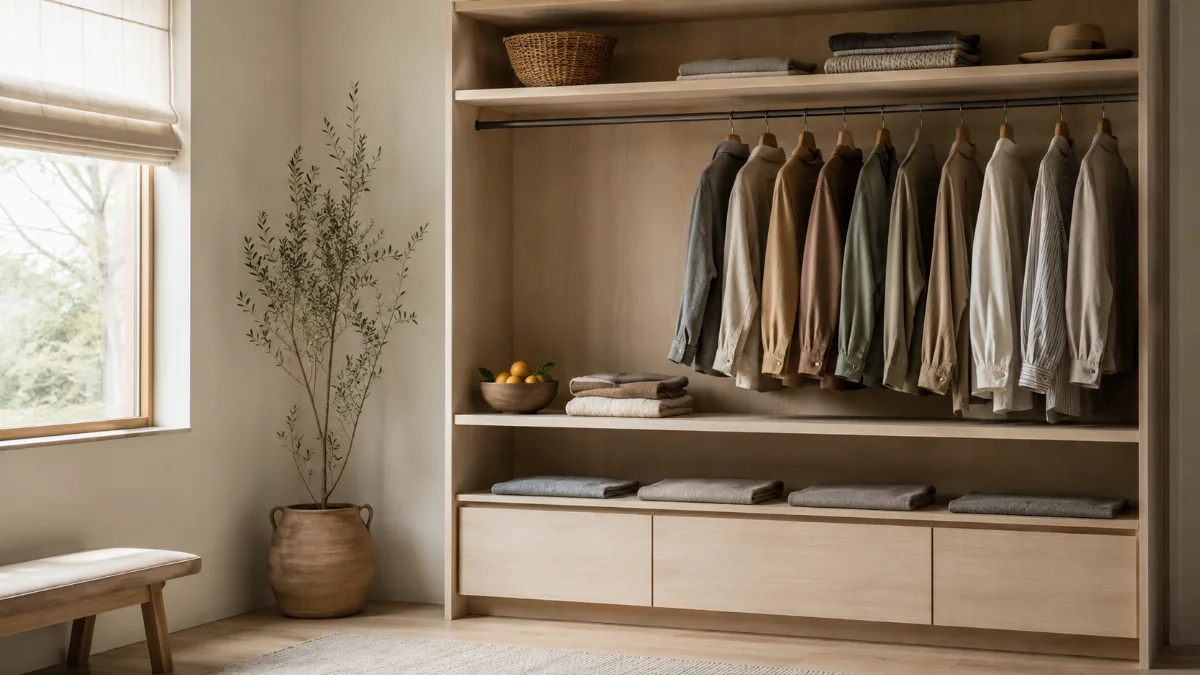
A capsule is not a specific number — it is a set of items, spread across functional categories, that covers the actual occasions of your life. Which categories carry weight depends entirely on how you spend your time. Someone who works from home and spends weekends outdoors needs a completely different capsule than someone commuting to an office five days a week.
So before counting anything, map a normal week and assign rough percentages of your waking time to each type of activity: desk work, errands and casual time, exercise, occasional dress-up. If eighty percent of your week is casual and home-based, eighty percent of the wardrobe should serve that, not the two formal events a year. That mapping tells you where the closet's weight belongs and prevents the classic mistake of a closet built around the life you imagine rather than the one you live.
A Working Capsule, Category by Category
Within each category, quality beats quantity: one pair of well-fitted trousers worn three times a week contributes more than five pairs each worn twice a year. The counts below are a starting range for a single season, not a rule — adjust them to the percentages you just mapped.
| Category | Rough range | What decides the number |
|---|---|---|
| Tops | 7–12 | Laundry frequency and how many days are casual |
| Bottoms (pants, jeans, skirts) | 3–5 | Bottoms get re-worn more, so fewer are needed |
| Outerwear | 1–3 | Climate and how distinct the seasons are |
| Shoes | 3–4 | One pair per primary function: daily, exercise, occasion |
| Occasion-specific | 1–3 | Only what your calendar genuinely calls for |
A person whose week is mostly casual might sit at the low end of tops and skip formal shoes entirely; someone commuting to an office will weight tops and bottoms toward workwear. The point of the table is not the totals but the ratio — bottoms re-wear well, so they stay few, while tops and shoes flex with how varied your week is.
Getting the Removed Pieces Out the Door

Deciding to remove something is step one. Actually moving it out of the closet is step two, and this is where most people stall. Items that are "leaving" but still hanging there are not gone — they are just taking up space with guilt attached. Three destinations keep them moving:
- Items in good condition that someone else could use go to a charity shop, a community clothing exchange, or a specific person who wants them — not "maybe someday," but within the week.
- Items with resale value get listed immediately with a deadline: if unsold in three weeks, they go to donation. Open-ended selling timelines drag on indefinitely.
- Items that are genuinely worn out get thrown away without guilt. A t-shirt full of holes kept "just in case" does not serve you.
The removal step should feel like completion, not like relocating things to a limbo pile in the spare room.
Why Neutrals Do the Heavy Lifting
The reason capsule wardrobes lean on neutral colors is not aesthetic — it is combinatorial. Ten items in neutral tones that all work together produce more wearable outfits than twenty items in varied colors that mostly clash. That does not mean the whole capsule has to be gray and beige. It means building the foundation in colors that reliably combine, then adding a few pieces in shades or patterns you genuinely like.
A color you wear often that pairs with most of what you own belongs. A one-off purchase that works with almost nothing else is worth noticing. A practical test: stand in front of what you plan to keep and find the single item hardest to combine with the rest. That piece is usually the first one to reconsider — not because it is bad, but because it earns its closet space at a much worse rate than everything around it.
A useful way to check coherence before committing is to count outfits, not items. Pick a bottom and see how many tops genuinely pair with it; do the same for two or three key pieces. A capsule where each bottom works with five or six tops quietly generates dozens of combinations from a small number of garments, which is the entire payoff — more to wear from less to own. If a piece drags that count down, it is asking the rest of the closet to accommodate it rather than pulling its own weight.
Maintaining the Capsule Across Seasons

A capsule is an ongoing standard, not a one-time project. The maintenance question for any new item: does this work with at least five things already in the closet? If the answer is no, it probably shouldn't come in, no matter how appealing it is in the store.
Seasonal transition is the natural checkpoint. When you put away one season's clothes and bring out the next, assess each piece before it goes back into rotation. Something that went unworn through an entire summer will not suddenly get used next summer. The connection to laundry is direct, too: a smaller capsule means fewer clothes to wash, sort, and fold, which makes the whole system easier to keep up with — the same logic behind sensible laundry-room setups.
When the Closet Is Shared

Shared wardrobes complicate things. Partners hold different standards for what counts as worn out, different tolerances for wardrobe size, and different attachments to specific pieces. Applying capsule rules to someone else's clothes without their buy-in is a reliable source of conflict and rarely lasts.
What works: handle your own half completely, then offer to help with theirs only if asked. The visible change on your side of the closet is often more persuasive than any argument about minimalism — a smaller, obviously organized wardrobe tends to start the conversation on its own. Children's wardrobes follow the same structure with the parent making the calls: more clothes do not mean more outfits when most are out of season, too small, or something the child refuses to wear. A kid's closet edited down to what fits and gets worn shortens the morning dressing battle considerably.
The Buying Standard Going Forward
The capsule changes your relationship with buying as much as it changes the current closet. The test for a new item shifts from "do I like this" to "does this replace something worn out, or fill a real gap in what I actually wear?" A replacement is easy to justify. An addition needs more thought, and only makes sense if the piece will be worn regularly and works with at least five things already in rotation. This lines up with University of Georgia Extension.
Shopping from a list — specific gaps identified during the wardrobe audit — is far more efficient than browsing and grabbing whatever appeals in the moment. It heads off the gradual accumulation that quietly reverses the capsule work, and it keeps purchases pointed at function rather than novelty. The closet stays small not because you keep purging it, but because far less gets in.

Comments
No comments yet.