
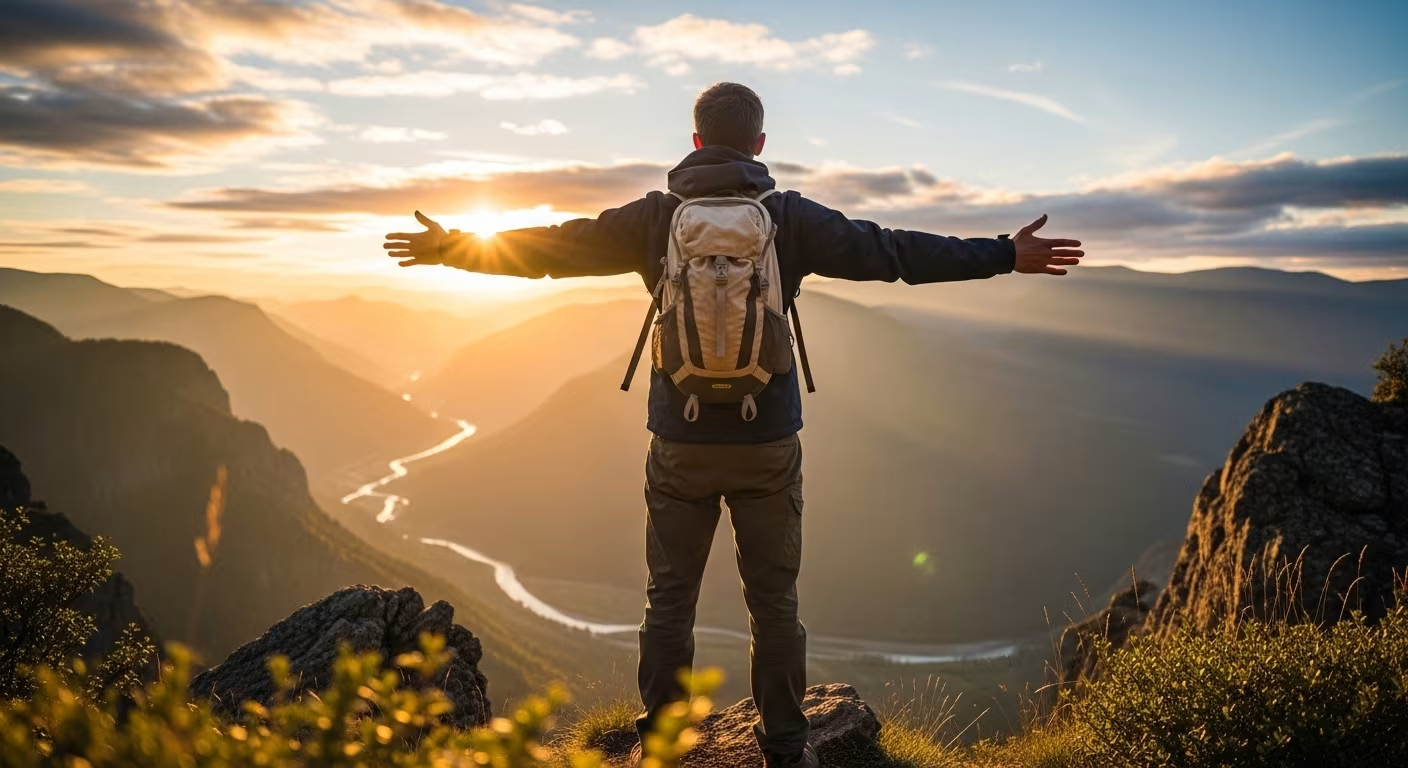

Why Solo Travel Suits Minimalists
Solo travel and minimalism run on the same logic: strip away what isn't essential and deal directly with what's left. A group trip provides social scaffolding — someone else researches the restaurant, someone else has opinions about the itinerary, the day's decisions get averaged across four people. Take the group away and none of that averaging happens. You set the pace, choose the destinations, and decide when the day starts, which is either liberating or exhausting depending on the day.
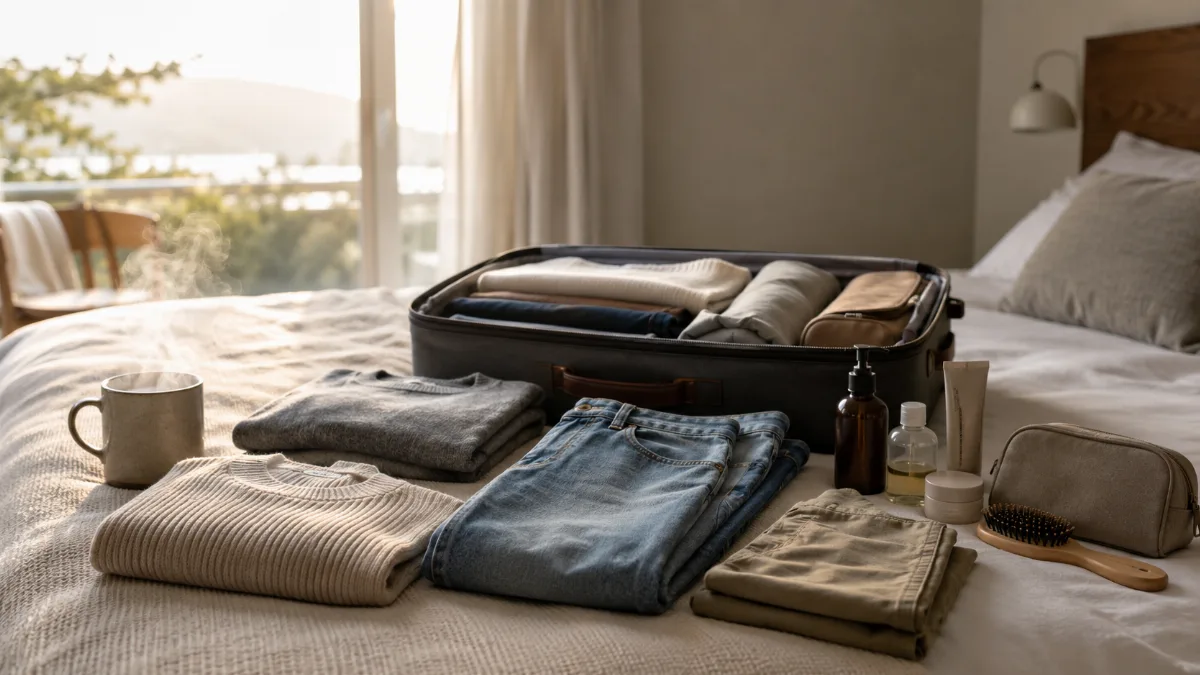
The directness carries into the logistics too. A solo traveler with a 30- to 40-liter bag moves through an airport without waiting on anyone, changes accommodation on a day's notice, and rearranges a plan the moment something better appears. Spontaneity that stays theoretical in a group — the detour to a town someone mentioned on the train — becomes an actual option when the only person who has to agree is you. The lighter the setup, the more real that flexibility gets.
Safety and Situational Awareness
Traveling alone asks for more active awareness than moving in a group, which supplies a natural buffer against certain risks just by being a group. A few cheap habits close most of that gap without turning a trip into a security operation. The State Department's guidance for solo women travelers is a practical baseline worth reading before a first solo trip, and much of it applies regardless of who's traveling.
Sharing your rough itinerary with one person at home — which city, which accommodation, approximate dates — is the single highest-return safety measure, and it costs nothing in freedom. A two-line message every few days is enough of a backstop. On arrival in each new country, spend ten minutes learning the local emergency number (112 across the EU, 911 in North America, 999 in the UK) and noting roughly where the nearest hospital or police station sits relative to where you're sleeping. Save the accommodation address in your phone before you leave the airport; it's the step most often skipped in the arrival rush and the one you'll want when a taxi driver asks "where to?" and your battery is at 4 percent.
Choosing accommodation in a well-reviewed, central area addresses the most common solo vulnerability more effectively than any gadget. Reviews that specifically mention arriving alone at night are worth more than an extra star of overall rating.
Handling Solitude
Extended solo travel involves more time alone than most people experience at home. Being alone with your own thoughts for most of a day, every day, is a different thing from an occasional quiet evening — some people find it deeply restorative, and others find it heavy by day three. It's worth knowing which kind you are before booking a month of it, because the fix is easy once you expect it.
Hostels and social guesthouses solve this almost mechanically. Common areas, a shared kitchen, and a bulletin board of organized activities generate conversation at low effort; an hour in a hostel common room in most cities produces at least one. If dormitories aren't appealing, a free walking tour on the first morning in a new city introduces other travelers and locals at once, gives the place some context, and asks nothing but showing up at the meeting point. Coworking spaces and language-exchange evenings do the same job for people who want a lighter kind of contact.
Building a Loose Daily Structure
Total freedom can quietly curdle into passive drifting — walking without direction, sitting in cafés, watching rather than doing. Some of that is exactly the point of a trip. But a run of entirely shapeless days tends to feel empty in retrospect, while a single small intention per day fixes it. One neighborhood to explore, one specific site, one meal at a place you looked up: enough direction to feel purposeful, loose enough to abandon the moment something better appears, which is far easier alone than with a group to consult.
Morning is usually the most productive window for a solo traveler. Popular sites are emptier, energy is fresh, and the day's direction is easiest to set at the start rather than salvaged at 3pm. Anchoring the intention to the morning and leaving the afternoon open tends to produce the best mix of purpose and wandering. It also front-loads the day's one non-negotiable while your motivation is highest, so a slow afternoon feels earned rather than aimless.
Managing Solo Travel Costs
Solo travel usually costs more per person than traveling as a couple, and the reason is almost entirely accommodation: a single occupancy rate often sits close to the double rate, so one person absorbs a cost designed to be split. Hostels, long-stay apartments booked by the week, and guesthouses that price per room rather than per bed shrink or erase that premium. A private hostel room can land between a dorm bed and a hotel and remove the accommodation penalty almost entirely.
Food tends to break in the solo traveler's favor in destinations with strong street-food and market cultures, where a single portion at a stall is the standard unit rather than an awkward request. Sit-down restaurants built around groups can feel odd for one, though that's far more a matter of perception than any practical obstacle in most of the world. Transport is where being alone bites: a taxi that's economical split three ways becomes expensive for one, which quietly pushes a solo budget toward public transit, cycling, and walking — usually the better way to see a place anyway.
The Particular Value of Solo Experience
What solo travel offers that no other format replicates is an unmediated relationship with the experience. There's no translation layer between what you see and how you process it — no one else's reaction to calibrate your own against, no group mood to read and manage. Your response to a place, a conversation, an unexpected turn is entirely your own.
That cuts both ways. When the response is boredom or loneliness, there's no one to diffuse it with, and you feel it fully. But when a place is genuinely extraordinary, the response is equally undiluted — not filtered through anyone else, not performed for a companion. It's the reason people who travel alone often describe their destinations in sharper detail years later; the memory wasn't shared, so it stayed intact. Minimalism amplifies the same effect: with less gear to mind and no one to coordinate, there's simply less between you and wherever you are.
Documentation and Emergency Preparation
A solo traveler has no companion on hand for the administrative emergencies — a lost passport, a stolen wallet, a medical situation in a language you don't speak. Preparing before any of it happens removes most of the panic. Photograph every critical document (passport photo page, visa, insurance card, credit cards front and back) and store the images in cloud storage you can reach from a borrowed device, not only from the phone that might be gone. Keep a printed card of key numbers — insurance emergency line, card-cancellation lines, nearest embassy — separate from both phone and wallet, since the scenario you're preparing for is often losing both at once.
For higher-risk or politically complex destinations, registering with your government's traveler notification service before entering means someone official knows you're there and can reach you in a genuine emergency. It takes about five minutes and only matters for the handful of places where it matters, so it's easy to skip until the one trip where it counts.
Meeting Other Travelers
The social side of solo travel has changed enormously from the days of hoping to strike up a conversation. Apps built for traveler meetups, destination-specific groups, and hostel-organized events all provide structured ways to meet people without the randomness. City-specific meetups — anything from an informal evening drink to an organized day hike — run regularly in most tourist cities, and joining one on the first or second day introduces people and local knowledge quickly.
Travelers met on the road share the fact of being away from home, which lowers the threshold for conversation dramatically. Exchanges that would be unlikely between strangers at home happen easily on a night train or in a hostel kitchen, and the light-pack traveler who can relocate on a day's notice is well positioned to follow a good one — extending a stay somewhere because the people turned out to be worth it.
Managing Solo Travel Fatigue
Long solo trips accumulate a specific fatigue that isn't physical. Making every decision alone, navigating every new place without help, and carrying all the logistics personally eventually gets heavy in a way a single good night's sleep won't fix. Recognizing it as its own thing — not just tiredness — is what lets you address it before it sours an otherwise good trip.
The remedies are deliberate rather than accidental: book a few nights in social accommodation, join an organized tour for a day so someone else handles the plan, or schedule a video call with people at home. Building genuine rest days into a longer trip — no agenda, spent reading or walking nowhere in particular — resets the mental energy that sustained exploration burns through. Treating every day as productive travel is the fastest route to the fatigue; planning to waste a few of them is what makes the whole trip last.
Solo logistics, condensed:
| Move | Number |
|---|---|
| Bag | 30–40 L — no waiting on anyone |
| Arrival ritual | 10 min: emergency number (112 EU / 911 N.America) + address saved |
| Big sights | first thing in the morning — empty and fresh |
Comments
No comments yet.