
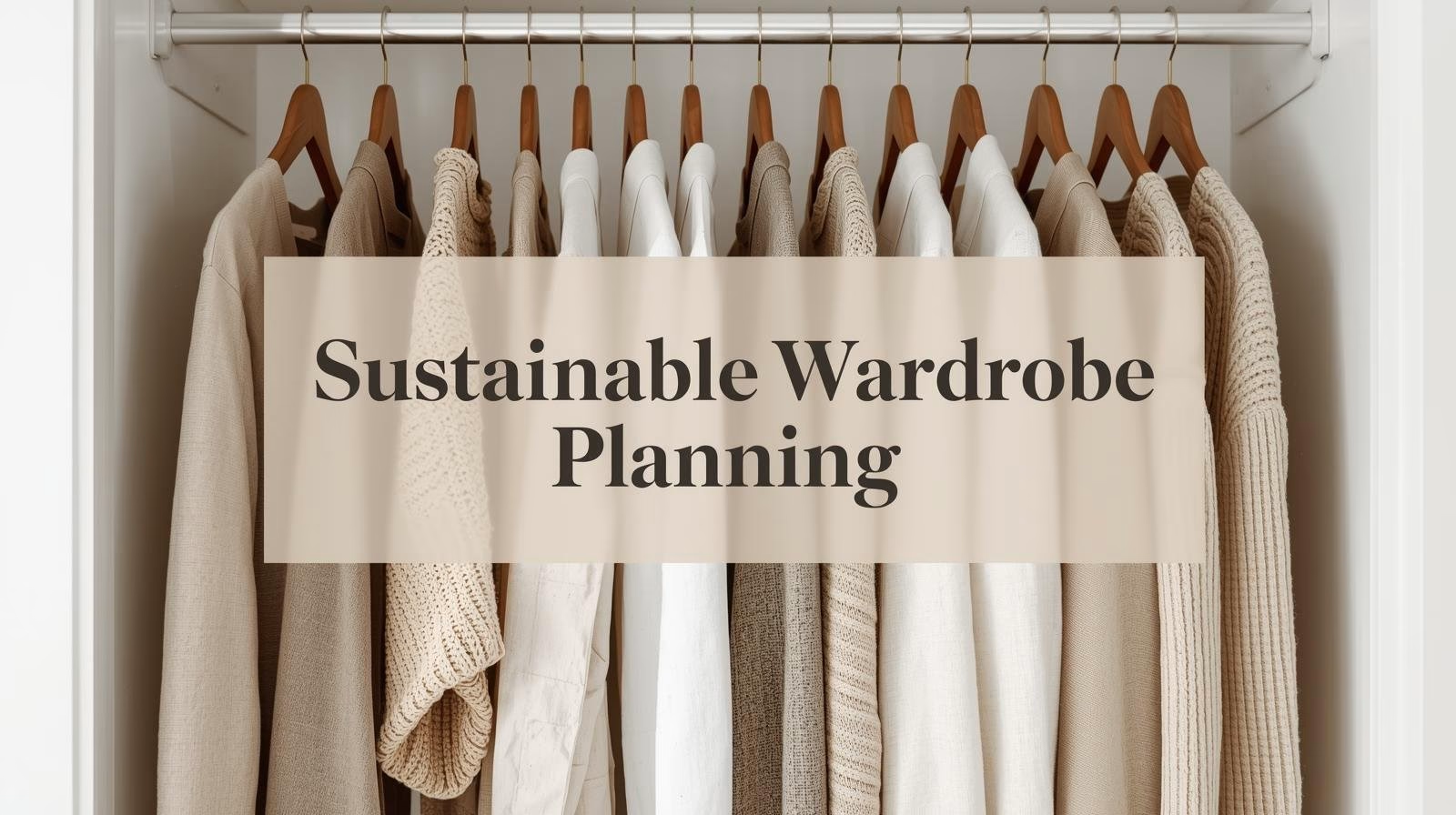

Standing in front of a full closet feeling like you have nothing to wear isn't irrational. It's what happens when the clothes don't work together, when you own 60 items but only a dozen combinations you'd actually leave the house in. The closet is full; the wearable wardrobe isn't. That gap is a planning problem, not a shortage, and more clothes make it worse rather than better.
The fix is a routine that keeps what you already own accessible, coherent, and easy to deploy on a Tuesday morning when you have eight minutes to get dressed. It runs on three timescales, weekly, seasonally, and at the point of purchase, and none of them require buying anything.
Why Quantity Works Against You
Decision fatigue is a well-documented pattern: the more choices you make, the worse your later choices get as the day wears on. A closet of 60 items generates more decisions per outfit attempt than a closet of 30 well-matched pieces, not because options are inherently bad, but because options that don't combine produce failed attempts you have to reject before landing on something that works. Every rejected shirt is a small tax paid before breakfast.
Research on capsule wardrobes, cohesive interchangeable collections usually in the 30-to-50-item range, consistently finds that people with smaller, well-planned wardrobes get dressed faster and report more satisfaction with their daily outfits. The mechanism isn't that fewer clothes are better in the abstract; it's that a planned wardrobe removes the failed-combination problem at the source.
The sustainability angle compounds the time savings. A closet you actually use fully generates fewer replacement and filler purchases. Clothes worn in regular rotation wear out evenly and completely, which is a better outcome than garments that sit untouched for years, degrade on the hanger, and get discarded without ever really being used. Getting more wears out of what you own is the most sustainable move available before any question of what to buy next.
The Color Palette Foundation
The most common reason items refuse to combine is color incompatibility. A collection assembled across years of separate decisions, one shirt bought during an earth-tone phase, another during a bright phase, trousers that matched nothing you owned at the time, produces a closet where almost nothing works with almost anything.
The correction is retroactive: identify the colors you actually reach for repeatedly. Most people have a narrow natural palette, two or three base tones they feel good in plus a handful of accents. Once you name yours, the outliers become visible and you can make a deliberate call on each one rather than letting it sit as dead weight.
A workable structure for most wardrobes: two to three neutrals that anchor the basics, navy, white and charcoal, say, or black, cream and olive, plus one or two accent colors that show up in smaller pieces. The test for any single item is whether it works with at least three others in the closet. A piece that combines with nothing is a problem piece no matter how good it looks on its own hanger, and recognizing that is more useful than pretending you'll build an outfit around it someday.
The same logic applies to fabric weight and formality, not just color. A closet where the neutrals span roughly the same level of dressiness, workwear that also reads fine for dinner, combines in far more directions than one split between gym clothes and formal pieces with nothing in between. When you cut a garment loose in a seasonal audit, the honest reason is usually one of these two: the color sits outside your palette, or the formality sits outside your actual life. Naming which one it is stops you from buying the same mistake again next season in a different shade.
The Sunday 15-Minute Reset
A weekly check takes about 15 minutes and heads off the creeping disorder that makes Monday mornings hard. It has four parts: return anything worn but still clean to its proper place rather than the chair, move whatever needs washing to the hamper, look at your actual schedule for the next few days, and pull forward the specific items for any fixed commitments, a meeting, a dinner, a workout day.
That last step does most of the work. Planning specific outfits for specific commitments drops the average time spent getting dressed on those days from several minutes to under one. You're not deciding in the morning; the decision is already made. It doesn't require elaborate systems, just knowing on Sunday that Wednesday is a presentation, pulling the right clothes to the front of the closet or onto a designated chair, and not thinking about it again until Wednesday. Fifteen minutes on Sunday buys back several stressful minutes on each of the following mornings.
The Seasonal Audit
Twice a year, typically early spring and early autumn, the whole wardrobe gets a structural review. This is slower and more deliberate than the weekly reset. Everything comes off the racks and out of storage, gets sorted into three piles, keep, mend or tailor, and donate or pass on, and goes back only after each item answers one question: did I actually reach for this in the last season?
Items worn several times stay. Items worn once or twice stay only if they fill a genuine gap. Items never touched despite being in full rotation get questioned honestly, because a garment that survived a whole season unworn while fully visible is telling you something. The mend-or-tailor pile is the most underused of the three. A jacket with a broken button, trousers whose hem has dropped, a shirt with a fraying collar, none of those are finished. An alterations shop handles all three for less than the cost of one replacement garment, and the repaired item usually re-enters rotation immediately because it was already a piece you liked.
Whatever leaves in this audit goes straight into a bag and out the door the same day. A donation bag parked in the bedroom for two months quietly re-accumulates its contents; the only version of this step that works is the one that ends with the bag gone.
Shopping From Your Own Closet
Clothes you haven't seen recently aren't clothes you'll reach for. Items shoved to the back or folded under a stack become effectively invisible: you forget you own them, then conclude you have nothing to wear while standing in front of them. A simple visibility habit fixes most of it. Face every hanger the same direction. Return recently worn items to one side, leave the untouched ones on the other, and once a month pull a few of the neglected pieces to the front to either wear deliberately or decide to move on.
Some people find it easier to photograph the whole closet and study the photos. Seeing the collection as a collection, one step removed, makes gaps and redundancies obvious in a way that's hard to spot while standing inside the closet reacting to individual pieces. Either method turns a vague sense of "not enough" into a concrete picture of what's actually there.
When to Actually Buy Something New
The useful buying criterion isn't "do I love it." It's whether the item fills a real gap, works with three or more things you already own, and replaces something worn out or missing rather than adding to a pile of near-duplicates. A fourth grey sweater on top of three existing ones is a gap-less purchase. A pair of trousers in the neutral that anchors the rest of your wardrobe, bought because the previous pair is beyond repair, is a gap purchase. Holding new items to that line prevents the slow accumulation of things that each seemed sensible alone and combine with nothing. It helps to cross-check ideas like these against the Consumer Financial Protection Bureau's budgeting tools.
The single habit worth starting tonight: move everything you haven't touched in the last month to one side of the closet. Three months from now you'll know exactly which items you actually wear, and the seasonal audit will practically do itself. It also quietly reveals which "someday" pieces have been someday for a year.
The "Cost Per Wear" Frame for Buying Decisions
The calculation that actually changes spending behavior is cost per wear: an item's price divided by the number of times you'll wear it over its useful life. A $200 coat worn 150 times across five years costs $1.33 a wear. A $40 fast-fashion coat worn 12 times before it loses shape costs $3.33 a wear. The cheap coat is the more expensive one in use, which is the opposite of how it felt at the register.
This reframes what "affordable" means for clothing. A higher upfront price for better construction and a more versatile cut often delivers a lower cost per wear, which is the better outcome financially and environmentally at once. Garments built for longevity, natural fibers, solid seams, classic silhouettes, hold up through more wears and more washes, so the durable choice tends to win on both counts.
The frame has one hard limit: it only works when you actually wear the thing. A $150 blouse worn twice is a worse value than a $30 one worn 40 times. Cost per wear is a planning tool for the pieces you already know you'll reach for; it is not a justification you reverse-engineer to excuse expensive impulse purchases after the fact.
See also: capsule wardrobe building guide and how to let go of clothes you're keeping for the wrong reasons.
The wardrobe numbers:
| Number | Meaning | |
|---|---|---|
| 60 items, 12 real combos | the “nothing to wear” math | |
| 30–50 cohesive items | the range capsule research keeps landing on | |
| Sunday reset | 15 minutes | heads off Monday chaos |
| $200 coat × 150 wears | $1.33 per wear — cost-per-wear beats price |



Comments
No comments yet.