

What "Zero Waste" Actually Means
The name oversells it. No household in a modern consumer economy sends literally nothing to landfill, and chasing that as a target produces the same arc as every other perfectionist project: a burst of intense effort, then paralysis over the one thing you can't get right, then quitting. Treated as an absolute, zero waste defeats beginners fast.
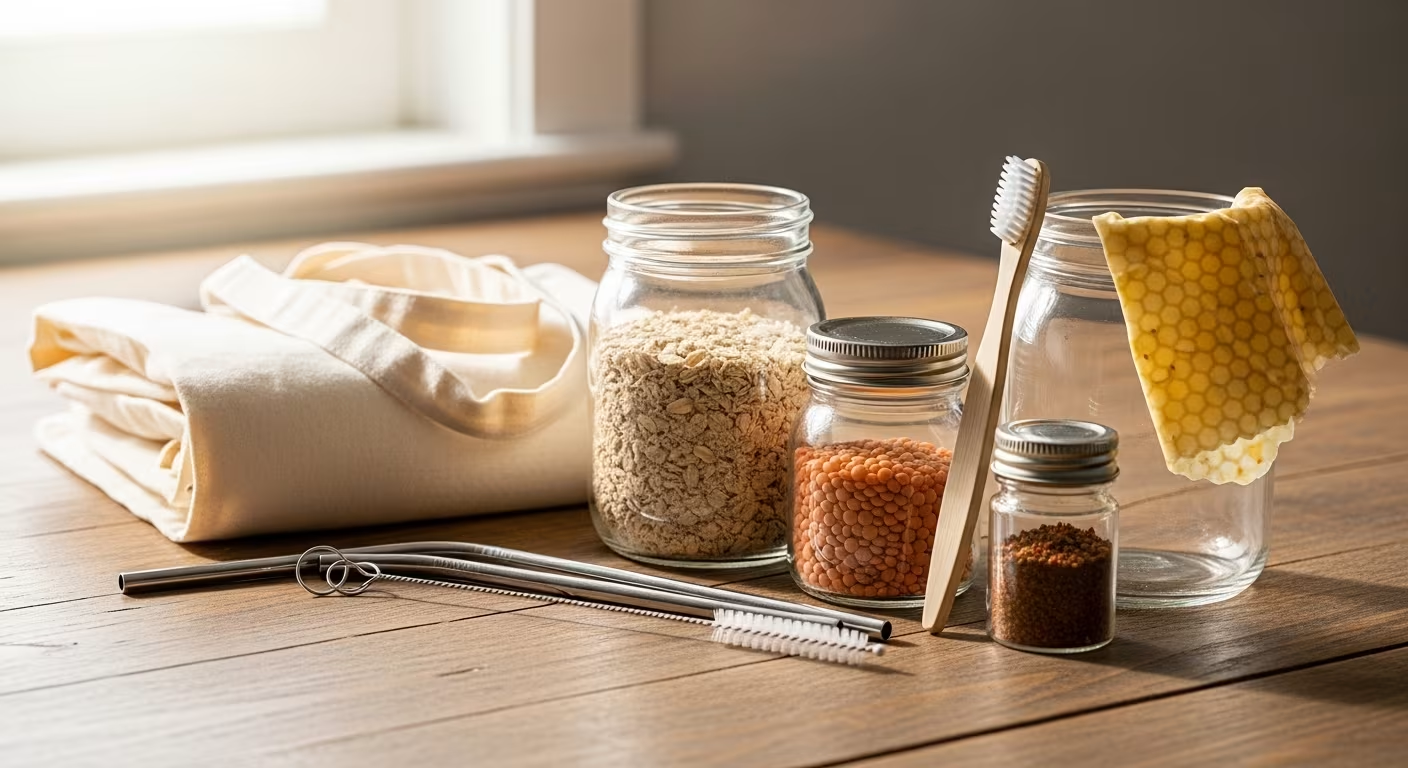
As a practical approach it means something achievable: sharply cutting what your household sends to landfill by refusing what you don't need, reducing packaging, reusing what can be reused, and composting the organics that remain. The five-R order of priority matters, and it surprises people — recycling sits fourth, not first. Most introductions to the topic open with swap products, the bamboo toothbrush and the beeswax wrap, because those are visible and purchasable. But the highest-impact changes cost nothing: refusing packaging at the door, buying less overall, and composting the food scraps currently rotting in a landfill.
| Priority | Principle | What it looks like |
|---|---|---|
| 1 | Refuse | Decline the bag, straw, freebie, and excess packaging before it enters the home |
| 2 | Reduce | Buy fewer, less-packaged things; choose whole ingredients over convenience packs |
| 3 | Reuse | Cloth bags, refillable bottles, containers used until worn out |
| 4 | Recycle | Only what your local program accepts, clean and dry |
| 5 | Rot | Compost food scraps and yard waste instead of landfilling them |
Start With a One-Week Waste Audit

Before changing anything, look at what your household actually throws away. Set aside a week's trash and sort it, and the real composition of your waste stream shows up — almost always different from what you'd have guessed. For most homes, food packaging (produce bags, plastic wrap, takeout and delivery containers) and food waste (spoiled food, vegetable trimmings, eggshells, coffee grounds) together make up the bulk of what goes to landfill. Glass, metal, cardboard, and paper are usually recyclable. Organic material that could be composted commonly runs a fifth to nearly a third of household waste by weight.
The audit tells you where effort pays off. A home buried in food packaging should change where and how it buys food. A home dominated by scraps should compost first. A home with mostly recyclables has a different starting move. Skipping the audit means guessing, and the guess is usually wrong.
The audit is a week of keeping what you throw away, sorted into 5 bags: food, plastic packaging, paper and card, glass and metal, and everything else. At the end of the week, weigh or photograph each. The point is not the total; it is which bag is fullest, because that is where any effort should go first.
Most households find the same shape: food waste and plastic packaging dominate, and everything else is a rounding error. Household food waste typically runs somewhere between a fifth and a third of what was bought — which means the single most effective change in this entire topic is usually meal planning, not switching to a bamboo toothbrush.
Refuse and Reduce: Where the Real Cuts Come From
Refusing an item before it enters the home beats managing it afterward, because it eliminates the thing entirely instead of finding a tidier way to dispose of it. Saying "no bag," "no straw," or "no cutlery" before they're handed over, declining the promotional freebie, choosing the order that ships with less packaging — none of these cost a cent or create any waste. The habit takes a few small shifts: keeping a folded tote in a coat pocket or car so refusing plastic bags is actually practical, and learning to decline before the default is applied rather than after.
Food shopping drives a large share of most households' packaging, and a few behavior changes cut it without needing special stores. Buy produce loose — most of what's sold bagged is available loose at the same shop. Use bulk bins for grains, legumes, nuts, and spices with your own containers or the store's paper bags. Lean toward whole ingredients over heavily packaged convenience foods, and shop farmers markets where packaging is naturally minimal. These are changes to how you shop within whatever retail you already have access to, not a demand for a specialty grocer across town.
Compost: The Single Biggest Lever
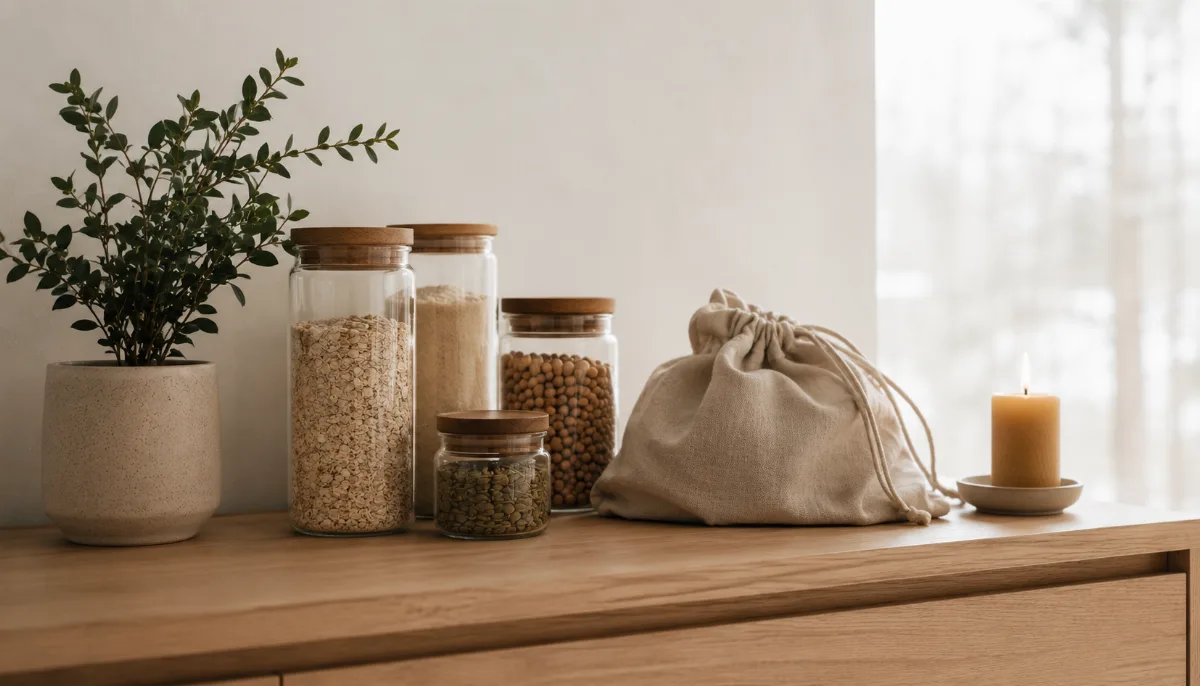
For most households, composting removes more from the landfill bin than any other single change. Food scraps buried in landfill break down without oxygen and release methane, a far more potent greenhouse gas than carbon dioxide; composted the same scraps become soil. The obstacle is rarely difficulty — it's the perception of difficulty. A basic outdoor pile needs a bin, a rough balance of wet materials (scraps, fresh grass) and dry ones (leaves, cardboard, woody trimmings), the occasional turn, and enough moisture. Kitchen scraps collect in any lidded container — ceramic, steel, or plastic, the seal matters more than the material — and go out every day or two. No yard? Many municipal programs now collect food scraps curbside for commercial composting, needing only a countertop pail and the habit of using it.
The reason composting outperforms almost every other change is what happens to food waste in landfill: buried without oxygen, it produces methane, a considerably more potent greenhouse gas than carbon dioxide over a 20-year horizon. Diverting it changes the emissions profile rather than just the bin volume.
Which method fits depends on space. A garden bin needs about 3 by 3 ft and takes garden waste alongside kitchen scraps. A worm bin fits under a sink or on a balcony, processes roughly 2 to 3 lb of scraps per week once established, and does not smell if the ratio is right. Bokashi ferments in a sealed bucket and is the only method that accepts meat and dairy. Where none of these work, a municipal food waste collection or a community drop-off does the same job.
Two exclusions apply to most home systems: meat, fish, dairy and oils attract pests and go to bokashi or municipal collection instead, and compostable plastics generally need industrial temperatures and will not break down in a garden bin.
Reusables and Recycling: Spend and Sort Deliberately

The zero waste market sells a lot. Some of it earns its place; much of it replaces things that were never generating meaningful waste. The high-return buys see daily use and each displaces hundreds of single-use items a year: cloth grocery bags, a reusable water bottle, a reusable coffee cup, cloth napkins, a few glass storage containers. The low-return buys are specialty produce bags for things you rarely purchase, slow-use beauty products in fancy packaging, and the full catalog of swap products bought to complete a set. Replace high-frequency disposables first; ignore the collection instinct.
Recycling ranks fourth for good reason — it's less effective than the steps before it, and contamination erodes it further. The most useful practice is knowing exactly what your local program accepts and putting only that in, clean and dry. Most programs take rigid plastics (types 1 and 2 most reliably), cardboard, paper, glass, and metal; most reject plastic bags, film, greasy cardboard, and foam regardless of the symbol stamped on them. Wishful recycling — tossing questionable items in hoping they'll somehow be processed — contaminates loads that would otherwise have been recycled. A clean stream of accepted materials beats a bin optimistically stuffed with everything.
The version that sticks is built gradually. Compost for a month before touching packaging; carry the bag consistently before reforming every other purchase. Two or three habits held for a year cut far more waste than ten changes that last a fortnight. For the wider framework these practices fit into, see our guide to minimalist sustainability habits. The EPA's overview of reducing household waste lays out the same priority order if you want the source behind the five-R sequence. The aim is not a waste-free home by next week, but a household that quietly sends less to landfill every year through habits reliable enough to outlast the enthusiasm that started them.

Comments
No comments yet.