
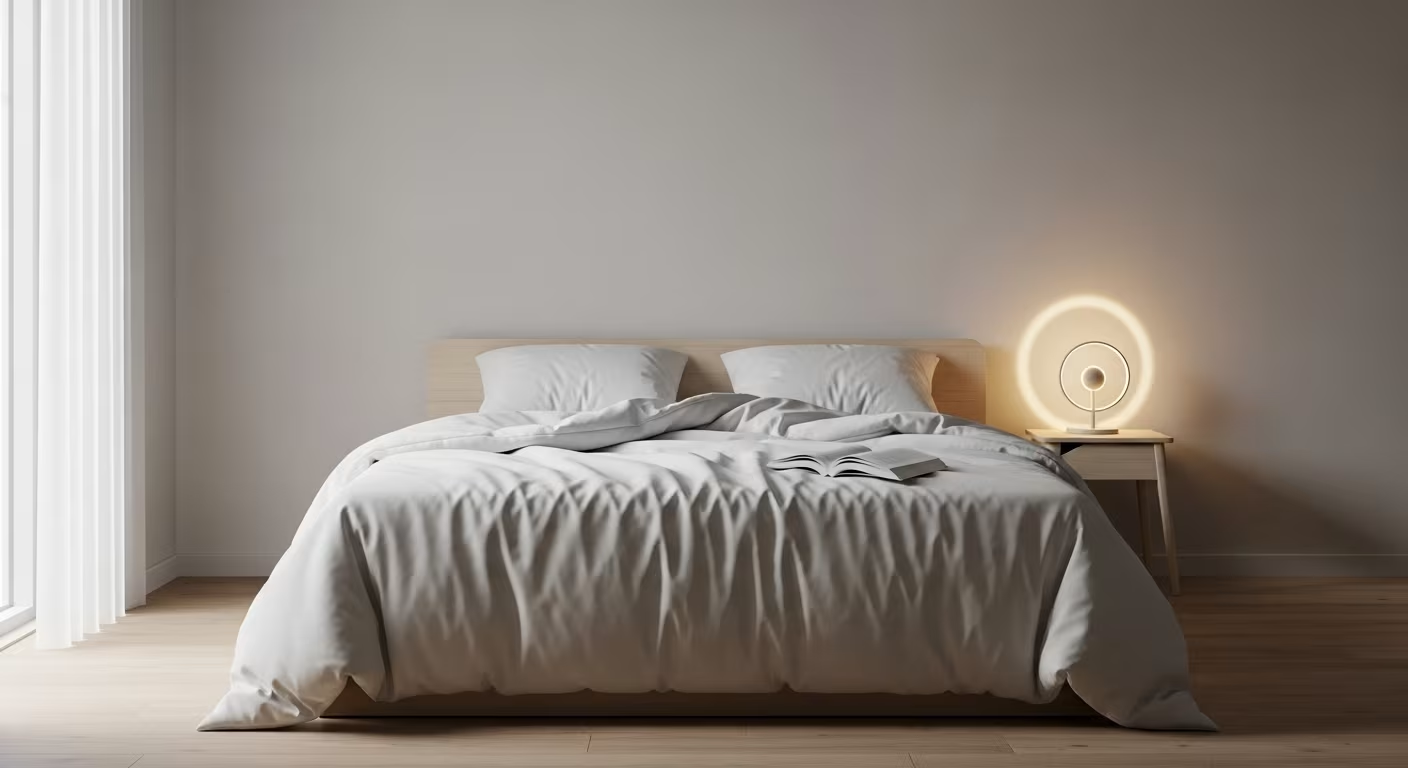

The room you sleep in shapes how well you sleep in it. Guidance on sleep hygiene from the Sleep Foundation points to the same handful of environmental levers again and again: light, temperature, sound, and the general order or disorder of the space. Of those, the visual state of the room — cluttered and object-dense versus clear and settled — is the one most directly under a designer's control, and the one minimalist bedroom design is built to address.
A busy bedroom quietly signals activity. Objects imply tasks; a stack of unread books implies reading not done; a chair draped in clothes implies a decision deferred. Even in peripheral vision, the brain registers all of it as low-grade input at exactly the moment it should be powering down. Clearing that visual noise is not decoration for its own sake — it removes small obstacles between you and the mental quiet that sleep requires.
Clear the Surfaces First

The highest-return change in most bedrooms is clearing the flat surfaces you can see from the bed: the nightstand, the dresser top, any open shelving. Every object sitting there is a small visual input, and a dozen of them together build the busy, faintly demanding atmosphere that works against rest.
Pare the nightstand back to what the act of sleeping and waking actually uses: a lamp, a phone or clock, a glass of water, and the one book or journal currently in rotation. The rest — the three remotes, the tower of finished books, the receipts, the little things set down "for now" and never moved — contributes nothing to sleep and clutters the one surface best placed to be calm. A nightstand with four items on it reads completely differently from one with fifteen, and the difference registers every night as you turn out the light.
Get the Screens Out of Reach
Electronics in the bedroom work against sleep on several fronts at once. Screen light in the evening suppresses melatonin. The content on those screens — news, social feeds, work email — winds the mind up right when it needs to unwind. And the sheer habit of using the bed as a place to scroll trains the brain to associate the mattress with alertness instead of rest.
The minimalist move is to remove whatever is not truly needed for sleep. A phone doubling as an alarm can be set and turned face-down before the wind-down begins — better still, a $15 dedicated alarm clock takes the job entirely and removes the temptation of one last check. A television facing the bed is worth relocating; a bedroom that has never hosted a screen is far easier to keep as a room for sleeping than one you are constantly resisting.
Choose Calm Color and Real Textiles
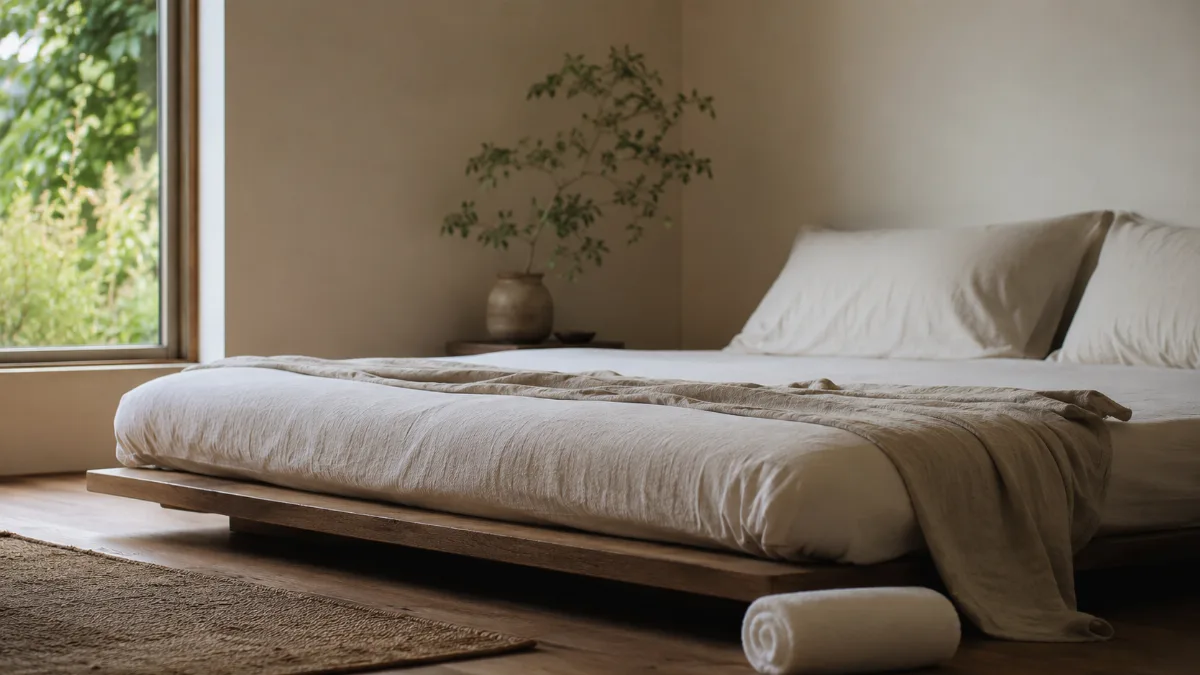
Color sets the room's baseline arousal. Cooler, muted tones — soft blues, greens, warm neutrals — tend to read as low-key and settling, while highly saturated colors and busy high-contrast patterns create visual activity that pulls in the opposite direction. You do not need to repaint to benefit; the largest color fields in a bedroom are usually the bedding and curtains, and swapping a loud duvet for a quiet one shifts the whole room.
Texture does as much work as color, just through touch instead of sight. Natural, soft fabrics — linen, cotton, wool — in the bedding and soft furnishings build a sensory environment that is comfortable to be inside. Slick synthetics, or any material with a texture you notice against your skin at night, produce small continuous sensations that chip away at rest. Linen sheets are the common upgrade here: breathable, they soften with each wash, and they hold temperature better than most synthetics across a night.
Control the Light, Down to the Bulb

Light is the strongest environmental regulator of the sleep-wake cycle, which makes darkness worth engineering deliberately. A bedroom that can be made genuinely dark — with blackout curtains or shades that actually block streetlights, passing headlights, and early dawn — beats one where outside light leaks in all night. Effective window treatments are one of the few sleep purchases that pay back directly, night after night.
The light you add inside matters just as much as the light you keep out. In the hour before sleep, favor warm-toned, dimmable fixtures over bright overhead white light, which runs counter to the body's wind-down. A single warm lamp — think a low-Kelvin bulb around 2700K on a bedside lamp — gives you enough to read by without the physiological jolt of a ceiling fixture blazing at full white. If you only change one bulb in the house, the bedside one earns it.
Keep the Visual Load Low With a Daily Reset
A bedroom where everything has a home — clothes in the closet rather than the floor or the chair, surfaces holding only their assigned items — keeps a steadier, lower visual load than a room that gets organized in bursts and drifts in between. The steadiness is what matters; a room that is spotless on Sunday and buried by Thursday still spends most of the week working against you.
The habit that holds it is short: two or three minutes before bed to hang or fold what you wore, clear whatever landed on the surfaces during the day, and return the room to its settled state. Done nightly, it never becomes the dreaded hour-long overhaul, and it keeps the room reading as a place of rest rather than a to-do list you sleep beside. For the broader design logic that carries across the whole home, our guide to minimalist home decor covers the principles that apply room to room.
When the Bedroom Is Also an Office
When a bedroom doubles as a workspace, protecting its sleep function takes deliberate effort. A desk you sit at for several hours a day teaches the brain to link the room with focus and effort, not rest — and that association follows you to the pillow.
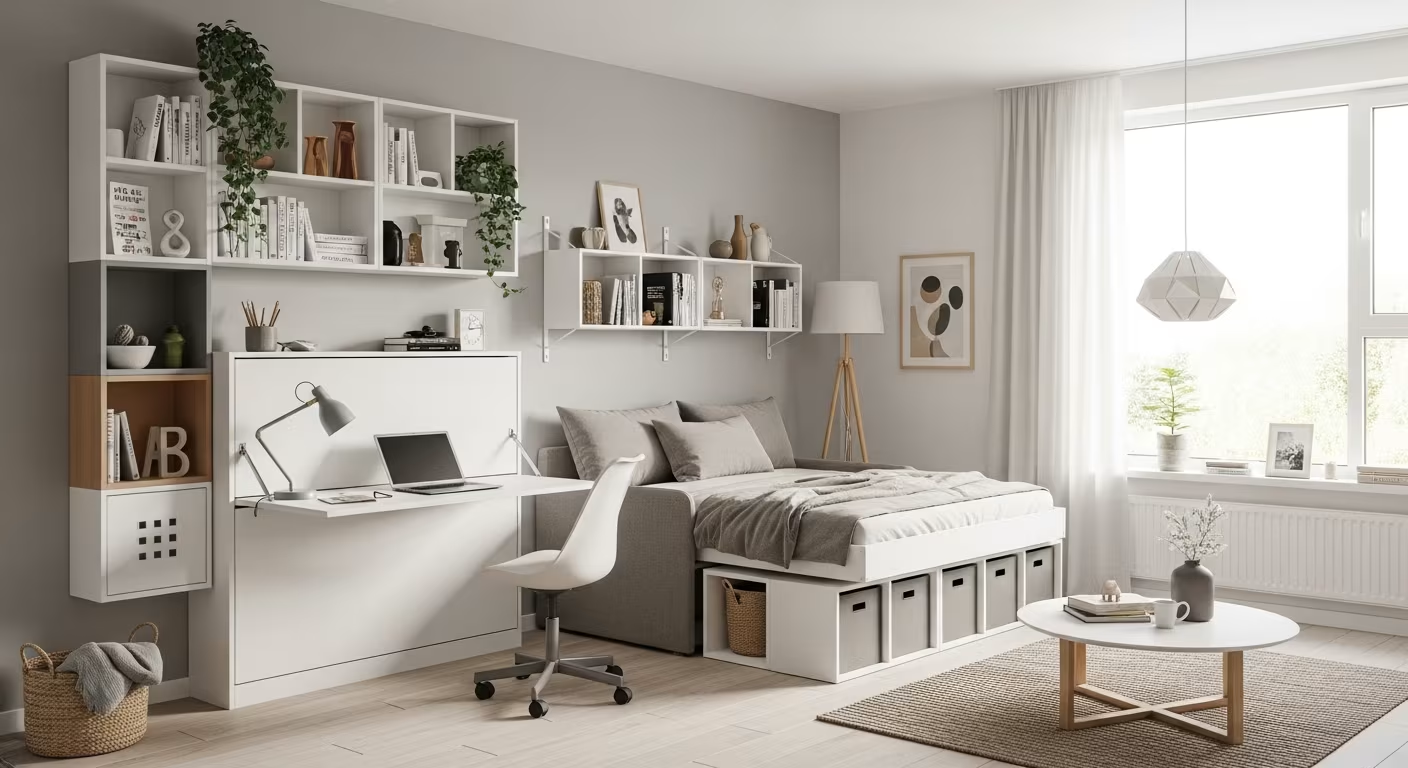
The most effective fix is a visible boundary between the two zones: a room divider, a separate rug under the desk, a different light for work than for winding down. Small end-of-day rituals reinforce it — closing the laptop, turning the desk chair to face away from the bed — and signal the shift from work to rest more clearly than simply stopping while the whole setup stays in view from the mattress. If nothing else, a cloth thrown over the monitor at night removes the most work-coded object in the room from sight.
Positioning helps as much as ritual. A desk placed so your back is to the bed while working, and so the bed is not the first thing you see from the desk, keeps the two functions from bleeding into each other. Where the room genuinely cannot hold both, a folding desk or a laptop on a small table that gets put away at day's end beats a permanent workstation staring at the pillow — the setup that disappears each evening lets the room go back to being only a bedroom, which is the whole point.
Scent and Sound at the Margins
Beyond light and clutter, scent and sound are two levers you can pull. A consistent scent tied only to bedtime — a particular essential oil, or a laundry product used just on the bedding — can become a cue the body learns to read as the start of sleep. The effect comes from the repetition, not from anything special about the specific smell; pick one and keep it consistent.
Sound runs from simple to elaborate. A basic fan or a white-noise source masks the irregular outside noises — a passing car, a door down the hall — that briefly lift you toward waking even when they do not fully wake you, and smoothing those out improves how continuous the night feels. A pair of foam earplugs does the same job even more completely for a couple of dollars and no equipment at all. None of this is exotic; it is a short, repeatable set of adjustments, and the room that gets them tends to be the room you sleep well in.
The two light decisions:
| Change | Spec | Why |
|---|---|---|
| Dedicated alarm | ~$15 clock | the phone leaves the bedside equation |
| One warm lamp | ~2700K bedside bulb | enough to read by, no ceiling blast |

Comments
No comments yet.