
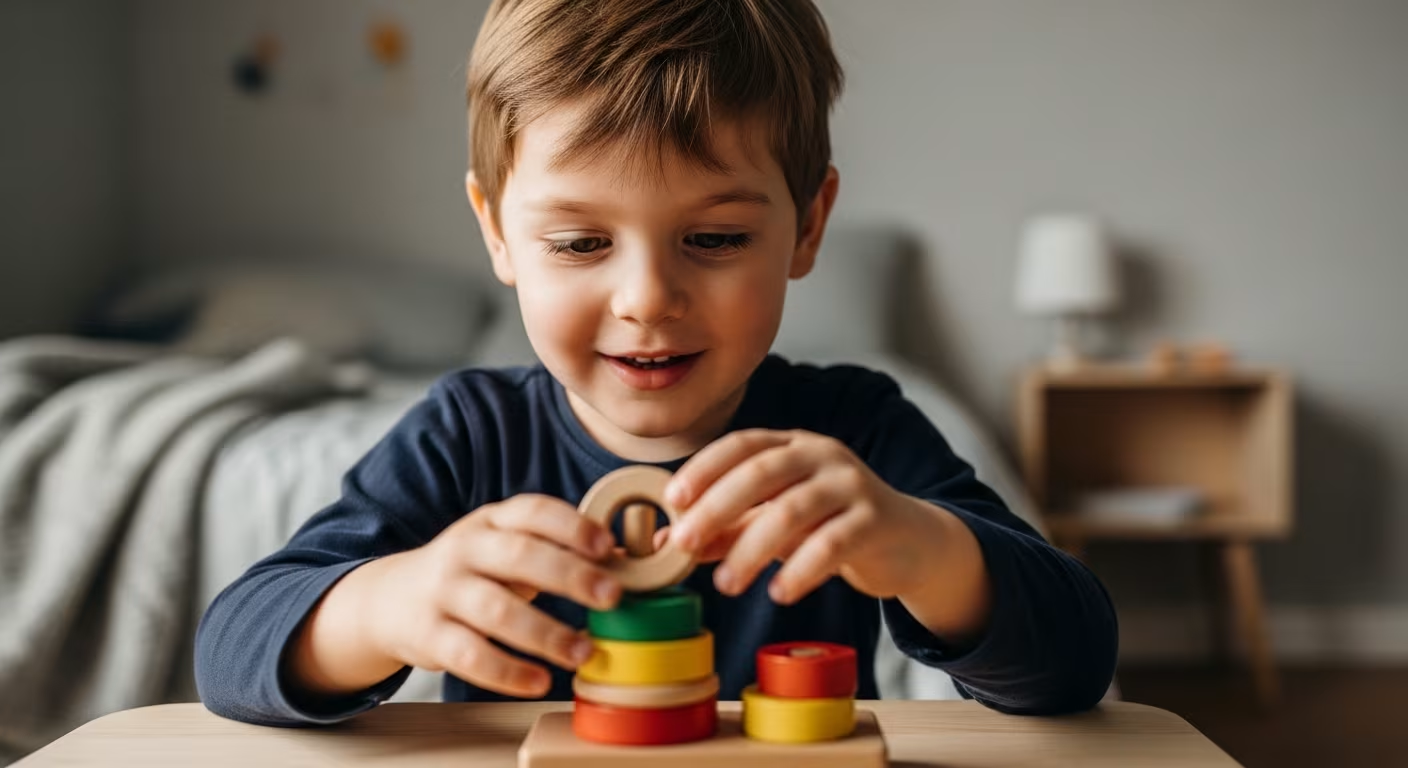

Walk into most children's rooms and the working assumption is visible on the shelves: more toys should mean more play. It is an intuitive idea and a wrong one. The child surrounded by thirty toys tends to flit between them, abandoning each after a minute or two, while the child with four in front of them will build, narrate, and rework a single game for a long stretch. The quantity is not helping the play — it is competing with it.
The likeliest explanation is attention. When a lot of options sit within reach, part of a child's focus stays busy scanning the alternatives instead of sinking fully into the toy in hand. Fewer choices let the whole of that focus land on one thing. This does not argue for a bare room; it argues that the reflex to add more is often working against the very absorption parents are hoping to buy.
You can watch the effect over a single afternoon. Clear the floor down to four or five things and a child will usually settle into a longer, more inventive stretch of play than the same child manages amid a full toy bin. The difference is not motivation or mood — it is the number of competing signals in the room, and that is something a parent can adjust directly.
Where All the Toys Come From
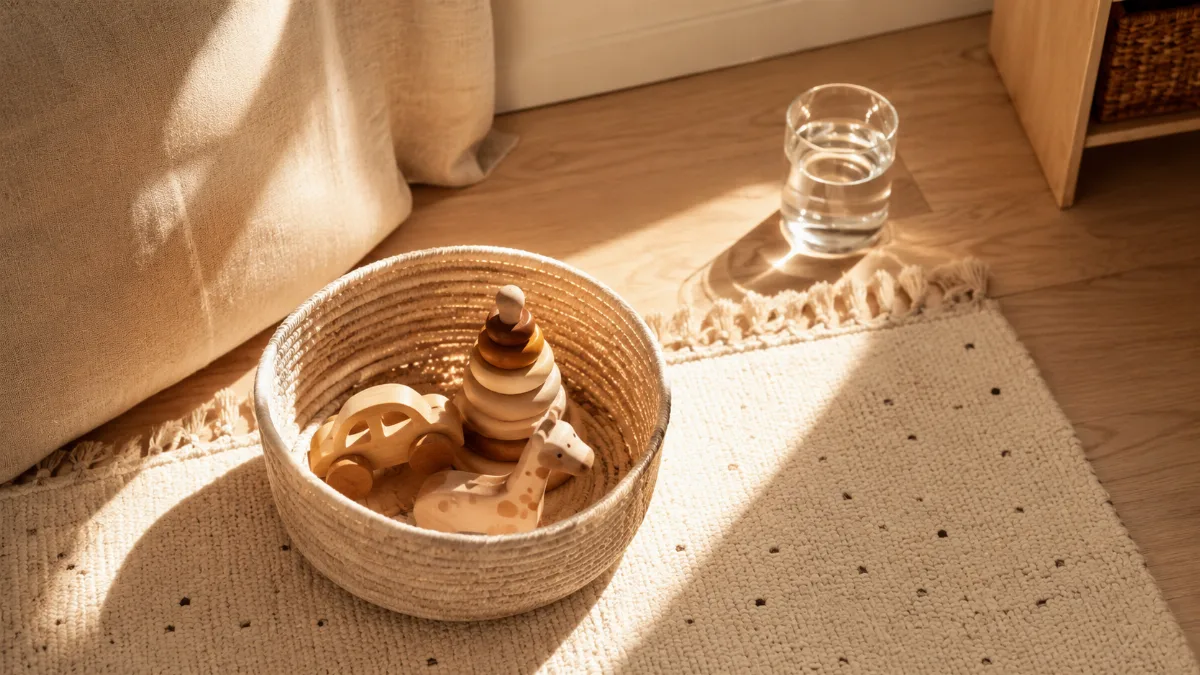
Toys arrive through more doors than any other category of household stuff. Birthdays and holidays are the obvious ones, but the steady drip matters more: grandparents on a Tuesday visit, a party favor bag from a classmate's celebration, a plastic figure tucked into a fast-food meal, a relative who spotted something on sale. A parent can be genuinely careful about their own purchases and still watch the collection swell, because most of the inflow is not theirs to control at the point of purchase.
The result is a familiar paradox. A room packed with options often produces a child who announces they are bored — not for lack of things but because the sheer volume makes settling on one difficult, and because a good share of what is there was never actively chosen. Nobody feels much attachment to the toy that simply showed up.
Managing that inflow is the real work, and it looks like managing any other accumulation: slow what comes in, regularly release what has stopped earning its place, and hold the collection at a size that serves actual play rather than representing every gift-giving occasion of the past two years.
Open-Ended Toys Versus Single-Use Toys
The single most useful lens for evaluating a toy collection is whether a given toy is open-ended or single-use. Open-ended toys support many kinds of play and stretch across years of development. Single-use toys do one thing, get used hard for a few weeks, and then go quiet on a shelf. A collection weighted toward the first kind stays alive far longer than one weighted toward the second.
The difference shows up over time. Wooden blocks used for stacking towers at age two become bridges and enclosed zoos at five and a working marble run at eight. A basket of art supplies produces scribbles at four and recognizable, deliberate work at seven. A licensed figure tied to one cartoon storyline, by contrast, tends to carry only that storyline, and when the child ages past the show, the toy is done.
| Type | Examples | Play lifespan | Drives accumulation? |
|---|---|---|---|
| Open-ended | Blocks, art supplies, dolls and figures, balls, dress-up, sand and water | Years, evolving with the child | Low — grows in use rather than being replaced |
| Single-use | Licensed character playsets, one-interaction electronic toys, fixed-function gadgets | Weeks to a few months | High — exhausted quickly, then more arrives |
None of this makes single-use toys forbidden. Some are genuinely beloved, and a child's favorite is a favorite for real reasons. But they are the engine of accumulation, because each one is used up and set aside while a replacement rolls in behind it. Knowing which category a toy falls into makes the keep-or-release decision far less murky.
Bring the Child Into the Decluttering
Children can take part in thinning the collection surprisingly early, and involving them pays off twice. It teaches a real decision — this stays, this goes to a younger cousin, this we no longer reach for — and it builds a more conscious relationship to belongings than the default of endless acquiring.
For younger children, sit down and do it together rather than presenting a fait accompli. Go through the bins alongside them, ask which ones they actually play with and which have gone untouched, and let them name the items to pass on. A child who helped decide may feel a brief pang over one specific toy; a child who comes home to find toys quietly removed feels something closer to betrayal, and remembers it.
Older children can handle the conversation head-on: the shelves hold more than can be organized or genuinely used, and they get to choose what stays. Handed real authority over the call, most school-age kids make more thoughtful choices than their parents expect — often paring back further than the adult would have dared to suggest.
The Grandparent Conversation
The people who give the most toys are frequently grandparents, which makes this one of the genuinely delicate parts of raising kids with less. They give generously because they adore the child, so a request for fewer or different gifts can land as a comment on the love behind them. Handled bluntly, it stings. It helps to cross-check ideas like these against MedlinePlus from the National Library of Medicine.
The framing that works points at the grandchild, not at the parents' storage. "She is completely obsessed with drawing right now — a set of good markers would be perfect" travels far better than "please stop giving so many toys." A specific suggestion anchored to a current, real interest redirects the generosity toward something the child will actually use, and it gives the grandparent a satisfying way to hit the mark.
Experiences are the other release valve. An afternoon outing together, a class in something the child is into, or a subscription to an ongoing activity are often welcomed warmly by grandparents who want to give something memorable and are perfectly open to an alternative — as long as the alternative is offered as a concrete idea rather than a vague preference.
What a Right-Sized Collection Makes Possible
Hold the collection at a sensible size — enough for genuine variety across categories, not so much that the room can't be tidied or a specific toy can't be found — and something practical opens up: an organization system simple enough for the child to run themselves.
When every toy has a home and the total fits the available bins and shelves, a child can take part in the cleanup. When the volume overflows the storage, or the system is too fiddly, tidying reverts to an adult job. Children develop a real capacity to reset their own space from around age three onward, but only if the setup is simple enough to succeed at. That self-sufficiency is the quiet payoff of a right-sized collection, and it compounds year after year. For the specific method of keeping that collection lively over time, see our guide to toy rotation systems for children.
Comments
No comments yet.