
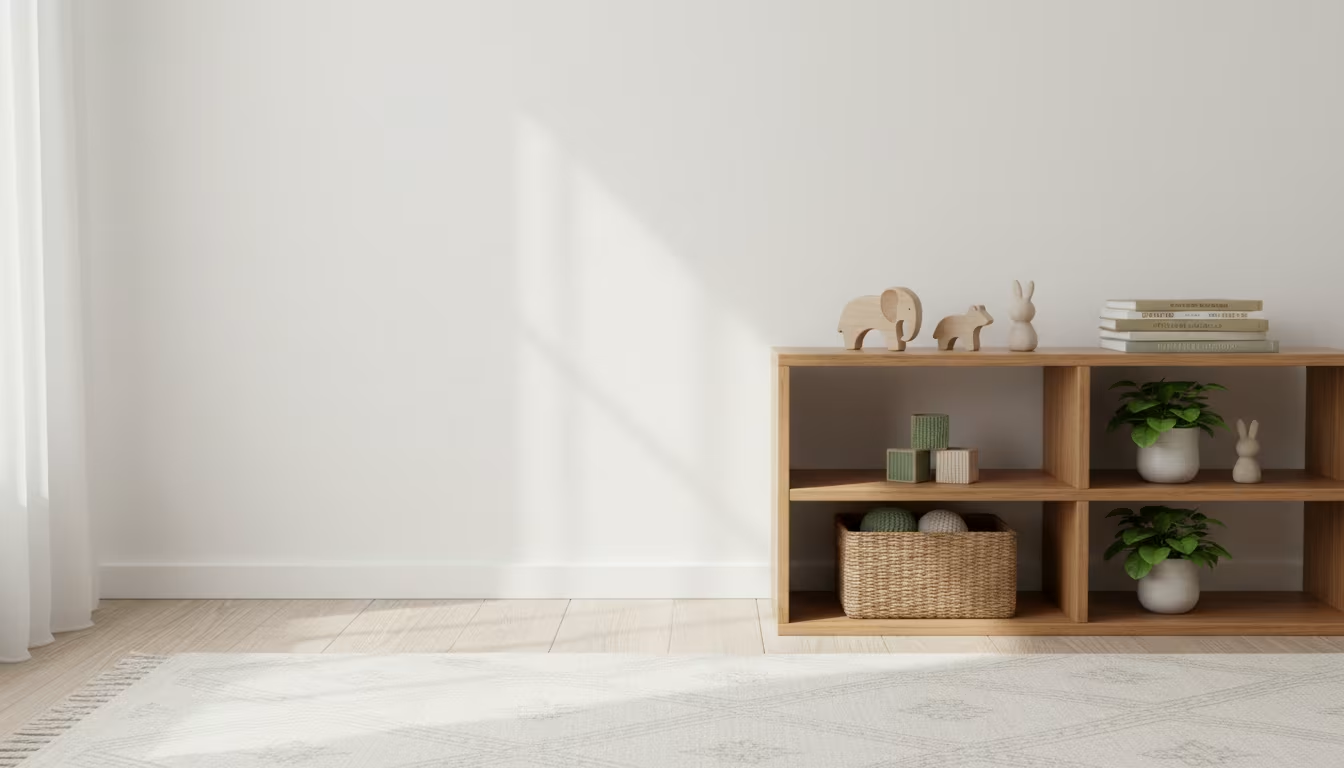

Slow parenting is not permissive parenting. It is not neglect, and it is not a retreat from ambition for your children. It is a deliberate choice to resist the cultural pull toward constant activity, wall-to-wall scheduling, and optimized development — in favor of something that looks less impressive from the outside and tends to work better on the inside.
What Slow Parenting Actually Is
The core idea is straightforward: children develop better when they have time that is not accounted for. Time to be bored, to play without a director, to follow their own curiosity, to make a mistake without an adult stepping in to correct it. The overscheduled child — moving from school to activity to homework to activity with no unstructured gap — is not getting more development out of the day. Often they are getting less, because the traits that drive real development (self-direction, creative problem-solving, internal motivation) can only be practiced in unstructured time.
Slow parenting is the practice of protecting that time even when the culture around you is busy filling it. It is a position, not an absence of one, and holding it deliberately is what separates it from simply having a quiet week by accident.
The Cost of Over-Scheduling
The heavily scheduled childhood looks impressive from the outside: soccer, piano, an academic enrichment program, a language class, a coding camp over the summer. Parents who provide all of this are working from a reasonable intuition — more exposure, more practice, more experience should add up to better outcomes.
The trouble is that the intuition doesn't hold as cleanly as it feels like it should. Children with more unstructured time tend to build stronger internal motivation, more flexible creative thinking, and steadier self-regulation than children whose hours are continuously managed. The reason is not mysterious. Self-regulation and self-direction are practiced skills, and they can only be practiced when no one is directing. A calendar with no empty squares removes the very conditions those skills need.
Over-scheduling also produces a specific kind of fatigue. It shows up in children who cannot occupy themselves, who announce they are bored within minutes of free time appearing, and who struggle to start anything that an adult hasn't handed them. Those are not the signs of abundant stimulation producing a robust child. They are the signs of a capacity for self-direction that was never given room to build. You can find authoritative guidance on this from KidsHealth from Nemours.
How It Differs From Permissive Parenting
Slow parenting involves clear structure, consistent expectations, and genuine involvement. What it leaves out is the compulsion to fill every hour with organized activity or to manage the child's experience minute by minute in the name of development.
The slow-parenting household still has bedtimes, chores, table manners, and deliberate family time. It simply also has long stretches where the child is free to run their own hours without a parent programming them. That is why the label is sometimes misread as underparenting. It isn't. It is a different theory of what effective parenting looks like — one that prioritizes the conditions under which development happens over the accumulation of activities that look like development from the sidelines.
A Slow Week, in Concrete Terms

In practice, slow parenting means one or two meaningful structured activities per child per week instead of four or five. It means real unscheduled time built into most days, meals eaten without devices and without hurry, and a weekend that keeps genuinely unplanned hours rather than being booked solid from breakfast on.
Consider a common starting point: three children, four activities each, spread across the week. That is twelve weekly commitments, each with a drop-off and a pickup, some with equipment to pack and a fee to keep current. A single youth sports season can run well over a hundred dollars in registration before uniforms and travel, and a weekly music lesson often lands in the twenty-to-forty-dollar range per session. Multiply that across children and activities and the household is carrying a four-figure annual cost and several evenings a week that belong to the car.
The slow version keeps the one or two activities each child actually cares about and lets the rest go. An unstructured afternoon is the fundamental unit here — a stretch of two or three hours with nothing scheduled in it. A child who gets several of these a week across childhood is receiving something that cannot be manufactured by adding one more class to an already full calendar. Treating a lighter week as a success rather than a failure of provision is the mental shift that makes the whole approach hold.
Described as a schedule rather than a philosophy, a slow week has a specific shape:
| Element | Slow week | Typical full week |
|---|---|---|
| Structured activities | 1 to 2 | 4 to 6 |
| Free afternoons | 3 or more | 0 to 1 |
| Evening commitments | 1 maximum | 3 to 4 |
| Weekend plans | 1 per day | 2 to 3 per day |
| Family meals together | 4 or more | 1 to 2 |
| Unscheduled child-led play | 1 hour daily | Whatever is left |
The row that produces the rest is free afternoons. Once three afternoons are genuinely unbooked, the family meals and the child-led play appear without being scheduled, because the time exists. Trying to schedule the bottom two rows while the top two stay unchanged is the version that does not work.
The Resistance You Will Face
Slow parenting runs against the dominant current wherever competitive parenting norms are strong. The family that keeps fewer activities on the board will meet, sooner or later, the implicit or explicit suggestion that they are not doing enough. It can come from other parents at the school gate, from relatives, or from the simple discomfort of watching a neighbor's child collect another trophy.
That pressure is real and worth naming rather than pretending it away. It is also worth having a clear answer ready: the leaner schedule is not laziness or a lack of investment but a considered position about what children actually need to develop well. Having thought the rationale through in advance makes the pressure far easier to absorb without quietly abandoning the plan the first time someone raises an eyebrow.
Children raise their own resistance too, especially early on. In the first weeks of a lighter schedule they may report being bored and complain that there is nothing to do. That is a predictable stage of the transition, not evidence that the approach is failing. The capacity for self-directed play rebuilds gradually, and it only rebuilds when the child is given consistent, repeated space to practice it.
The resistance arrives from three directions and each has a different answer. From other parents, usually as a comparison about what other children are doing — the useful response is factual rather than defensive: this is what our week holds, and it works for us. From the child, in the first fortnight, as boredom that reads like an argument for filling the time; it typically resolves within 2 to 3 weeks once self-directed play re-establishes. And from yourself, as the suspicion that unused time is wasted potential.
The last one is the hardest and the most worth naming. The discomfort of watching a child do nothing in particular is an adult problem, not a developmental one, and it is what most often ends a slow week in its third week.
The Long View on Development
The child who grows up with adequate unstructured time, enough sleep, and a household pace that leaves room for genuine rest tends to arrive at adulthood with something that is genuinely hard to retrofit later: the ability to sit still, to direct themselves, and to generate motivation from within rather than waiting for the next external prompt.
Those qualities are not produced by adding more to a schedule. They are produced by protecting the conditions in which they grow on their own — which, more often than the culture admits, means doing less than you are told you should. Slow parenting is not the child doing nothing. It is trusting that a child with enough free time will do roughly what they need to do, and that this serves them better over a lifetime than the optimized, activity-packed childhood that photographs so well in the short term.
It helps to remember that the skills a packed schedule is meant to build are frequently the ones it crowds out. A child enrolled in a coding camp learns some coding; a child left with a free afternoon and a box of odds and ends learns to invent a project, hit a wall, and work around it without an instructor to smooth the path. Both matter, but only one of them is scarce. Structured instruction is available everywhere and can be added at almost any age. The habit of self-directed engagement is far harder to install later, and it forms mainly in the empty hours that a maximalist schedule treats as waste.
The Household Benefits Beyond Development

The case for slow parenting is usually made in terms of the child. But there are household benefits that need no developmental argument at all. A less-scheduled week is a cheaper week — the registration fees, the equipment, the uniforms, the gas — and those costs disappear the moment the schedule shrinks.
A less-scheduled week is also a less exhausted one for the adults running it. The driving, the waiting in parking lots, the coordination between two working parents and three calendars, the gear that has to be washed and repacked: these are real time and energy costs that compound across a year. A single weeknight activity across town can swallow ninety minutes of an adult's evening once travel and waiting are counted, and stacked several times a week it consumes the exact window in which a family might otherwise eat together or simply be in the same room. Parents who cut the schedule back consistently report having more energy left for the thing the activities were supposedly protecting — the present, unhurried time with their children that a packed calendar quietly crowds out.
Starting Slower Than You Think You Need To
The instinct when adopting these ideas is to taper gently: drop one activity, watch how it goes, reassess in a month. That is a reasonable approach, and it also tends to underestimate how deeply accumulated over-scheduling has shaped the household's daily rhythm.
Families that make a sharp reduction — from four activities per child down to one — often describe the first couple of weeks as strange, as though something is missing. Then an unexpected relief settles in. The pace changes. Evenings open up. The children protest, then find their own rhythm within days. The pace you land on after that reduction becomes the new baseline, and from a calmer baseline it is far easier to judge which activities are genuinely worth adding back and which were only ever there out of habit or pressure. Start by cutting more than feels comfortable; you can always add one thing back, and from the quiet side of the change you will actually be able to tell whether it belongs.


Comments
No comments yet.