

What Swedish Death Cleaning Actually Is
Döstädning, the Swedish word that translates roughly to "death cleaning," is the practice of systematically going through your possessions and removing what you no longer use, specifically so that your family isn't left to do it after you are gone. The concept was popularized by Margareta Magnusson, who wrote about it as a natural and practical act of consideration for the people you will leave behind.
The name sounds morbid, but the practice is not. It is a deliberate, ongoing process of keeping only what is genuinely used and loved and removing what has accumulated without intention. The motivation is care for others rather than personal aesthetic preference, which gives it a different quality than decluttering for its own sake — every decision is framed around someone else rather than around a photograph of an empty room. It is worth separating the method from its unsettling name: nothing about it requires dwelling on mortality day to day. In practice it looks like ordinary, unhurried tidying with a clearer filter for what earns a place.
Young families are not the obvious audience. It was described and received largely as a practice for older adults managing decades of accumulated possessions. But the logic applies just as well at thirty as at seventy, and the families that start early have a real advantage: they have less to sort, fewer sentimental complications, and the chance to build the habit of regular editing before possessions pile up to an unmanageable level.
The Guiding Question Behind the Method
The practical test that drives Swedish death cleaning is one specific question: would the people left after you are gone want to deal with this item? Not "is this useful to me" or "does this bring joy," but "would this be a burden to the people I love?" It is a colder question than the usual decluttering prompts, and it cuts through indecision faster because it removes you as the person who benefits.
Applied consistently, it eliminates a different category of object than other frameworks do. Things that are marginally useful but not particularly wanted by anyone — the duplicate appliances, the outdated electronics, the items kept out of guilt, the paperwork from three jobs ago — answer the question clearly. The answer is no. They would become someone else's sorting problem, most likely during an already difficult week.
For young families, the question also clarifies decisions about children's items. Keeping every drawing, every school project, every childhood artifact is understandable, and over time it is also the accumulation of a large, emotionally complicated sorting task for someone else. Selecting a meaningful subset — a single box per child per year, for instance — honors the impulse to preserve without building the burden.
Starting the Process With a Family
Swedish death cleaning in a family works differently than solo decluttering. The starting point is a conversation between partners about the goal and the scope: not a single weekend project but an ongoing practice that moves one category at a time, at a pace that stays sustainable across months rather than burning out in a weekend.
The categories that are easiest to start with share one trait — low emotional weight:
- Papers and documents more than three years old that no longer carry legal or sentimental relevance
- Duplicate kitchen items: utensils, appliances, and serving pieces not used in two years
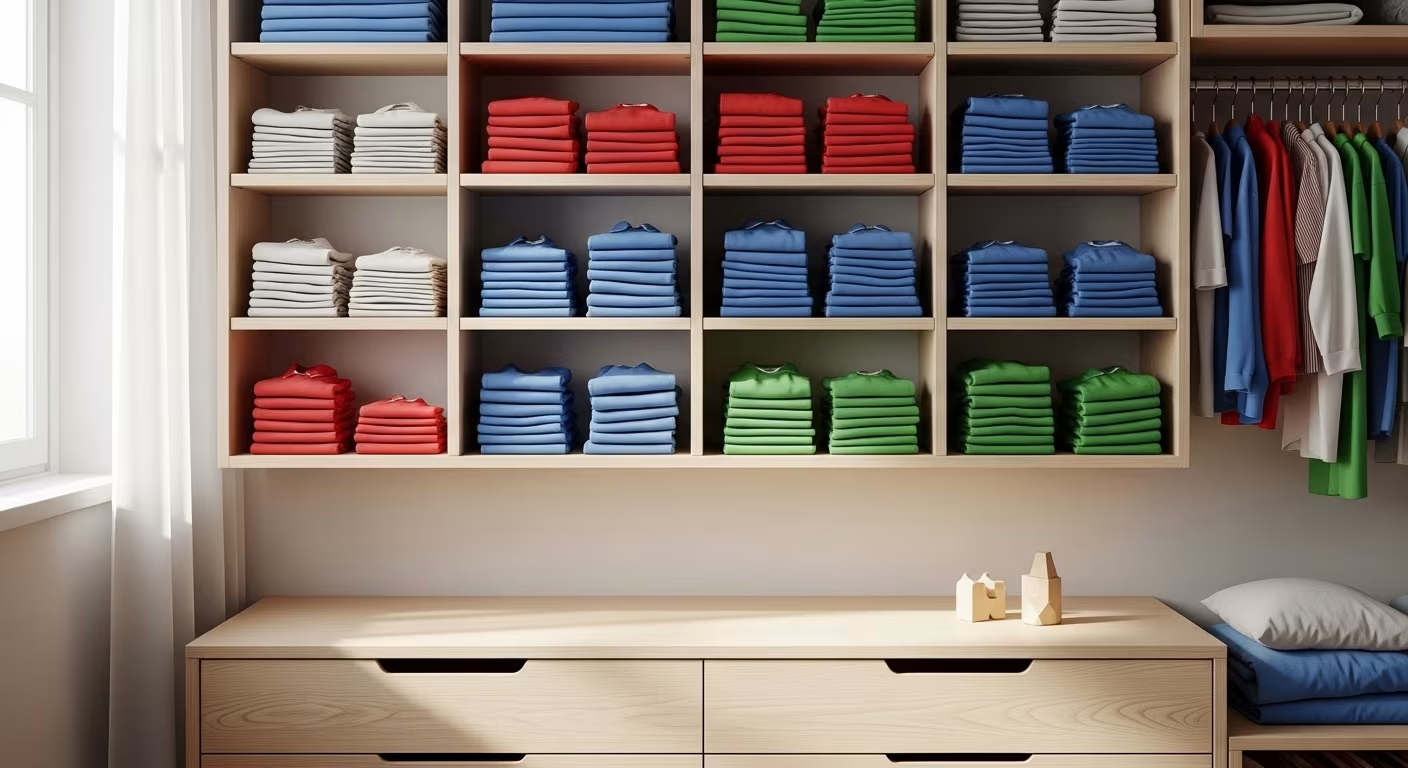
- Clothing no longer worn, in sizes that no longer fit anyone in the household
- Gifts that were received but never used and are unlikely to be
Starting here builds the decision-making habit before you reach the harder categories. Family photographs, children's artwork, and heirlooms are far easier to handle once you have already made a hundred straightforward keep-or-release calls on things that carried no feeling at all.
What to Do With Things You Remove
The removal step is where many efforts stall, because a pile of things to deal with is its own kind of clutter. Items that are clearly usable but no longer needed benefit from going somewhere useful rather than into a landfill. For furniture, clothing, and kitchen items in good condition, local charity resale shops or community groups let things go directly to people who need them. Much of this echoes the CPSC's home safety guides.
The Scandinavian approach leans toward giving things straight to a person who can use them rather than through institutional channels — there is something more personal in knowing a specific item went to a specific home. For items of potential value, hold a single sale event or listing session with a defined end point: the item either sells by a set date or is donated. Handling one category at a time, the same way you sorted it, keeps this from turning into an open-ended list of things to sell that drags on for months. And for genuinely worn-out items, dispose of them without guilt — keeping a worn-out thing because throwing it away feels wasteful just passes the same disposal to whoever sorts your possessions later.
Sorting the outflow by destination before the session ends is what stops it from returning. Family and friends get first refusal, but with a deadline — 2 weeks, after which the item moves on. Charity shops take clothing, books, kitchen items and small furniture in working condition. Specialist charities take specific categories: animal shelters take towels and blankets, schools take craft supplies and instruments, tool libraries take working hand tools.
Two categories need their own handling and are the ones that stall the process. Paperwork: keep tax records for the period your jurisdiction requires (often 5 to 7 years), shred anything with account numbers or identifiers, and recycle the rest. Photographs: scan at 300 to 600 dpi before deciding on the originals, because the decision becomes much easier once the image is safe.
Building It Into Regular Life
The version that stays sustainable for a young family is not an annual major project but a background orientation — a habit of evaluating items when natural moments arise rather than a scheduled event on the calendar.
When something new comes into the home, something comparable leaves. When the children move up a clothing size, the outgrown items leave that same week. When an appliance is replaced, the old one goes immediately instead of waiting in storage. When an unwanted gift arrives, it is redirected promptly rather than stored out of obligation. Each of these small decisions is a death-cleaning moment, and none of them requires a Saturday. Collectively they prevent the accumulation that makes the eventual sorting — triggered by a move, a loss, or simply the wish for a calmer home — feel overwhelming.
The advantage for a young family compounds over time. A decision made now, with two adults and a couple of children's worth of belongings, is a decision that doesn't have to be made in twenty years across a full and crowded house. Starting early doesn't only spread the work out; it means there is dramatically less work to spread in the first place.
Applying It to Inherited Possessions
One category the method addresses head-on is inherited items: objects that arrived from parents or grandparents and were kept out of obligation or grief rather than use or appreciation. These are emotionally the hardest to evaluate and often the most burdensome to store — a full set of china, a cabinet's worth of ornaments, boxes never opened since they arrived.
The distinction the method draws is clean: an item can be kept because it is genuinely used and valued, or it can be released because the person it came from is honored in memory rather than in the object. A grandmother's entire china set sitting unused in boxes is storage of obligation; one piece from that set, used at occasional dinners, is a genuine connection to her. For families with children, this framing teaches well — keeping a few meaningful pieces from the previous generation and explaining why they matter creates more connection than keeping everything and explaining none of it. The one-category-at-a-time approach keeps even this hard work from stalling.
When to Schedule the Review
Once a year is the cadence that suits most families: a deliberate review of possessions, category by category, to identify what can leave. The timing that tends to work is early spring, when a change of season makes the task feel timely, or autumn before the holidays, when a wave of new items is about to arrive.
A useful annual sequence runs clothing and linens first, since seasonal changes make the relevant items visible, then kitchen and household goods, then children's items, then papers and stored boxes. Spread across four to six weeks, the whole sequence is manageable. Attempting every category in a single weekend usually produces stalled decisions and half-filled boxes that sit in the hallway — the opposite of the calm the practice is meant to create. Whatever season you choose, put the review on the calendar as a recurring commitment rather than a good intention; like a donation run or a dentist appointment, the practice survives on being scheduled.
Attaching the review to events that already exist works better than choosing a date. The natural triggers: a house move, a child changing school stage, a birth, a bereavement in the wider family, a renovation, or the end of a lease. Each of these already forces a look at what you own.
Without a trigger, an annual pass in the same month each year is enough for a young family, running 2 to 3 hours across a weekend rather than a single long session. The categories that change fastest — children's clothing, toys, paperwork, kitchen equipment — deserve the time; furniture and books rarely need annual attention and can run on a 3 to 5 year cycle.
Death-cleaning numbers for young families:
| Item | Rule |
|---|---|
| Family first refusal | 2-week deadline, then it moves on |
| Tax paperwork | keep 5–7 years (check your jurisdiction), shred account numbers |
| Photos | scan at 300–600 dpi BEFORE deciding on originals |
| Cadence | annual pass, same month, 2–3 hours total |
Comments
No comments yet.