

What Children Actually Remember
Ask an adult about childhood and the stories that come back are almost never about objects. It's the camping trip where the rain drove everyone into one tent, the summer of a particular game with impossible rules, the afternoon a grandparent taught them something with their hands. The specific toy received at age seven is usually gone from memory entirely.
That gap is worth taking seriously, because it sits between what adults tend to buy for children — a lot of things — and what children actually carry forward as meaningful. Closing it doesn't take a dramatic overhaul. It takes some deliberate redirection of where attention and money go, and a home environment that makes experiences the easy default rather than the rare exception.
Why Kids Ask for Things
Children ask for toys and gadgets because that's what's visible, advertised, and held by the kids around them. The wanting is real — but it's also responsive to environment. A child whose world is saturated with things, whose reflex when bored is to acquire something new, keeps asking for things because that's the pattern the surroundings have taught.
A child who has learned that boredom leads somewhere interesting — that an afternoon at the park, or cooking together, or building a fort leaves them more satisfied than another toy — develops a different internal appetite. That reorientation isn't about refusing things or preaching about possessions. It's about giving experiences enough space and frequency that they become the reference point a child measures a good day against.
Model the Trade-Off Out Loud
Children learn from watching adults decide and hearing the reasoning behind it. When a parent says, "We could buy that, or we could put the money toward the botanical garden on Saturday — I think the garden's more fun," and then actually goes, the child sees the trade-off happen in real time rather than hearing it as a rule.
This doesn't need to run constantly. A few well-placed moments where the choice is visible and the result is good outperform a running commentary on consumer values. The one requirement is that the chosen experience genuinely delivers: a great afternoon at the garden makes the case better than any explanation, and a dull one undercuts it. The demonstration has to land, so pick experiences you're fairly confident will be worth it.
It helps to make the trade-off tangible rather than abstract. "That toy is about twenty dollars — the same as the movie tickets we could use instead" gives a child something concrete to weigh, and older kids can even be handed the decision: here's the amount, would you rather have the thing or the outing? A child who chooses the outing and has a genuinely good time has learned something no lecture delivers, and a child who chooses the thing and finds it forgotten in a week has learned it just as clearly. Either result teaches, as long as the choice was real and the money was actually the same.
Shift the Gifting Culture
Birthday and holiday gifts from relatives pile up faster than most children can meaningfully engage with them. The sheer volume often flattens the value of each item — when fifteen new things arrive at once, none of them gets the sustained attention that turns into real enjoyment. Two or three well-chosen gifts frequently produce more play than a mountain of them.
Some families ask extended relatives to lean toward experience gifts: a museum or zoo membership, tickets to a show or a game, a class in something the child is curious about, or a contribution toward a planned trip. The reaction from grandparents is often warmer than expected — plenty of adults would rather give an outing they can share in than add another object to the pile. And even when the wider gifting culture doesn't budge, the home can still shift: the parents' own gifts and the household's everyday spending can favor experiences on purpose, which models the value regardless of what arrives from outside.
Changing what relatives give works better with a specific request than a general principle. Concrete alternatives that land well: a contribution to a savings account, membership to a zoo, museum or pool for the year, a class or lesson block, tickets to something you will attend together, a subscription to a magazine the child chooses, or an annual outing that becomes a tradition with that relative.
The phrasing matters more than the list. "We're trying to keep the toy count down — would you consider a zoo membership instead?" gives a specific alternative and a reason, which is easier to accept than a rule about what not to buy. Grandparents in particular respond to being offered a role rather than a restriction, and a membership they are named on gives them one.
Give Boredom Some Room
The instinct to fill every gap in a child's day — with activities, screens, or things — works against the development of an inner life that finds experiences rewarding. A child who is always externally stimulated never gets the chance to discover what they're curious about on their own. For more detail, it is worth checking Harvard's Center on the Developing Child.
Unstructured time is where interest actually forms. The afternoon with nothing planned that becomes an hour of building something strange in the backyard, a homemade game with invented rules, an extended conversation about a topic that suddenly grabs them — those stretches produce memory and meaning in a way a scheduled activity often can't. Tolerating boredom without instantly resolving it is the whole mechanism. Most children, given twenty to thirty minutes of genuinely unoccupied time, land on something to do, and what they find tends to be more absorbed and imaginative than anything handed to them.
The hard part is the parental urge to rescue. The first ten minutes of unoccupied time often look like complaint — "I'm bored, there's nothing to do" — and the reflex is to fix it with a screen or a suggestion. Sitting through that stretch without solving it is the actual work. "I know, being bored is a strange feeling. See what you come up with" hands the problem back where it belongs. The boredom that gets instantly filled never has the chance to turn into anything; the boredom that's left alone is what becomes the fort, the game, the sudden fascination with how something works.
Experiences Don't Have to Cost Much
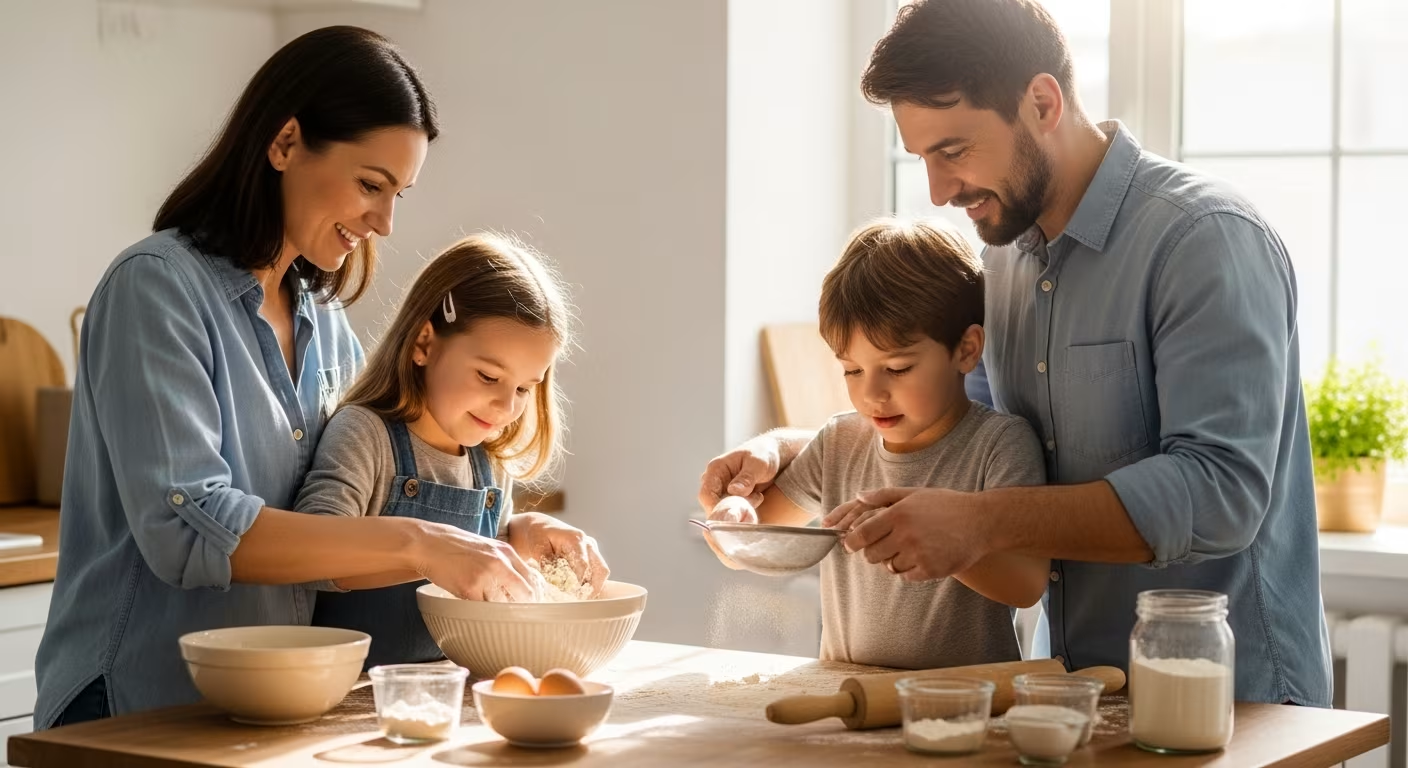
A common misread of experiences-over-things is that it means expensive travel and elaborate outings. It doesn't. The experiences that produce memory are usually close and cheap: a picnic in a park, learning to bake bread together, a long afternoon at a free museum, a night camping in the backyard.
What makes any of these stick isn't the price tag — it's the novelty, the undivided attention, and the sense of doing something together without a screen or a clock in the way. A free afternoon of real engagement outlasts an expensive one spent mostly on phones. That same quality is available daily at the table; see how reducing screen time at family dinners creates more of that space on ordinary nights.
The list of experiences children reliably remember is unhelpfully cheap, which is inconvenient for anyone who assumed otherwise. Free or near-free: library events and story times, public parks and nature reserves, a museum on a free-entry day, cooking something together, camping in the garden, a bike ride to somewhere you have not been, a bus journey with no destination, feeding ducks, building something from cardboard.
Under about $20 for a family: a swimming session, a cinema matinee, ingredients for a baking afternoon, a day-pass at a local pool, seeds and a pot each. What these have in common is not the price — it is that an adult is present and participating rather than supervising, which is the variable children actually register.
What to Say in the Moment
The everyday "Can I have that?" doesn't call for a lecture on consumer values — it calls for a short, honest answer delivered without drama. "Not today" covers most situations. "We have what we need at home" works for others. "Let's do something instead" reframes the moment without turning the object into the enemy. None of these require explaining why experiences matter more than things; the pattern of responses, repeated calmly over time, communicates the value without the speech.
The moments that do warrant more are the ones where a specific experience can stand in as a concrete alternative — not "let's not buy that," but "let's go to the park this afternoon instead." And then the experience has to actually happen. An unkept promise to do something in place of a purchase is worse than a plain no, because it teaches the child that the alternative was never real.
Handling the Pressure You Can't Remove
The advertising ecosystem aimed at children is built to manufacture desire for things. Screen time, trips to stores, comparisons with peers — all of it generates wanting that the home has to absorb. You can dial some of these inputs down deliberately, but you can't switch them off, and pretending otherwise just sets everyone up for frustration.
What you can do is name the mechanism when it's in front of you. "That commercial is trying to make you want to buy something" is a genuinely useful observation for a child old enough to follow it — not because it grants immunity, but because it hands the child a frame for their own reaction. Wanting something you just saw advertised is completely normal; it's also not the same as a considered preference for something that would actually add to your life. A child who can feel that difference, even a little, is better equipped than one who's simply told no. Try naming it out loud the next time an ad lands, and let the child draw the line themselves.
Under-$20 memory makers:
| Experience | Note |
|---|---|
| Swimming session / cinema matinee | the family versions |
| A baking afternoon | ingredients ARE the gift |
| The insight | adults remember the rained-out tent, never the toy from age seven |
Comments
No comments yet.