

A good-enough dinner on the table by 6:45 does more work for a household than an impressive dinner that gets abandoned at 7:30 for a delivery order. On an ordinary weeknight — after work, after pickup, after whatever knocked the afternoon off schedule — dinner is a logistics problem with a 30-to-45-minute window, not the creative project it can be on a slow Sunday. Treating it as the same task is where the pressure comes from.
"Done is better than perfect" is not a lowering of standards here. It is a switch to a standard that actually fits the constraint. The meal that gets cooked and eaten five nights a week is doing more nutritional, financial, and routine work than the ambitious meal attempted once and replaced by takeout the other four.
What Good Enough Looks Like on a Tuesday
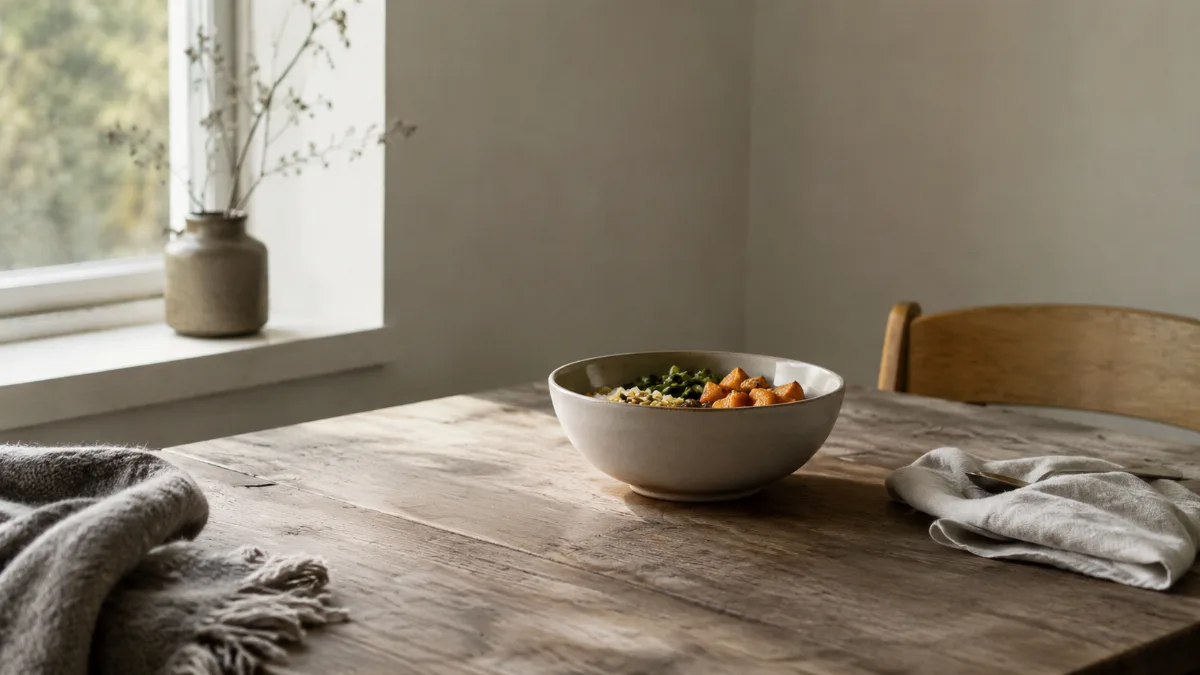
Good enough means edible, reasonably balanced, and on the table without a fight. It does not mean scrambled eggs every night, though eggs and toast is a real dinner. It means the question you answer is "did we eat a home-cooked meal," not "did we eat an interesting one."
The engine that makes this repeatable is a rotation of eight to ten meals the household can cook without a recipe, built from ingredients the pantry reliably holds. Think a sheet-pan chicken thighs and vegetables, a pasta with jarred sauce dressed up with garlic and frozen spinach, rice-and-beans bowls, a stir-fry over frozen vegetables, tacos from a pound of ground turkey. None of these takes more than 35 minutes, and every one survives a distracted cook. Much of this echoes the FoodKeeper storage guidance from FoodSafety.gov.
The rotation asks for less planning than cooking freestyle, not more, because the decisions are already made. On a given night you are not choosing from every meal that exists — you are choosing from a short list of things that are fast, familiar, and stocked. Variety lives in the details: a different vegetable in the pasta depending on the season, a new sauce on the same grain bowl, chicken one week and chickpeas the next. The base stays boring on purpose.
Letting Go of the Variety Rule
Much weeknight stress traces to a quiet belief that eating the same meals repeatedly is a failure. Variety is pleasant, but it is not a nutritional requirement, and chasing it on a busy night produces the worst outcome available: a complicated new dish that goes sideways at 6:30 and ends with everyone eating cereal.
Children in particular lean toward familiar food. A household of three kids eating reliably from a ten-meal rotation is getting better nutrition than one that cooks something exciting twice a week and orders pizza the rest of the time. There is also a competence dividend. The first time you make a given pasta it is fine; the fifteenth time it is genuinely good, because each round you adjusted one thing — a little more garlic, two minutes less on the heat, a shape that holds the sauce better. Repetition quietly turns decent cooks into reliable ones.
The Tools and the Budget That Follow

A few tools cut the friction directly. A half-sheet pan turns protein and vegetables into a hands-off meal: load it, set a timer, walk away. A slow cooker or multicooker (a 6-quart model runs roughly $60 to $100) finishes dinner over the afternoon with no attention during it. A large stockpot makes Sunday batch cooking possible — one pot of chili or a big tray of baked pasta covers two or three weeknights. None of these are required. Each one removes decisions and active minutes from the hour you have the least of both.
The rotation pays off at the register too. When you cook the same meals week after week, you know exactly what the staples are and buy them in the cheaper quantities — a big bag of dried pasta, large cans of tomatoes, a family pack of chicken thighs portioned into the freezer. A household that cooks unpredictably buys small, expensive, last-minute amounts because it can't forecast next week. A stable rotation buys to actual use, which is almost always cheaper per unit, and it trims shopping time at the same time.
Planning for the Nights Nothing Works

Even a good system has bad nights: the chicken you forgot to defrost, the meeting that ran two hours long, the kid who has decided overnight that they no longer eat a food they liked last week. The move on those nights is not to rescue the plan. It is to reach for a defined fallback that doesn't register as failure — pasta with olive oil and parmesan, eggs and toast, a quesadilla and an apple, a can of good soup with bread.

Naming the fallback in advance removes the decision from exactly the moment your capacity to decide is lowest. Over a year, the household that cooks at home five or six nights a week — imperfectly, from a short list, with a soup-and-bread tier for the worst days — comes out ahead of the one that cooks beautifully twice a week and orders in the rest. Pick your ten meals this week, write down the two-minute fallback, and let the consistency do the compounding. If you want a structure that organizes the rotation further, assigning each weeknight a loose theme makes the choosing even smaller.
The weeknight rules:
| Rule | Number | Why |
|---|---|---|
| Time ceiling | nothing over 35 minutes | every dish survives a distracted cook |
| The target | on the table by 6:45 | good-enough beats abandoned-impressive |
| Set-and-forget option | 6-qt slow/multicooker, $60–$100 | afternoon cooks itself |
| Variety | pleasant, not required | chasing it on busy nights produces the worst outcome |

Comments
No comments yet.