


Decision fatigue isn't a figure of speech. It's a documented pattern in psychology: the quality of your choices degrades as the number of choices you've already made piles up through the day. Roy Baumeister's research on ego depletion put the idea on the map, and while some of the strongest early claims have been debated since, the everyday version is familiar to anyone who has stood in front of an open refrigerator at 5:30 p.m. with no idea what to cook. By late afternoon — precisely when most households have to answer "what's for dinner" — the part of the brain that handles deliberate decisions is running low.
One of the most-cited illustrations comes from a 2011 study of judicial parole rulings in Israel, where favorable decisions fell from roughly two-thirds of cases early in a session toward almost none right before a meal break, then rebounded once the judges had eaten. Whatever the exact mechanism, the shape is consistent: decisions made late, tired, and hungry are worse than the same decisions made early and rested. Dinner is the household decision most reliably scheduled for the worst possible moment.
Why the Easiest Dinner Wins at 5:30
A parent arriving home on a weekday has already spent the day's decision budget — at work, in traffic, on a dozen small logistics calls. The dinner that actually gets made in that state isn't the most nutritious or the most economical one. It's the one that demands the least deliberation: takeout, pasta with jarred sauce, cereal for everyone. Not because the skills or the ingredients are missing, but because the decision to cook something better can't be assembled from what's left in the tank.
This is the trap minimalist meal planning is built to escape. The problem was never a shortage of recipes. It was being asked to choose at the exact hour you're least equipped to. Most people respond to that pressure by trying harder — pinning more recipes, buying another cookbook, resolving to be more organized next week. None of that touches the actual mechanism, which is timing. You can own a hundred dinner ideas and still order pizza on a Wednesday, because the barrier at 5:30 isn't a lack of options. It's the depleted capacity to pick one and commit.
Shift the moment the choice gets made, and the same brain that folds at 5:30 handles it easily at 10 a.m. on a Sunday. Nothing about your cooking skill or your family's tastes changed. Only the hour did.
Moving the Decision to Sunday

Planning relocates the food decisions from the depleted end of a weekday to a calmer window — Sunday morning over coffee, or Sunday evening after the kids are down. A fifteen-to-twenty-minute session replaces seven separate dinner decisions with one. And the version of you making that single decision is rested, unhurried, and not hungry, which produces a consistently better menu than the Wednesday-at-5:30 version ever could.
The output is a short list of five or six dinners for the week, chosen once, at full capacity. On Tuesday you don't decide anything — you open a plan the well-rested Sunday you already made.
A Standing Rotation Beats a Blank Page
The most common reason a planning session stalls is the blank page: "I don't know what to make." The fix is to never start from zero. Keep a running list of 20 to 30 dinners your family already accepts — the ones that reliably get eaten without negotiation — and each week just pull five from it. Selection is quick because the options are familiar and pre-approved. You're not inventing a menu; you're choosing from a shortlist.
The same principle extends past dinner. Every meal you can put on autopilot is a decision removed from the day before it can drain anything.
Defaults for Breakfast, Lunch, and Snacks

Fixed defaults answer a question before it's asked. A weekday breakfast that's always oatmeal, a lunch that defaults to last night's leftovers, a snack shelf stocked with the same two or three options — each of these removes a recurring choice entirely. The meal follows from the day rather than from a fresh decision.
| Slot | Fixed default | Decision it removes |
|---|---|---|
| Weekday breakfast | Oatmeal with the same three toppings | Every weekday morning meal choice |
| Weekend breakfast | Eggs and toast | The "let's do something special" debate |
| Weekday lunch | Last night's leftovers, salad as backup | Midday assembly from scratch |
| Afternoon snack | Fruit and nut butter, or plain yogurt | Mid-afternoon foraging in the pantry |
| Weeknight dinner | One of five meals chosen Sunday | The 5:30 "what's for dinner" |
None of this has to be rigid forever. The point is that the routine choices run on rails, which protects your decision-making for the meals and moments that genuinely benefit from attention.
Theme Nights Cut the Choice Even Further
If picking five dinners from a list still feels like work, put a loose theme on each weeknight and the field narrows on its own. Monday is a grain bowl or a stir-fry that clears the fridge's leftover vegetables. Tuesday is tacos or another handheld build the kids assemble themselves. Wednesday is a sheet-pan dinner — protein and vegetables on one tray, twenty minutes, one pan to wash. Thursday is pasta. Friday is breakfast-for-dinner or a homemade version of takeout. Now the Sunday session isn't choosing among thirty options; it's answering "which stir-fry" and "which pasta," which is a far smaller question.
Theme nights also make the grocery list nearly write itself, because each slot maps to a predictable short list of ingredients. Families with kids get a second benefit: the week becomes legible to everyone. A child who knows Tuesday is taco night stops asking what's for dinner, and the low-grade negotiation that surrounds unpredictable meals quietly disappears.
Fifteen Minutes That Pay Back All Week
The arithmetic is straightforward: one planning session at high cognitive capacity prevents six or seven improvised sessions at low capacity. Fifteen minutes on Sunday buys back a small piece of every weekday evening. The households that gain the most are the ones most drained by 5 p.m. — dual-income families with children, single parents juggling several schedules, and anyone whose job spends their decision budget before they get home.
There's a compounding effect that's easy to miss. A missed dinner decision doesn't cost only the takeout money and the nutrition; it costs the mental churn of realizing at 4 p.m. that nothing is defrosted, the guilt of a third pizza night, the low hum of "I should have a system." A plan removes all of that at once. The fifteen minutes doesn't just produce a menu — it retires an entire recurring source of daily friction, and that's why households who plan consistently describe the evenings feeling calmer even on nights the meal itself is nothing special. Much of this echoes Nutrition.gov's shopping and meal-planning resources.
Making the Session Actually Happen
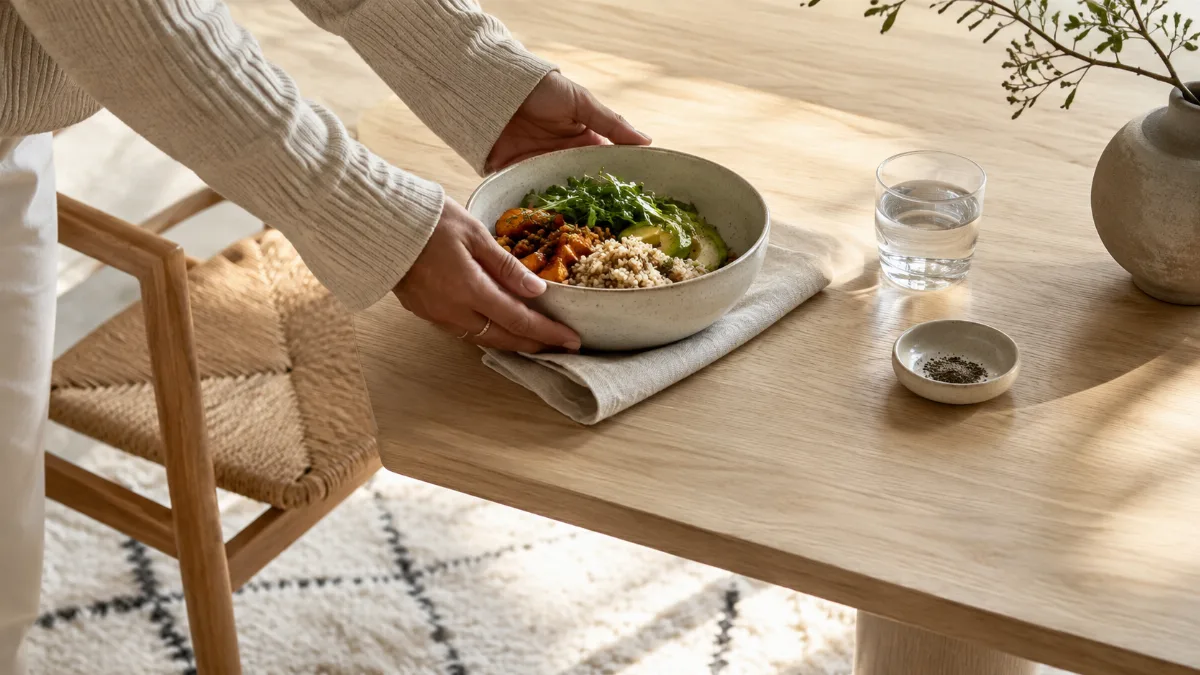
A plan only helps if the session happens consistently, so the design goal is low friction. Two obstacles account for most failures. The first is forgetting: attach the planning to an existing Sunday anchor — after breakfast, before the grocery run — so it rides on a habit you already have instead of needing its own reminder. The second is stopping halfway: planning isn't finished until the grocery list is written. Treat the menu and the list as one continuous twenty-minute task, not two separate chores, or you'll arrive at the store improvising all over again.
What the Session Looks Like in Practice
Concretely: pull the rotation list up on your phone, glance at the week's calendar for the nights that will be rushed, and assign the fastest meals to those nights — a sheet-pan dinner or a twenty-minute stir-fry to the evening with back-to-back activities, the slower braise to the night that's wide open. Check the fridge and pantry for what's already on hand so nothing gets bought twice, then write the grocery list straight off the five chosen meals, grouped by aisle if that speeds your trip. The whole thing fits in the time it takes to finish a cup of coffee, and it ends with two finished artifacts: a menu on the fridge and a list in your pocket.
About That "226 Decisions" Figure

You'll often see the claim that people make around 226 food-related decisions a day, a number from Brian Wansink's Cornell Food and Brand Lab. It's worth being honest about it: much of Wansink's work later ran into serious replication problems, and several specific figures from that lab are disputed. Treat the precise count as unreliable. The idea it's usually cited for — that small food choices accumulate and that decision quality falls over the day — rests on much sturdier ground in the broader ego-depletion literature. The practical takeaway doesn't depend on any exact number: people decide worse about food late in the day, and moving the decision earlier reliably helps.
Fewer Decisions at the Store, Too
Planning also disarms a second set of choices: the ones a grocery store is engineered to provoke. End-cap promotions, product placement, and the smell of the bakery all exist to trigger unplanned purchases. Walking in with a written list and a rough time limit blunts that design. Open-ended trips tend to run 45 minutes to an hour and generate noticeably more spending; a focused, list-driven run usually takes 20 to 35 minutes and holds closer to the plan. Households that plan before shopping tend to report not just lower grocery bills but higher actual cooking rates and less takeout — because a plan turns intention into a structure that survives the week, and raw intention usually doesn't.
That's the real return on a Sunday meal plan: it isn't only about food. A household that already knows Tuesday's dinner has its Tuesday decision-making free for whatever Tuesday actually throws at it. Protecting a handful of small decisions each week compounds quietly, and it's worth far more than the fifteen minutes it costs. See also: minimalist meal planning guide and capsule pantry guide.
Comments
No comments yet.