

The Accessories Trap
Accessories are marketed as the easy upgrade — the quick addition that transforms a basic outfit into something more interesting. The pitch is effective. Accessories are lower cost than clothing, take less visible space, and seem like additions rather than commitments.
The cumulative result of many small additions is a drawer full of tangled necklaces, three black belts with barely distinguishable differences, five bags that cover the same function with minor variations, and a collection of pieces that are rarely worn because their presence is forgotten or because the occasion they were acquired for rarely arises.
The accessories trap is the same as the clothing trap, at smaller scale. Many individual reasonable decisions produce an overall collection that is too large, incoherent, and difficult to use easily.
Jewelry: The Rotation Principle

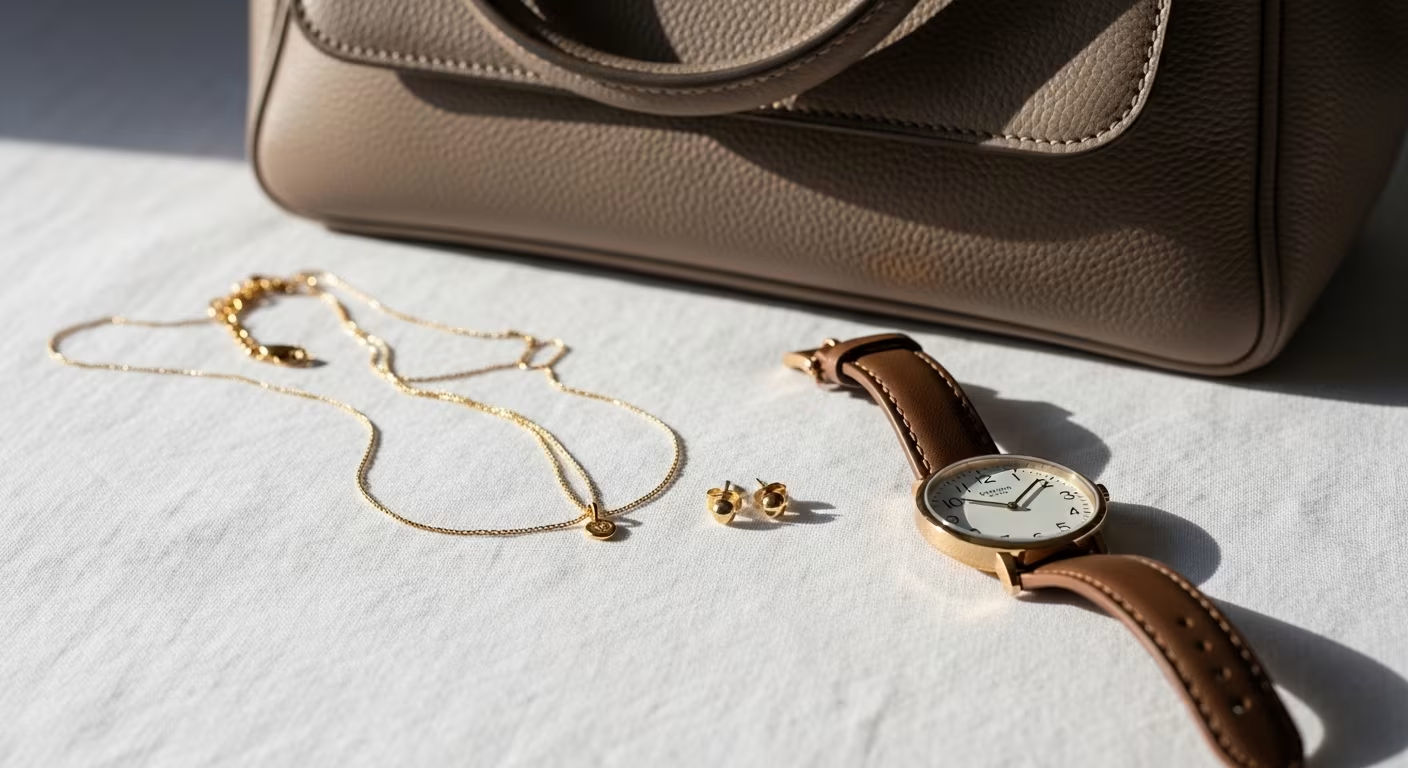
The most practical approach to a minimalist jewelry collection is a small set of daily pieces and a deliberately small set of occasion pieces. The daily pieces are the ones worn consistently — a chain necklace, a pair of stud earrings, a watch, a ring. The occasion pieces are for contexts where different jewelry is appropriate.
The total count does not need to be rigid, but it should be small enough that every piece is actually worn. A drawer full of tangled necklaces contains mostly pieces that are never worn; the tangles themselves create friction that discourages wearing what is there.
Storing jewelry in a way that makes all of it visible — a small tray, a hanging organizer, a few hooks — prevents the out-of-sight accumulation that occurs when pieces are buried in a drawer. What is visible is used; what is buried is not.
Bags: One Per Function
Bags accumulate because each seems to serve a distinct purpose that the others cannot. The everyday bag. The smaller going-out bag. The work bag for the laptop. The weekend bag for overnight trips. The tote for shopping. Each purchase was justified by a genuine use case.
The honest audit question for bags is the same as for shoes: has this been used in the past three months? The weekend bag used twice a year may be genuinely necessary despite the low frequency — the use case exists even if it is rare. The fourth tote bag acquired because the others are somehow not quite right is a different situation.
One bag per genuine use case is sufficient. Most people find that their actual use cases reduce to two or three: an everyday carry bag that handles most daily needs, a more formal option for professional or formal contexts, and a larger bag for travel or specific activities. These three cover nearly all situations for most people.
Belts: The Over-Variation Problem

Belts are the category most prone to over-variation. Black leather dress belt, brown leather casual belt, tan leather, woven canvas, fabric casual — the visual differences are subtle, the functional differences minimal, and the total wearing frequency for most of the collection is low.
A functional belt wardrobe for most people consists of one or two: a belt that works with formal or professional trousers, and a casual belt for less formal contexts. Some people need only one if their clothing context does not vary significantly between professional and casual.
The rest of the belt collection — the ones that are vaguely similar to one of the two functional belts but not quite the right option — are candidates for release.
Scarves, Hats, and Other Accessories
The smaller categories of accessories — scarves, hats, gloves, sunglasses — follow the same audit logic. Functional items that are regularly used belong; duplicates of functional items and occasion items for occasions that do not occur belong only if the occasion is both real and likely.
Seasonal accessories deserve particular attention. A collection of winter scarves and hats that accumulated over several years often contains more variety than any wardrobe system needs. Two or three scarves that are actually worn regularly are more useful than ten that get unwrapped from a storage box once a year to make a selection.
The After-Edit Maintenance Habit

After editing the accessories collection down to what is actually used and fits the clothing palette, the maintenance habit is simple: before acquiring any new piece, identify what it would replace or which gap it fills. If it replaces an existing piece, release the existing piece when the new one arrives. If it fills a genuine gap, the gap should be identifiable specifically before the purchase rather than after.
This habit prevents the reaccumulation that typically follows any declutter if no maintenance habit is established.
The Cost of Tangled Storage
A drawer of tangled necklaces is not a storage problem — it is a usage problem. Jewelry that cannot be quickly located and easily accessed does not get worn. The tangles that develop when multiple chains share an unstructured storage space remove the pieces from practical use while maintaining their presence in the household inventory.
Organized storage makes a small jewelry collection fully usable; disorganized storage makes even a large one practically unavailable. A velvet tray with separate compartments, a few hooks on a bathroom wall, or a small standing organizer with individual sections — any of these simple solutions transforms the same jewelry from inaccessible to accessible within minutes of setup.
Gifts and Accessories

A significant source of accessory accumulation for many people is gifts: jewelry received for occasions, scarves given by people who associate a color with the recipient, bags purchased as thoughtful presents by people who didn't know the specific wardrobe needs. These items arrive with emotional significance that makes assessment and release more difficult than with self-purchased items.
A useful framework for gift accessories: if the item fits the established palette and fills a genuine function, it belongs. If it falls outside the palette or duplicates something already in use, the emotional significance of the gift is real but does not change the wardrobe calculation. The gift was an expression of care; the care is not diminished by the item being passed on to someone for whom it is better suited.
The One-In One-Out Rule for Accessories
Maintaining a minimal accessories collection over time requires a simple acquisition discipline: before bringing a new piece into the collection, identify what it replaces or which specific gap it fills. If it replaces an existing piece that has worn out or no longer suits, the old piece leaves when the new one arrives. If it fills a genuine gap — a function not currently covered — the collection grows by one to cover that function.
Without this discipline, accessories accumulate steadily even after a thorough edit. The low price point and small physical size of most accessories make each individual addition feel minor. The aggregate effect of many minor additions over a year restores the cluttered drawer that the edit removed.
The two-set system:
| Set | Contents | Rule |
|---|---|---|
| Daily | a chain, studs, a watch, a ring | worn constantly, stored in reach |
| Occasion | deliberately small | for contexts, not maybes |
| Storage | tray, hooks, hanging organizer — all visible | what is visible is worn; what is buried is not |
| Duplicates | three near-identical black belts | the drawer version of the clothing trap |

Comments
No comments yet.