

A wardrobe that holds every season at once is harder to use than one organised around the season you are actually in. When winter coats share a rail with summer dresses, finding anything means scanning past clothes that are not relevant for months. Getting dressed becomes a small daily search instead of a quick choice.
A seasonal rotation fixes this by keeping only the current season in the main wardrobe. Off-season pieces move to secondary storage — a spare wardrobe, boxes under the bed, vacuum bags in a cupboard — and come back when the weather turns. The active wardrobe shrinks, and everything left in it is something you might actually wear this week.
When to Rotate
Most homes do well with two rotations a year: one in spring, moving winter pieces out and bringing spring and summer forward, and one in autumn that reverses it. Timing depends on climate — in temperate regions, late March to April and late September to October are the usual transition windows. University of Nebraska-Lincoln Extension is a useful outside reference here.
The real trigger is friction, not the calendar. When you have spent a week reaching past out-of-season clothes to get to what you are wearing, the rotation is due. Waiting for a fixed date instead of the actual weather means the wardrobe keeps getting in the way through the whole changeover, which in most climates drags on for several weeks.
A partial rotation covers the awkward shoulder seasons, when a warm day can follow a cold one. Rather than swapping everything at once, move the clear extremes first — the heaviest coats and thickest knits into storage, the shorts and swimwear out — and keep a small transitional layer of cardigans, light jackets, and long-sleeve tops on the rail through the changeover. Once the weather has genuinely settled, the second half of the swap takes twenty minutes.
Temperature is a better trigger than the calendar. Rotating when the daily high has held above roughly 18 °C for a week, and again when it holds below about 12 °C, matches what you actually reach for. In most temperate climates that lands in late April and late September, which is why those months feel right rather than any date being special.
The full rotation takes 2 to 3 hours and works in a fixed order: empty the storage container, wash and repair anything going away, sort the outgoing set as you pack it, then set up the incoming one. Sorting while packing rather than while unpacking is the part that matters — an item you did not wear all summer is easy to release in September and hard to release in April, when it looks new again.
Sort as You Rotate

The rotation is the natural moment to judge each item as it moves. Anything heading into storage gets three questions first: does it still fit, was it worn at all this past season, and is it in good enough condition to keep? A piece going into a box unworn this season and unworn last season has answered its own question — two seasons of no use is a clear signal it can be donated instead of stored.
Items coming out get the same look. Tastes and routines shift; the coat that seemed fine eighteen months ago may not suit how you dress now. Deciding at the point of unpacking is easier than hanging it back up and leaving the decision for a "someday" that rarely arrives. The annual declutter that most people postpone indefinitely simply happens inside a rotation that was going to happen anyway.
Storage That Actually Works
Off-season storage has to do three things: protect clothes from dust and damp, stay compact enough to fit the space you have, and let you retrieve things at the next rotation without a full excavation. Matching the storage to the type of garment does most of that work.
| Item type | Best storage | Why it works |
|---|---|---|
| Sweaters, scarves, folded knits | Under-bed boxes with lids | Dust-proof, stackable, easy to slide out |
| Winter coats, heavy knitwear | Vacuum compression bags | Cut bulk by more than half in small homes |
| Dresses, tailored trousers, shirts | Spare wardrobe or closet rail | Hanging avoids the deep creases folding leaves |
| Every container, whatever the type | A written label ("winter jumpers") | Find one thing without opening all of them |
None of this needs to be elaborate. A marker on a strip of tape is enough; the point is that next season's retrieval is a five-minute job rather than an afternoon of opening every box to find one specific jumper.
Three details prevent the usual damage. Everything goes away clean, because body oils and food residue set into permanent stains over 6 months and attract moths. Vacuum bags are fine for cotton and synthetics but should not be used for wool, down or anything structured — prolonged compression damages the fibres and the loft does not return. And knitwear is folded rather than hung, since hanging stretches the shoulders permanently over a season.
For moths, cedar and lavender are mild deterrents rather than treatments; the reliable measure is that garments are clean and the container is sealed. A clear, labelled box under a bed works as well as anything sold for the purpose, provided it closes properly.
The Lighter Active Wardrobe
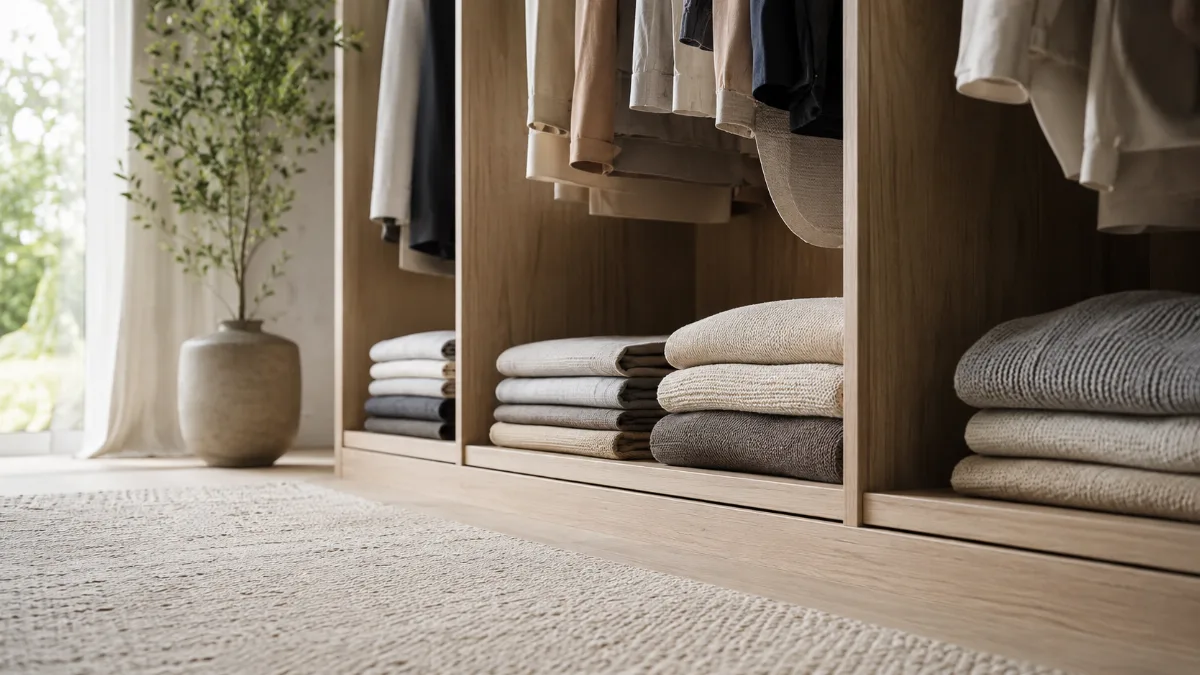
With only the current season on the rail, the wardrobe feels noticeably lighter and everything in view is relevant now. The lower count also makes any system easier to hold: grouping tops with tops and trousers with trousers stays visible when there are thirty items instead of ninety. The capsule wardrobe approach is far easier to maintain inside a rotation, because the active set is always a manageable size.
There is a quieter benefit too. A wardrobe rotated by season lands close to a capsule for each season on its own: a finite, edited set chosen for the same weather, so the pieces tend to work together. Winter holds warm textures that pair; summer holds lighter colours picked for the season. Opening a wardrobe of only current-season clothes is a different morning than facing the whole year at once, where winter wool and summer linen compete for attention and add visual noise to a decision you make while half awake.
The Pieces That Never Rotate
Not everything belongs in storage half the year. A working wardrobe has a core that stays out all the time: jeans, plain t-shirts, a couple of jumpers, underwear and socks, and anything genuinely worn across seasons. Trying to rotate these creates friction for no benefit — you only end up retrieving them a week later.
The clean division is by function, not just by temperature. Store the pieces that are useless out of season — the winter parka, the wool base layers, the summer sundresses and sandals — and leave a small, stable set of year-round basics on the rail permanently. That core, plus the current season's specific pieces, is the whole active wardrobe. Knowing which items are permanent also makes the rotation faster, because you are only ever moving the seasonal extremes, not re-deciding the basics twice a year.
Putting It on the Calendar
A rotation that actually happens needs a slot in the calendar, not a vague plan to do it when life settles down. Two half-day sessions a year, one in spring and one in autumn, booked like any other commitment, keep it from slipping. The first one takes longest because you are building the system — buying the boxes, deciding the storage spots, writing the labels. After that, a rotation runs in two to three hours and feels routine rather than effortful.
Rotating a Child's Wardrobe
A child's rotation carries an extra job: the size check. Moving the season's clothes is the natural moment to see what still fits, what has been outgrown, and what needs replacing before the new season starts. Outgrown pieces in good condition go to a younger sibling or to donation; what stays is the current-size wardrobe that genuinely works, without the near-fits and too-smalls padding it out.
For families with children close in age, this is also when outgrown clothes move into storage for the next child, labelled by size, rather than being discovered months too late or lost in the general wardrobe. And the same rule closes the loop for adults: the item that sits in a box through two consecutive seasons, untouched at either rotation, is clearly not needed — the next rotation is the natural moment to let it go.



Comments
No comments yet.