

The Stretching Paradox
Nearly everyone acknowledges that they should stretch more than they do. Flexibility limitations are directly felt — the tight hamstrings during forward folds, the shoulder restriction during overhead reaching, the hip stiffness after extended sitting. The awareness of these limitations does not consistently produce practice.
The barriers are familiar. Stretching feels slow compared to more active training. The results are less immediately visible than strength or cardiovascular fitness. The practice requires sustained discomfort that people actively train toward rather than away from. And stretching feels like the optional end of the workout that gets cut when time runs short — which is often.
What Consistent Stretching Actually Produces

Flexibility — specifically, the ability to move through a full range of motion around a joint — is a genuine component of fitness that declines with disuse. Sedentary work and repetitive movement patterns create functional restrictions that, left unaddressed, produce compensation patterns in adjacent joints and eventual pain.
Consistent stretching, practiced after exercise when muscles are warm and circulation is higher, produces measurable flexibility improvement over weeks and months. The adaptation is slower than strength adaptation — flexibility gains require sustained practice over longer periods — but the results are real and relevant to daily movement quality.
Beyond flexibility, consistent stretching promotes recovery by improving circulation in worked muscles, reducing the subjective soreness associated with training, and providing a lower-intensity transition from the sympathetic activation of training to a more parasympathetic state.
A Fifteen-Minute Routine Worth Keeping
A fifteen-minute post-training stretching routine covers the major areas that accumulate restriction most commonly. Each stretch held for thirty to sixty seconds produces meaningful stimulus.
Hamstring stretch addresses the posterior chain tightness that develops from both sedentary sitting and training patterns that load the hamstrings. A simple seated or lying position with one leg extended produces sufficient stretch without elaborate positioning.
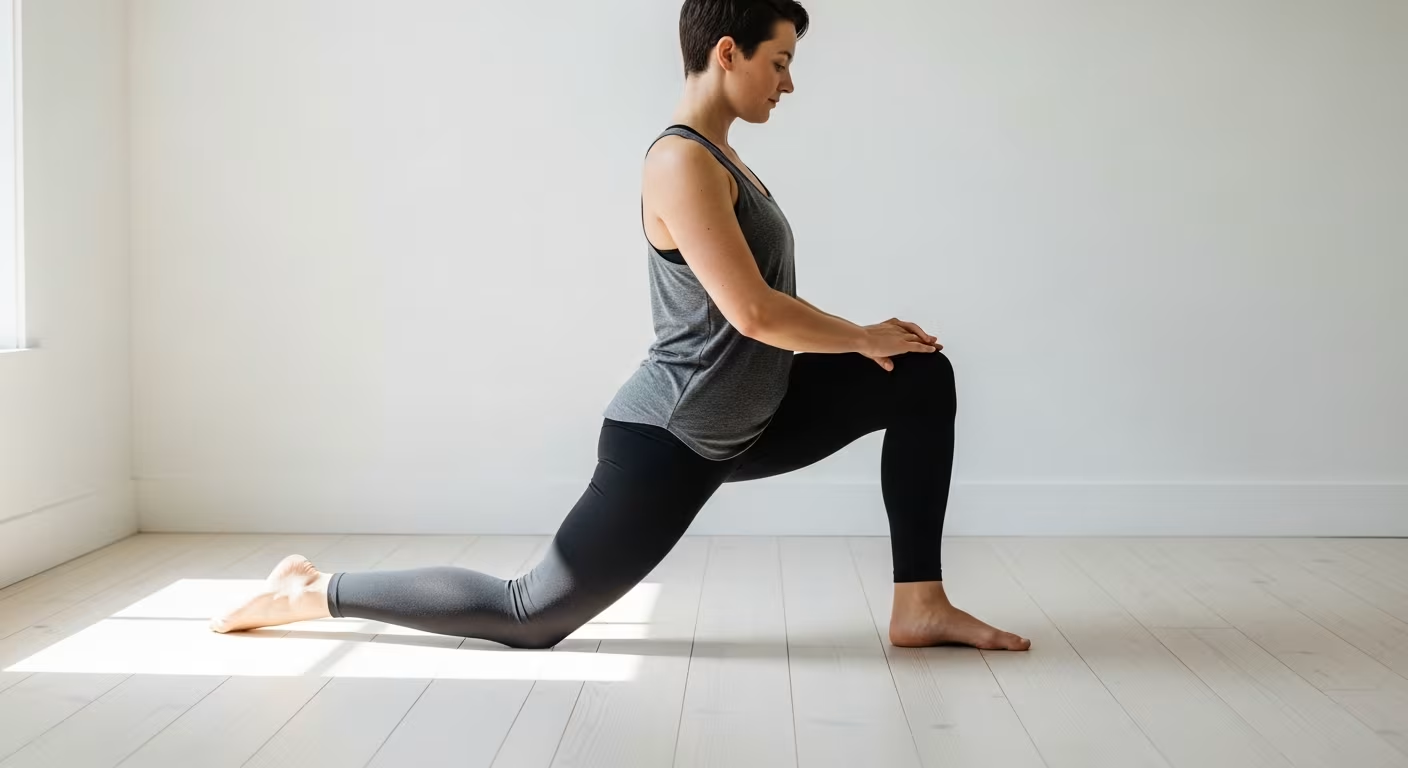
Hip flexor stretch addresses the anterior hip tightness that accumulates from extended sitting. A kneeling lunge position with the rear knee on the floor provides direct hip flexor stretch with adjustable intensity.
Thoracic spine mobility work addresses the upper back stiffness that develops from forward-flexed posture. A foam roller placed perpendicular to the spine — or a rolled towel as a substitute — with the thoracic spine resting across it, produces extension through a commonly restricted area.
Shoulder and chest opening addresses the internal rotation bias that develops from computer work and pressing-heavy training.
Timing and Why It Matters

Post-training stretching is more effective than pre-training static stretching. Warm muscle tissue responds to lengthening more readily than cold tissue, and the flexibility gains from sustained static stretching accumulate better when the neuromuscular system is already engaged.
Pre-training movement preparation is better served by dynamic movement — hip circles, leg swings, thoracic rotation — than by static holds. Dynamic movement increases range of motion temporarily and prepares the neuromuscular system for training demands. Static stretching before training can temporarily reduce force production capacity, making it counterproductive as a warm-up.
The fifteen-minute post-training routine therefore serves two functions simultaneously: flexibility development and recovery transition. Making it the consistent end of every training session uses existing training time rather than requiring additional time.
Frequency Over Duration

Fifteen minutes of stretching practiced consistently after every training session produces more flexibility development over months than occasional hour-long flexibility sessions. The adaptation to stretching responds to consistent stimulus — regular exposure to range of motion that the body is asked to adapt to — rather than to occasional intensive sessions.
This makes the fifteen-minute post-training routine more effective than the longer standalone flexibility session for most people, not because longer duration is without benefit but because the shorter daily version is more consistently practiced.
Building the Habit
The consistency problem with stretching is not motivation failure — it is structural. Stretching added as an optional extension to a training session will be regularly cut when the session runs long or time pressure arrives.
Treating the stretching routine as a fixed component of training rather than an optional extension changes this. The training session is not complete until the post-training routine is done. Building this into how the session is defined — scheduled as fifteen minutes shorter in the main training block, with the final fifteen minutes designated for the stretching routine — prevents the cut that optional additions routinely receive.
Consistency Over Intensity

The common failure in stretching practice is attempting an intensive session sporadically rather than a modest session regularly. An hour of aggressive stretching once a month does not produce the same tissue adaptation as ten minutes practiced daily. Connective tissue responds to consistent, low-grade mechanical stimulus over time — the same principle governing strength training adaptations.
Daily practice at moderate intensity — stretching to mild tension rather than to the edge of pain — produces more lasting flexibility gains than infrequent sessions pushed to maximum discomfort. Pain triggers a protective reflex that causes the target muscle to contract rather than lengthen, which works against the purpose of the stretch. Comfortable tension held for thirty to sixty seconds produces more adaptation than brief, painful stretches held for ten.
Consistency also means the body begins to associate certain times, positions, and sequences with relaxation, which makes achieving the target range progressively easier over weeks. The first week of daily stretching feels stiff and uncomfortable. By the fourth week, the same positions feel substantially more accessible without any increase in effort.
Integrating Stretching Without Extra Scheduling
Post-training stretching requires no additional time if it replaces what most people already spend on cool-down activities — putting equipment away, checking a phone, reviewing workout notes. Fifteen minutes of structured stretching while the body is still warm from training is more effective than the same stretching done an hour later, and requires no additional block in the day's schedule.
Warm tissue after training is more extensible than cold tissue, which means less effort is required to reach the same range of motion. This also reduces the discomfort often associated with stretching, which contributes to the habit forming more easily and being maintained longer.
Morning stretching before the day begins works well for people who train in the evening and want to address mobility independently from training sessions. Five to ten minutes of movement-based work — hip circles, thoracic rotations, ankle mobility — prepares the body for prolonged seated work and reduces the accumulation of stiffness through the day.
Either approach produces genuine benefit. The specific timing matters far less than the frequency. Stretching that occurs at a consistent time becomes a habit; stretching that happens only when time remains at the end of a gym session rarely occurs with sufficient regularity to produce lasting change.



Comments
No comments yet.