

Mom guilt is not a character flaw and it is not irrational. It is the natural output of a standard — absorbed from social media, peer comparison, and cultural messaging — that is incompatible with the actual conditions of a family's life. The guilt is the distance between that standard and the reality of a normal Tuesday. Minimalist parenting does not close that distance through harder effort or better performance. It closes it by changing the standard itself.
Where the Standard Comes From
The parenting standard that generates the most guilt is what researchers call intensive parenting: the belief that good parenting demands constant engagement, continuous enrichment, activity after activity, and the steady sacrifice of the parent's own needs to the child's development. This model took roughly its current shape in the 1990s, and social media has amplified it by surfacing the curated best moments of every other family's week.
The uncomfortable finding running through the research on intensive mothering is that it does not deliver what it promises. Studies on intensive mothering beliefs have linked them to higher stress and lower wellbeing in mothers, without a matching payoff in children's outcomes — the children of intensively parenting mothers do not reliably fare better than children raised with a lighter touch. The standard manufactures guilt without producing a proportional benefit. Understanding that is the first crack in its authority.
What Minimalist Parenting Actually Means
Minimalist parenting is not neglectful or disengaged parenting. It is parenting that stays present and involved while rejecting the premise that more — more activities, more toys, more stimulation, more organized experiences — is always better for a child.
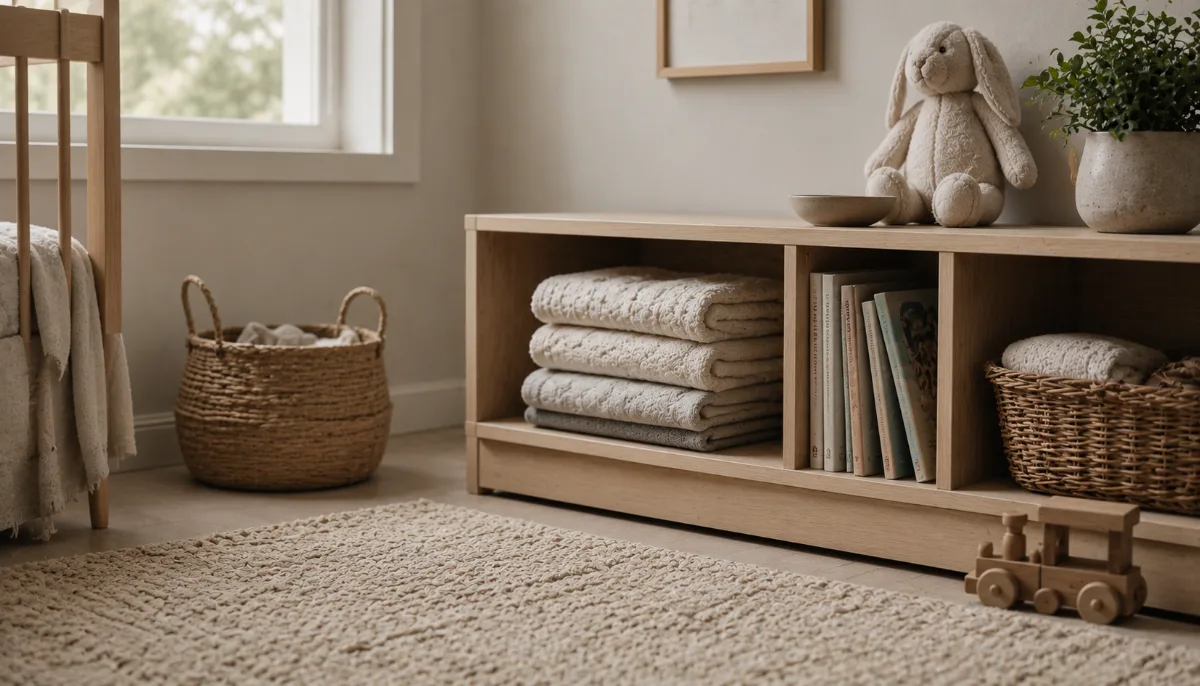
In practice it looks like fewer scheduled activities running at once, a house with a manageable toy count, meals that are nutritious and simple rather than elaborate and photogenic, and a parent who keeps meeting their own needs alongside the child's instead of surrendering them entirely to the child's schedule. A family running this way might have one after-school activity per child rather than four, a couple of bins of toys rather than a room full, and a standing rule that the parent's coffee and thirty minutes of quiet count as needs, not indulgences.
The developmental case supports the approach. Unstructured time is where much of a child's executive function and creative capacity gets built — the very things that packed schedules crowd out. Fewer toys tend to produce deeper, longer play, because attention is not constantly pulled to the next object. And a parent whose own tank is not empty is measurably more available than a depleted one.
Fewer Toys, Deeper Play
The toy question is where minimalist parenting becomes concrete, and where the guilt is often loudest, because a well-stocked playroom reads culturally as a generous childhood. In practice the opposite tends to hold. A child surrounded by thirty toys grazes across them, giving each a minute before moving on. The same child with five or six toys available at a time settles into longer, more inventive play, because there is nothing new competing for the next glance.
A rotation handles this without throwing anything away. Keep a small selection out — a set of blocks, a couple of open-ended favorites, one or two current-interest items — and store the rest in a closet, swapping a few pieces every week or two. Toys that reappear after a month of absence get greeted like new ones. The approach borrows the logic of a capsule wardrobe: a smaller active set, quietly refreshed, does the work of a much larger pile. It also shrinks the daily management burden that quietly drives a good share of parental exhaustion, since a room with six things to put away resets in two minutes rather than twenty.
The Specific Guilt Sources and Minimalist Responses

Mom guilt rarely arrives as one vague feeling. It shows up as a handful of specific, recurring accusations, and each one has a proportionate response once the intensive-parenting standard behind it is set aside.
| Guilt source | The intensive-parenting claim | Minimalist response |
|---|---|---|
| Screen time | Any screen is a developmental risk | Screens used as a deliberate, time-bounded tool — an hour of decent content while a parent takes a break — are not the emergency the guilt treats them as |
| Activities | A good parent enrolls the child in many | One or two well-chosen activities per season, with real unstructured time as the equal partner, not a gap to fill |
| Food | Meals must be organic and home-prepared | A generally whole-food, varied diet meets the goal; the exact form on any given Tuesday does not decide outcomes |
| Presence | A parent should always be fully engaged | Fewer things competing for attention make genuine, full presence possible for real stretches — the honest fix, not more hours in the room |
The screen-time line is worth dwelling on, because it produces some of the loudest guilt for the least cause. A child who watches an hour of age-appropriate content while a parent handles something is fine; the American Academy of Pediatrics guidance on children and media is about intentional limits and quality, not zero minutes at any cost. The guilt is out of scale with the actual impact.
Present-moment engagement is the one to take seriously
Of the four, the guilt about being physically present but mentally elsewhere is the one worth genuine attention, because it often points to something real. A parent who is in the room but emotionally unavailable most of the time is offering less than a parent who is fully there for shorter, defined stretches. The minimalist response is not reassurance that it is fine — it is reducing the number of things competing for attention so that the periods of full presence can actually happen.
What Actually Reduces Mom Guilt

Research on maternal wellbeing keeps pointing at the same three factors: social support — other parents to share the experience with, without judgment — personal time that is protected rather than sacrificed at the first competing demand, and a realistic standard that does not require constant self-denial.
Minimalist parenting feeds all three directly. Fewer activities mean fewer logistics and more time. A lower toy volume means less daily management. Simpler meals mean less cooking pressure. Every hour reclaimed from unnecessary complexity is an hour available for genuine presence, personal restoration, and the connected parenting that actually matters. The guilt does not vanish — it is built into the role — but its intensity tracks the gap between the standard and the reality. Narrow the standard and the gap becomes manageable, and the guilt shrinks to a size a parent can actually carry.
The Comparison Engine and How Minimalism Disrupts It
Social media's role in mom guilt is specific and mechanical. It supplies a continuous feed of parenting moments selected for visual appeal and aspirational polish. The result is a comparison baseline that reflects not the real distribution of parenting experiences but the top five percent of moments, presented as if they were an average day.
Minimalist parenting cuts the supply. By reducing the activities, purchases, and productions that generate shareable content, it also reduces a family's involvement in the comparison engine itself. A parent who is not enrolling in five activities is not comparing activity counts. A parent who is not staging an elaborate birthday party is not measuring their aesthetics against a feed. Less comparison input means less guilt output — a quiet secondary benefit that rarely gets named but works reliably for families who make the shift.
What Minimalist Parenting Doesn't Promise
Minimalist parenting does not promise easier children, faster development, or an end to hard parenting moments. It promises a reduction in the logistical and material complexity that competes with the actual relationship.
A child with fewer toys is not automatically more creative, but the conditions for creative play are better. A child in fewer activities is not automatically happier, but the conditions for real rest are better. A parent who spends less time managing stuff and schedules simply has more attention left for the relationship, and the relationship is where parenting actually happens.
Holding the Frame Against Peer Pressure
Holding this frame against social pressure is not easy. A parent surrounded by intensively scheduling peers will hear, implicitly and sometimes explicitly, that a lighter schedule is not enough — the offhand "only one activity?" at pickup, the group chat organizing a fourth enrichment class, the birthday party that sets a bar the next one is measured against. Keeping the frame takes genuine conviction rather than defensive justification: a settled position grounded in what children actually need to develop well, held quietly rather than argued.
It also helps to be clear about what minimalist parenting is not. It is not a rival to attachment parenting, authoritative parenting, or any named relational framework. It operates on the material and logistical layer — the stuff, the schedule, the complexity — and can coexist with any of them. A parent can be deeply attached and attuned while owning few toys and keeping a light calendar; the two operate on different layers entirely. The guilt eases because the material layer gets lighter, which leaves more of the parent available for the relational layer underneath, where the actual parenting was always going to happen.
See also: frugal living tips for moms and morning routine for moms.


Comments
No comments yet.