


Why Whole-Home Decluttering Sessions Stall
The urge to declutter the entire home in one weekend makes emotional sense: the problem feels urgent, motivation is high, and a total reset sounds more satisfying than chipping away at it. In practice, whole-home sessions almost always collapse partway through. Hours of back-to-back decisions wear down the ability to keep making them cleanly — the same mental fatigue that makes the tenth decision harder than the first. Meanwhile every room sits half-emptied, which looks worse than the original clutter, and the day ends with the house in temporary disarray rather than improved order. The energy that started the project is gone, and what remains is a mess spread across more rooms than you began with.
The focused approach — one room, one session, finished before you move on — heads off all three failure modes at once. A single room holds a manageable number of decisions. A session that completes one room looks better when it ends than when it started. And the next session has a defined edge instead of being an overwhelming continuation of a sprawling unfinished job. The constraint is the whole point: by refusing to open a second front, you guarantee that every session produces a visible, finished result.
What Counts as a Room

For focused decluttering, a "room" is any space that can genuinely be sorted in a single two-to-four hour block. For most ordinary rooms — a bedroom, a bathroom, a living room — that's the physical room itself. For larger or denser spaces, it isn't. A garage packed with years of accumulation, a basement, or a home office buried in old paper is not a two-hour job, and treating it as one guarantees the half-finished result you're trying to avoid. In those cases a single section is the unit: one wall of the garage, one bank of shelves, the filing cabinet and nothing else.
The test is simple. Define the scope so it can be truly completed, not merely started, in the time you actually have. A session that ends with the space in better order than it began is a win. A session that ends with things pulled out and not yet resorted is demoralizing no matter how much work went into it — and that feeling is exactly what makes people abandon decluttering. Scope down until finishing is realistic. A bathroom in an hour beats a garage abandoned at hour three.
The Physical Process for One Room
The most effective sequence for a single room works in contained sections rather than emptying the whole space at once. Pick one contained area — a drawer, a shelf, one section of the closet — and remove everything from it. Sort what came out into three piles: keep, release, and relocate. Return the keep items in an organized arrangement, then move to the next contained area and repeat. Working section by section prevents the avalanche of an entire room dumped onto the bed with no path back to order.
Make each keep-release-relocate call at the moment of sorting, not later. Items moved to a "decide later" pile almost always drift back into storage without a real decision ever being made — "decide later" is where decluttering quietly stalls. Deciding on first touch, even when the call is genuinely hard, produces a faster and more honest result. The bathroom cabinet makes a good warm-up here: expired sunscreen, the sample-size bottles from a hotel, the second-favorite hair product tried once and abandoned. These are low-stakes calls that build the decision rhythm before you reach anything sentimental.
A worked example makes the rhythm concrete. Say the session is a bedroom. Start with the nightstand drawer: empty it, and the dead pens, expired earplugs, and a phone charger for a phone you no longer own go to discard, the two books you'll actually reread go back, and the paperback you finished goes to the donation bag. Next, one shelf of the closet: the sweater that hasn't fit in two years goes to donation, the winter gloves relocate to the entry closet where they belong, and the rest returns folded. Then the top of the dresser, then under the bed. Four contained areas, each finished before the next is opened, and at no point is the whole room in pieces at once. That containment is what lets you stop at the two-hour mark with the room in genuinely better shape than you found it.
What to Do With Released Items
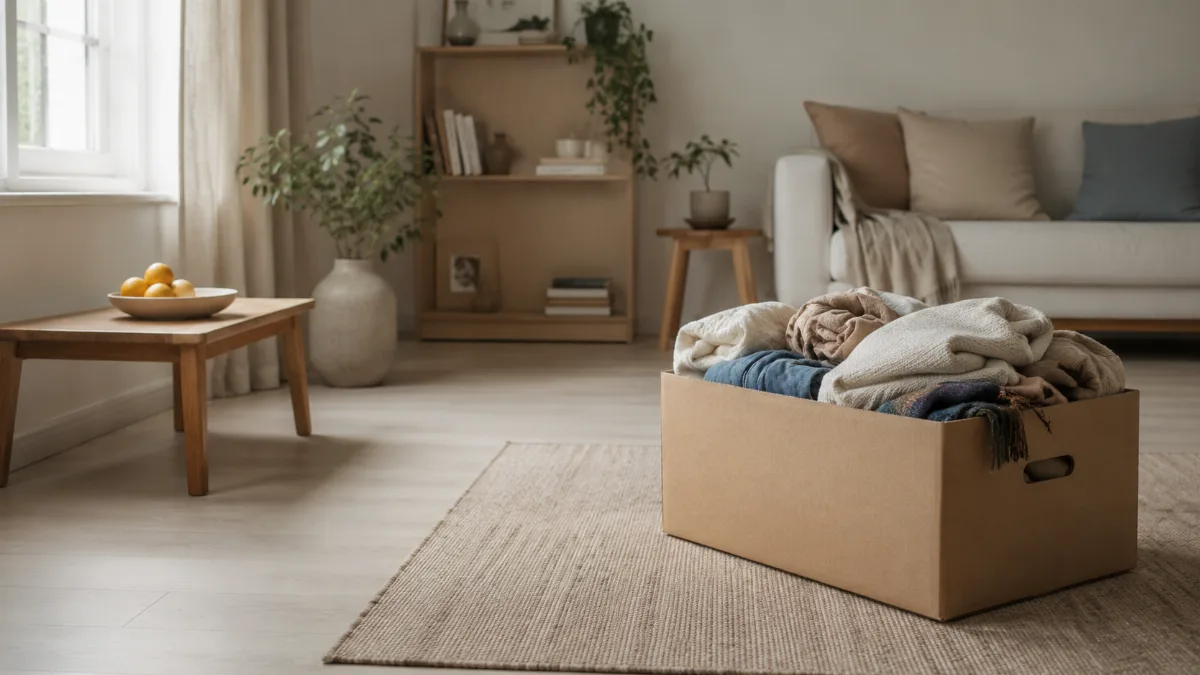
Having a release plan before the session starts removes a major friction point. Decide in advance that released items split into one bag for donation and one for discard, and that the donation bag goes into the car the moment the session ends. Without that plan, the release pile becomes a staging area that sits in a spare room for months, and its lingering presence quietly undermines the sense that anything was accomplished.
The most reliable donation method is the car-trunk system: released items go straight into the trunk, physically out of the home and ready to drop off at the nearest donation center without a separate "should I do this today" decision. A box that lives in a spare bedroom tends to sit far longer than the same box in the trunk, where it nags gently every time you load groceries until you finally hand it over. If the donation center is on a route you already drive — near the grocery store or the kids' school — the drop-off folds into an existing trip rather than becoming its own errand. University of Arizona Cooperative Extension is a good place to verify the details.
Building From One Room to the Next
The momentum of a finished room is the most reliable fuel for the next session. A kitchen that's now clear and organized tells the household, concretely, that the effort produced a real result — and that lowers the activation energy for starting again. Each completed room shrinks what remains and stands as a working reminder of what the process delivers. Motivation that would evaporate against an abstract goal holds up against a room you can walk into and see.
Scheduling the next session before the current one ends converts that momentum into commitment. Deciding at the close of Saturday's kitchen session that next Saturday is the bedroom is far more effective than leaving the next session open and waiting for motivation to reappear on its own. Households that book sessions in advance finish more rooms than households that rely on the mood striking again — because the mood, reliably, doesn't.
Coordinating in a Shared Household
Decluttering in a shared home requires coordination that solo decluttering doesn't. Items belonging to other people can't be released without their input, and any session touching shared space needs to be scheduled with the people who use it. Skipping this step is how decluttering turns into resentment: nothing sours a household on the whole project faster than discovering that a partner's or child's belongings were tossed while they were out.
The approach that holds up is to run shared-space sessions as a joint activity — each person responsible for their own zone within the room, shared items assessed together on the spot. That prevents unilateral decisions about shared possessions and builds a household-wide habit of regular assessment, rather than casting one person as the decluttering authority and everyone else as subjects of it. It's slower than deciding alone, but it's the version that survives past the first weekend.
Keeping a Finished Room From Refilling
The most common post-decluttering frustration is watching a cleared space slowly fill back up. Reversion runs on the same mechanism that created the original clutter: items arrive without a designated place, get set down temporarily, and stack into the next layer. Nothing about a single session immunizes a room against this — the clearing buys time, not permanence.
Two practices prevent it. First, every item in the newly organized space gets a designated location — a specific drawer, shelf, or bin — so returning things to their place requires no decision, only a habit. Second, new items entering the space are assessed at the door: does this have a place here, and does it belong in this room? Items that fail either question go somewhere else or don't come in at all. See our guide to the one-in, one-out rule for the specific habit that keeps each finished room from drifting back over the following months.
Three mechanisms hold a finished room. A photograph taken the day it is finished, kept on the phone, is the reference point — rooms drift slowly and the drift is invisible without a before image. A 5-minute reset in that room at the same point each day, which is short enough to survive a bad week. And a defined landing place for incoming items, because things arrive whether or not the room has space for them.
A monthly 15-minute check per room catches drift before it needs another full session. Rooms that get this treatment typically need a full pass again after 12 to 18 months rather than 3 to 4, which is the difference between decluttering once and decluttering repeatedly.
The Schedule That Keeps Sessions Completable
The focused method depends on realistic scheduling. A two-hour Saturday-morning block produces a completable kitchen sort. A vague plan to "work on the house this weekend" produces a session that starts in one room, wanders into another, and finishes nowhere. A defined room plus a defined time block produces a defined result — the specificity is doing the work.
Where weekend time is tight, the unit can shrink without breaking. A single hour on one drawer, one cabinet, or one section of a room still produces a completed, visible outcome, and a kitchen sorted one cabinet at a time across four short sessions is, at the end, a fully sorted kitchen. The right moment to open the next room is when the current one is genuinely finished — every item sorted, every keeper in its place, the donation bag already in the car — not merely started or underway. And if a room's sort turns up things that belong elsewhere, relocate them at the very end rather than following them into the next room mid-session. That discipline of finishing one room before touching any other is the single practice that makes this approach end differently than the whole-home weekend that started it.
Matching the room to the time available is what prevents a half-finished room, which is worse than an untouched one:
| Room | Realistic time | Sessions |
|---|---|---|
| Bathroom | 45 to 60 min | 1 |
| Entryway | 45 to 60 min | 1 |
| Bedroom (excluding wardrobe) | 90 min | 1 to 2 |
| Wardrobe alone | 2 to 3 hours | 2 to 3 |
| Kitchen | 3 to 4 hours | 3 to 4 |
| Living room | 2 hours | 2 |
| Garage or loft | 6 to 10 hours | 4 to 6 |
Starting with the bathroom or entryway is not arbitrary. Both finish inside a single session, both are used many times a day, and a completed room is the only reliable source of momentum for the ones that take four sessions.



Comments
No comments yet.