

Parenting produces objects with unusual efficiency. Some of it is genuinely needed: a car seat, a crib for a couple of years, clothes in sizes that turn over every few months, a stack of school supplies each September. Most of it arrives another way, through gifts from people who love the child, hopeful purchases for activities that never took hold, products sold as essential that turned out not to be, and the ordinary drift of a house where things come in faster than anyone decides about them.
Intentional parenting doesn't ask for a new philosophy. It asks for a different default: deciding what comes in before it arrives rather than after, removing what isn't used instead of storing it, and treating time and attention rather than objects as the main resource a child actually needs.
Why Less Stuff Changes How Kids Play
Studies of young children and toy quantity keep landing on the same counterintuitive result: a child with fewer toys within reach engages more deeply with each one. Play sessions run longer, a single object gets invented and reinvented into more uses, and attention settles instead of skating across the room.
The driver isn't deprivation; it's less decision overhead. A rug with thirty toys on it poses a constant, low-level question about what to pick up next, and many children answer by drifting between options without committing to any. Cut that to six or eight and the question mostly disappears. The child has to build something out of what's in front of them, which turns out to generate more real play, not less.
This doesn't mean removing what a child loves. It means shrinking the background inventory, the things that sit available but untouched, which is almost always larger than a parent guesses before actually counting. For evidence-based guidance here, see Common Sense Media's family technology guidance.
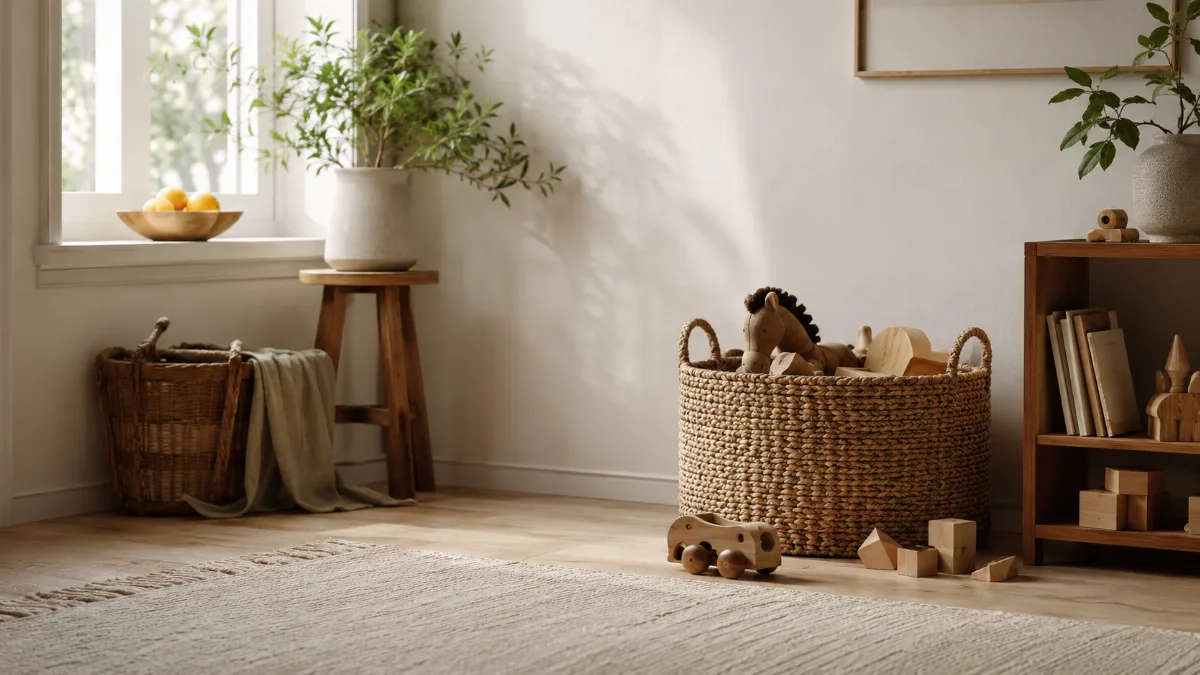
A concrete version helps. A child's room holding roughly eight to ten open-ended toys, plus a small shelf of books, gives more than enough to play with while still fitting into a single basket or two at cleanup. Compare that to the common reality of three overflowing bins where half the contents haven't been touched in months, and the difference isn't what the child can access; it's whether they can see and choose without being buried by the pile.
Running a Toy Audit
Pull every toy out of the space and group by type. Then judge each group honestly: has it been played with in the past two weeks? Does it need a parent, or a fresh set of batteries, to do anything? Does it invite open-ended use, or only one scripted interaction?
That last question matters more than it looks. Toys that perform on their own, the ones with lights, sounds, and a pre-set response, tend to draw a burst of interest and then passive watching. Toys that make the child supply the imagination and the motion, like blocks, plain figures, art supplies, vehicles, and basic building sets, tend to hold attention far longer. It isn't an absolute law, and most kids happily use some of both; it's a pattern worth noticing when the audit turns up a lopsided pile of the first kind.
Sort what's left into three piles: keep, pass on, and unsure. The unsure pile goes into a sealed bin, out of sight, for two weeks. If nobody asks for anything in it, the contents become donation candidates. If a specific toy gets requested, it comes back out and the rest still leaves.
A structured audit takes about 2 hours and works in a fixed order: gather every toy into one room, sort into five groups — played with weekly, played with monthly, broken or incomplete, outgrown, never played with — then act on each. Broken and incomplete go immediately. Outgrown goes to a sibling box, a friend or a charity, with a date. Never played with is the group worth examining rather than clearing: it usually reveals a pattern about what actually gets used.
Rotation handles most of what remains. Keep roughly a third accessible and box the rest, rotating every 4 to 6 weeks. Children typically engage more with a smaller accessible set, and a rotated-in box reads as new without anything being bought. Open-ended toys — blocks, figures, art materials, construction sets — are the ones worth keeping accessible permanently, because they are the ones that survive rotation without losing interest.
Bringing Children In Without a Fight
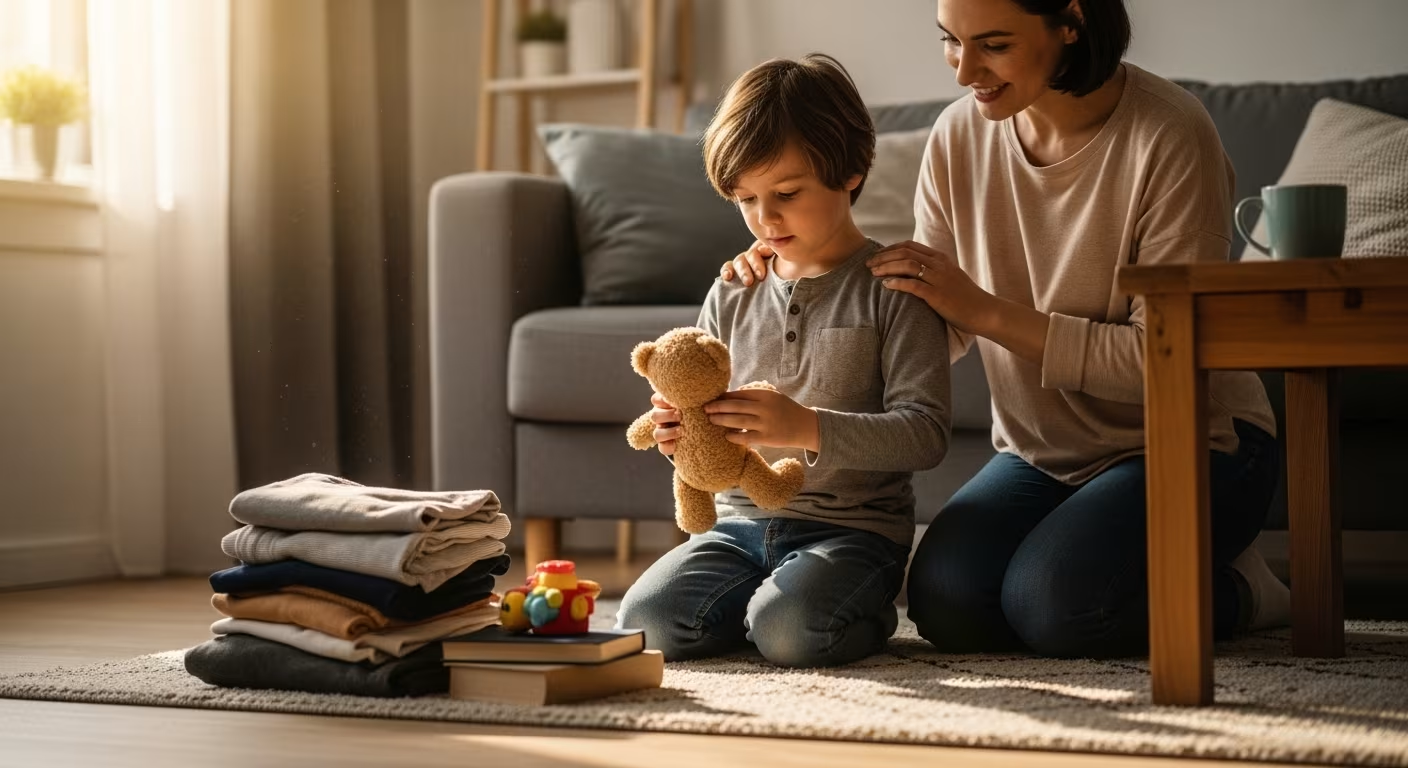
Children old enough to have opinions should take part, but the framing carries the whole outcome. "Which of these matter most to you?" produces better outcomes than "we're getting rid of some toys." The first asks a child to rank what they value; the second sounds like loss, and gets defended like it.
For children under five, rotation usually beats permanent removal. Keep about a third of the toys within reach and store the rest in bins up high. Every two or three weeks, swap some out for some in. The toy that returns from storage feels new even though it's familiar, and the amount on the floor at any moment stays manageable. Rotation also means no toy has to be permanently judged; items simply cycle in and out, which takes the pressure off the whole decision.
Managing What Keeps Arriving
The most stubborn source of family clutter isn't what's already home; it's the stream that keeps coming. Birthdays, holidays, grandparent visits, prizes from the school fair, party-favor bags: the inflow from outside the household is large and mostly outside any one parent's control.
Refusing gifts rarely pays off; the social friction costs more than the shelf space saves. The workable move is building an outflow that roughly matches the inflow. A birthday haul is a natural moment to reopen the audit and name what's leaving, one in and one out as a leaning rather than a strict rule. And when relatives ask what a child wants, experiences answer the question honestly: a museum membership, a swim class, a day out somewhere. Most grandparents genuinely prefer giving those once someone suggests it.
A simple ratio keeps the outflow honest. If a birthday brings in five new toys, the same week is the moment to move five older ones along, matched roughly by size and category rather than counted to the exact piece. Done at each gift-heavy occasion, a few birthdays and one winter holiday a year, this alone offsets most of what arrives from outside, and it does so without a single confrontation over any specific item.
The inflow is the variable that decides whether one audit lasts a season or a year. Four mechanisms handle most of it: a one-in-one-out rule applied before birthdays and holidays rather than after, a specific request to relatives with a named alternative, a staging box in a cupboard where new arrivals wait a week before joining the shelves, and a fixed shelf or bin limit per category — when the bin is full, something leaves before anything is added.
The staging box does more than its simplicity suggests. Toys that are still being asked about after a week join the collection; the ones nobody mentions can leave without a conversation, because they were never integrated into the room in the first place.
What Daily Life Feels Like
A household that manages objects with some intention doesn't look dramatically different from any other family home. The difference shows up in texture, not in staging: fewer things underfoot, less time lost hunting for something that lives nowhere in particular, and children who take more responsibility for their belongings because there's a smaller haystack to lose them in.
Tidying changes most of all. A room with eight toys that each have a home resets in about five minutes before bed. A room with thirty in general circulation takes far longer, so it gets deferred instead of done, and deferred mess compounds rather than clearing. Start with the audit in one room, carry the donation bag out of the house the same day, and give the survivors actual assigned spots; the daily difference is visible inside a week.
Intentional as a Default, Not a Project
Intentional parenting is never finished. It runs quietly in the background: a slightly higher bar for what comes in, a quicker decision about what goes out, and a steady preference for experiences and time over objects. Over years the effect compounds into children who develop a more calibrated sense of what they need versus what they momentarily want, who use and maintain what they own, and who can occupy themselves without something switching on to prompt them.
The parents who keep it going for years share one habit: they don't treat decluttering as a one-time cleanup. They treat it as a quarterly rhythm, a few hours every three months spent seeing what's actually used, what's been outgrown, and which of the past quarter's arrivals earned their keep. That cadence takes the moral weight off any single decision. Nothing failed when a toy moves on after three unused months; it was part of a rotating inventory, not a lifelong commitment.
The two-hour toy audit:
| Step | Number |
|---|---|
| Gather | every toy into one room |
| Sort | five groups, fixed order |
| Keep accessible | about a third |
| Rotate | every 4–6 weeks |

Comments
No comments yet.