
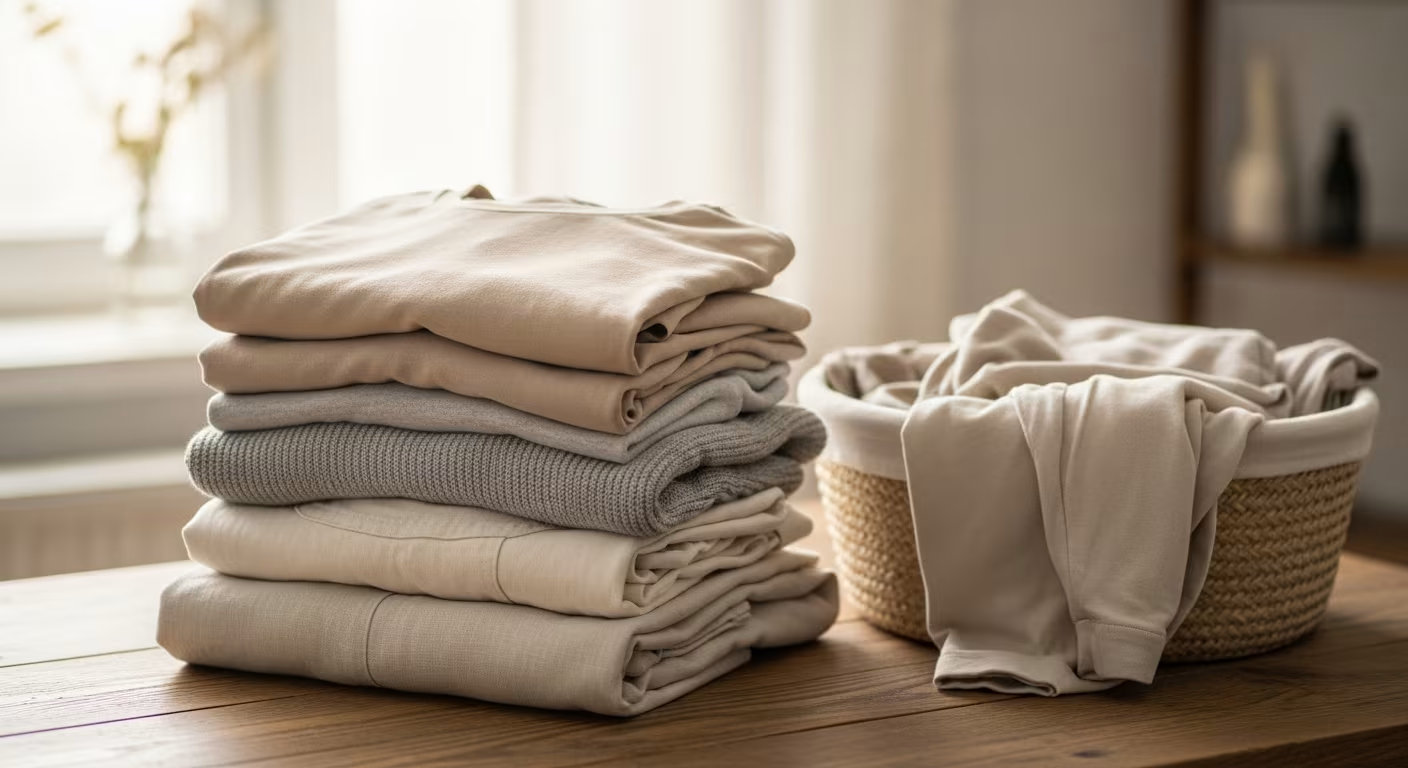

The Laundry Math Nobody Does
The average household spends significant hours each week on laundry — not just the washing but the sorting, transferring, drying, folding, and returning clothing to storage. The total time investment is rarely calculated because it is distributed across several days and feels like background maintenance rather than a significant commitment.
It is, however, directly proportional to clothing volume. More clothes means more loads, more sorting complexity, more surface area for wrinkles, more storage decisions, and more time between washing and returning pieces to active use. The household with forty pieces of clothing in regular circulation generates substantially more laundry work per week than the household with fifteen.
This is one of the less obvious practical benefits of a smaller wardrobe: the ongoing management time decreases with the clothing count. Fewer pieces mean fewer loads, simpler sorting, faster folding, and less time between wearing and re-wearing.
How Over-Accumulation Creates Laundry Avoidance

There is a counterintuitive relationship between wardrobe size and laundry frequency for many people: a very large wardrobe enables laundry avoidance. When there are always more clean options available, the motivation to launder the worn pieces decreases. The pile of worn clothing grows, the load becomes large and daunting, and the task gets deferred further.
A smaller wardrobe creates the opposite dynamic. When the wardrobe is small enough that pieces are needed again within the week, the motivation to launder them is natural and timely. The small load of a few worn pieces is easy to address; the mountain created by weeks of avoidance is not.
This dynamic — smaller wardrobe producing more consistent laundry practice — is reported consistently by people who have significantly reduced their clothing volume. The laundry becomes a smaller, more frequent task rather than a periodic large undertaking.
Care Labels and Real-Life Decisions
Many clothes accumulate unwashed because their care instructions create friction. Hand-wash only. Dry clean only. Lay flat to dry. Each such instruction makes the piece harder to maintain than a machine-washable piece. Over time, pieces with complex care requirements get worn less because the care barrier is high relative to the alternatives.
A minimal wardrobe built around machine-washable pieces eliminates this friction. Every piece in the wardrobe can go in the same wash, with the same temperature, and come out ready to wear or dry quickly. This simplicity is worth more than the average person gives it credit for when assembling a wardrobe.
The dry-clean-only piece, however attractive and well-made, requires trips to the dry cleaner, costs money per cleaning, and produces guilt when worn because the care cost looms. For most everyday pieces, machine-washable is not a compromise — it is a quality of life advantage.
Washing Frequency and Piece Longevity

Most clothing does not need to be washed after every wear. The norm of washing every garment after a single use is not universal, is not optimal for the clothing, and is one of the largest drivers of unnecessary laundry volume.
Jeans typically need washing after several wears unless visibly soiled. Knitwear aired overnight usually does not require washing after a single wear. Shirts worn over base layers need washing less frequently than shirts worn against the skin. Outerwear typically needs washing only a few times per season unless it gets dirty.
Washing less frequently when hygiene is not compromised extends the life of the clothing — washing is mechanical wear on fabric — and reduces both laundry time and water and energy use. Developing a sense of which pieces genuinely need washing after each wear and which do not takes a small amount of attention and produces ongoing benefit.
The Capsule Wardrobe and Laundry Planning

A planned capsule wardrobe for a given number of working days requires at minimum the same number of complete outfits. If the capsule covers a five-day week, the minimum piece count allows five distinct outfits — with laundry done over the weekend to return everything to circulation.
This structure turns laundry into a planned weekly task rather than a reactive one. The laundry happens at the weekend because the pieces are needed again on Monday, not because there is no alternative. The planning eliminates the decision of when to do laundry — it happens when the cycle requires it.
Building around this structure also clarifies how many of each type of piece is genuinely needed: enough to cover the cycle between laundry sessions, plus a small buffer for unexpected delays or extra wear.
What Changes With Less Laundry
The time recovered from reduced laundry management is not dramatic in any single week but accumulates to several hours per month for most households. More practically, the cognitive load of laundry management — the awareness of what is dirty, what needs to be washed, whether there is anything clean to wear — decreases when the total volume decreases.
A smaller, more intentional wardrobe eliminates the wardrobe management tasks that a larger one generates, and laundry is one of the largest of those tasks.
The Laundry Architecture Question

Where laundry is done affects how easily it can be maintained as a small, frequent task rather than a large, periodic one. A household where laundry facilities are in-unit and accessible produces different management patterns than one where laundry requires leaving the home to a shared facility.
For shared-facility households, the motivation to accumulate a full load before making the trip creates incentive to delay washing. A smaller wardrobe that requires more frequent washing creates tension with a shared-facility situation. The practical solution may be a slightly larger capsule — enough to span two weeks rather than one — combined with a consistent biweekly laundry schedule that fits the shared facility context.
Natural Fiber Care and the Minimalist Wardrobe
Natural fibers — wool, cotton, linen, silk — have different care requirements than synthetic ones, and a wardrobe built primarily of natural fibers may require more attention per piece than an all-synthetic one. Wool garments aired after wearing and spot-cleaned when needed can go many wears between full washes. Cotton and linen are machine-washable but may require ironing if wrinkles are a concern in the professional context.
Building a minimal wardrobe with an awareness of care requirements — favoring pieces whose care is simple and compatible with the household's laundry setup — reduces the ongoing maintenance burden. A cashmere sweater that requires hand washing is a different ongoing commitment than a merino sweater that is machine washable on a gentle cycle. Both are natural fibers; the care difference is significant over a year of regular wearing.
A laundry system calibrated to actual clothing volume — not more laundry infrastructure than the wardrobe requires — is one of the quieter practical benefits of owning less clothing overall.
The volume-to-load relationship:
| Wardrobe | Effect |
|---|---|
| 40 pieces circulating | more loads, more sorting, longer folds, laundry avoidance |
| 15 pieces circulating | forced rhythm — wash small, wash regularly |
| The paradox | more clean options = less motivation to wash = bigger scarier piles |


Comments
No comments yet.