
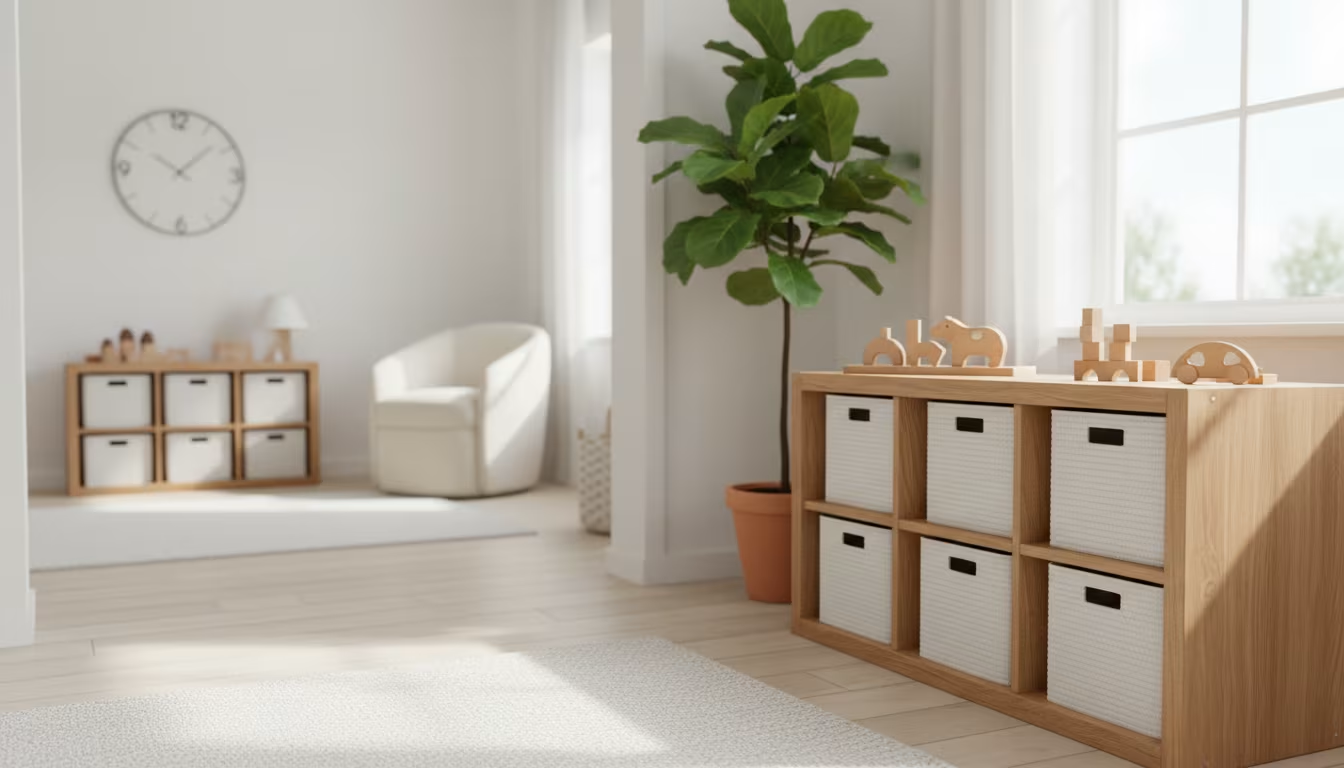

Spending on children's birthday parties has climbed steeply over the last twenty years. What used to be cake and a few games at home has become, in many circles, a production: a rented venue, catering, themed decoration, hired entertainment, and a favor bag for every guest — a bill that routinely runs from several hundred to a couple of thousand dollars. What children actually remember from their birthdays does not track that spending at all. Ask a five-year-old three weeks later and they'll tell you who came, what they did together, and whether there was cake. The tablescape, the entertainer, and the catering don't make the list.
That gap between what a party costs and what a child keeps is the whole opening for a smaller approach. A party built around a few real friends and one good activity can come in under fifty dollars and be remembered better than the expensive version.
The Guest List Is the Real Budget Dial
The single factor that moves party cost most is the number of guests. A party for eight children costs dramatically less than one for twenty-five across every line: food, cake, favors, activity supplies, and space. The common pressure to invite the whole class of twenty-five or thirty is social, not relational — it rarely reflects any real bond between the birthday child and each name on the list.
A gathering of eight to twelve actual friends is also easier on the child. At a large party the noise and social load often exceed what a young child can enjoy, and the birthday kid can end up a bystander at their own event. In a small group they stay at the center of it, which is the point.
A rough rule of thumb keeps the number honest: invite about as many children as the age the child is turning, give or take a couple. A child turning five is well served by four to six guests; one turning nine can handle more. The number that feels too small to the parent is often exactly right for the child, whose sense of a good party is a few people they actually like rather than a room full of names.
Venue: Home or a Free Outdoor Space
Venue rental is usually the biggest discretionary cost and the easiest to cut to zero. A home, a backyard, or a public park covers any party that's sensibly sized and matched to the season. For a cold-weather party held indoors, the living room with the furniture pushed back becomes its own kind of event — a cleared floor is genuinely exciting to a seven-year-old who came to play. For evidence-based guidance here, see the federal MyMoney.gov toolkit.
Public parks with reservable picnic shelters are available for little or nothing in many towns. An afternoon shelter reservation provides shade, tables, and room for a group of any reasonable size, which is often all an outdoor party needs.
If the party is at home, the preparation that matters most is clearing space rather than decorating it. A living room with the coffee table moved out and a rug rolled up gives eight children room to run a relay or spread out a craft, which does more for the afternoon than any amount of bunting. Decoration, if you want it, can be a single homemade banner and a bunch of balloons for a few dollars.
One Main Activity That Carries the Party
What makes a party work for children is simpler than the party industry implies: one clear activity, room to do it, and enough time to see it through. Decoration, an elaborate schedule, and favor bags all sit below that in importance. Activities that cost little and are remembered well include a scavenger hunt with clues written ahead of time, a relay race or obstacle course in a yard or park, a craft each child takes home (the craft doubles as the favor), a talent show, or a session where kids decorate their own cupcakes.
Supplies for any of these usually run under twenty dollars for ten children, and the memory tends to outlast the memory of watching a hired performer. Children are participants by nature; they hold on to what they did far longer than what they watched.
Match the activity to the age and it needs almost no managing. Four- and five-year-olds do well with short, simple tasks — a treasure hunt with picture clues, decorating cookies, a parachute game. Seven- to nine-year-olds can sustain a longer arc: a themed scavenger hunt with a dozen clues, an obstacle course they help build, a team craft with a real end product. The one failure mode to avoid is cramming several activities together; one done fully beats three rushed.
Food, Cake, and What Fifty Dollars Buys
Food expectations at a children's party are modest. Kids want the cake, something to drink, and something easy to eat. Pizza, sandwiches cut small, fruit, and chips cover it for most ages. A takeout pizza order for ten runs about forty dollars and needs no cooking. The cake is the item that carries weight — the candles, the song, the first slice — and a two-layer cake decorated at home costs five to ten dollars in ingredients and about an hour of baking, doing the same job as a specialty character cake at a fraction of the price.
Put together, a modest party lands well under the fifty-dollar line while still covering everything a child actually notices:
| Item | Minimalist approach | Approx. cost |
|---|---|---|
| Venue | Home, backyard, or park shelter | $0 |
| Main activity | Scavenger hunt or craft supplies for 10 | $15–20 |
| Cake | Two-layer cake baked at home | $5–10 |
| Drinks and snacks | Juice, fruit, chips | $10–15 |
| Favors | The craft each child made | $0 |
Add a takeout pizza order and the total sits near forty to sixty dollars. The favor bags, matching tableware, balloon arch, and photo backdrop are each optional add-ons that serve the idea of "a party" more than the child's enjoyment of it.
One practical courtesy costs nothing: ask about allergies when the invitations go out, and keep the snack table simple enough to work around them. A spread of fruit, plain chips, and cut sandwiches is easy to make safe; an elaborate catered menu is not. Most parents will tell you what their child can't have if you give them the opening.
Telling Other Parents It's Low-Key
A common worry about a smaller, simpler party is how other parents will read it. The practical fix is to be specific in the invitation about what the party is: "Backyard party, pizza and cake, wear clothes that can get dirty" sets accurate expectations and is usually welcomed. Most parents of young children are relieved by an invitation that doesn't require a gift-bag arms race or an hour's drive to a venue. A household that plans around deliberate choices rather than social defaults doesn't owe anyone an apology for a simple party — the child who ran a backyard scavenger hunt with eight friends and a homemade chocolate cake had a good birthday.
A short line about gifts on the invitation is welcomed more often than not — "no gifts, please" or "books only" takes the pressure off other families and spares the birthday child a pile of plastic to sort through the next day.
Ask the Birthday Child What They Actually Want
The most overlooked input in party planning is the birthday child's own preference. Asked plainly what they want — without a suggested venue or theme steering the answer — a five-year-old usually names something specific, concrete, and cheap: a particular game at home, one or two specific friends, a favorite flavor of cake. The answer is rarely a jumping castle at a rented hall. It's something tied to the child's current interests and friendships.
Asking the question directly, then treating the answer as the plan rather than a starting point to inflate, is the simplest route to a party the child enjoys and remembers. A kid who asks for a treasure hunt in the backyard with four specific friends and chocolate cake should get exactly that — not a scaled-up version built to look like what a birthday is supposed to be. The party a child still recalls years later is almost never the one that cost the most. It's the one where the day felt genuinely theirs.
Treating the child's answer as real also teaches something worth more than the party itself: that a good time is built from a few specific things done well, not from how much was spent. That lesson tends to outlast the cake.

Comments
No comments yet.