
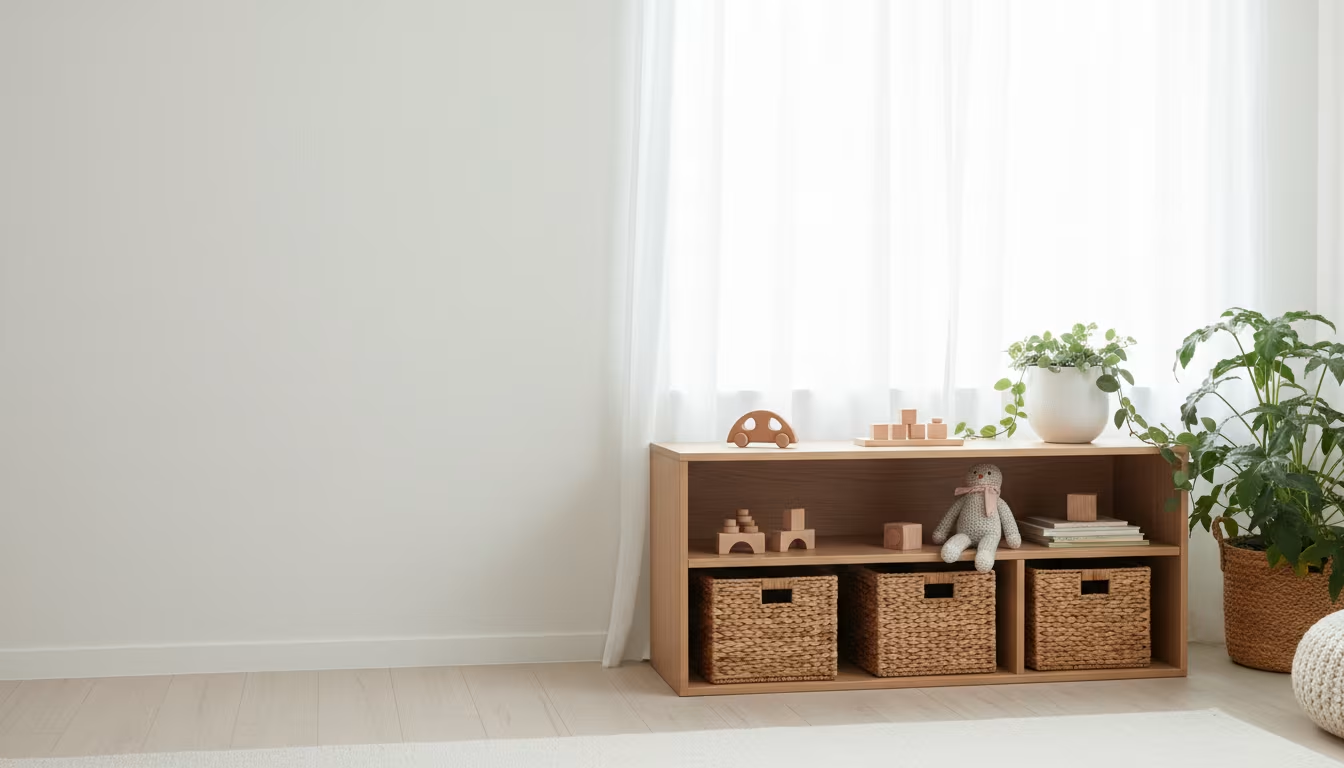

The link between a cluttered home and a higher baseline of stress is not just something people report anecdotally; it shows up across psychology, neuroscience, and research on how people actually use their homes. A visually busy space keeps the brain's threat-scanning systems lightly engaged, eats into the capacity for sustained attention, and generates a background cognitive load that quietly accumulates over the hours spent in it.
Understanding the mechanism rather than just the correlation makes the whole thing more workable. This is not really a question of taste or lifestyle branding. It is a question of how the brain processes visual information and what happens when there is too much of it competing for the same limited attention.
How Visual Clutter Triggers the Stress Response
The human brain is built to scan its surroundings for threats and relevant information. In a visually chaotic room, that scanning never fully switches off: the peripheral field keeps registering the disorder, and the brain keeps assigning a small slice of processing to monitoring it, even while conscious attention is pointed elsewhere.
Some of the most-cited evidence here comes from a long study of dual-income families and their homes, in which parents who described their living spaces as cluttered and unfinished tended to show less healthy daily patterns of cortisol, the body's main stress hormone. The takeaway is not a precise number to quote but a direction: the stress tied to a cluttered environment is not a single jolt at the sight of mess, it is a sustained, low-level activation that runs the whole time a person is in the space. For anyone already managing heightened everyday stress and anxiety, a cluttered home tends to compound the load rather than stay neutral — the place that should offer refuge becomes one more source of strain, and a feedback loop forms in which the disorder generates stress that drains the energy needed to deal with the disorder.
Attention and Cognitive Load

Every visible object in a room is a potential target for attention. A home with dozens of items sitting on open surfaces is therefore a home offering a constant supply of small redirects — each object able to trigger a memory, a task, a reminder, or simply a pull away from whatever a person is trying to focus on.
This is why concentrated work is harder at a cluttered table than a clear one, and it has nothing to do with willpower. The visual field is competing, continuously, for the attention being aimed somewhere else. A cleared working surface and reclaimed space is not a styling choice; it is an attention-management move with real effects on focus and how much work actually gets done in an hour.
Consider a home office desk holding a stack of unopened mail, three coffee mugs, a phone charger for a device that has since been replaced, and a half-read book. None of it is being used, yet every item is a small live prompt: the mail says handle me, the mugs say clear me, the book says finish me. A person trying to write an email at that desk is doing so against a quiet backdrop of four unrelated demands, each drawing a sliver of the attention meant for the email. Clear the surface to a laptop and a single notebook and the demands go quiet — not because the underlying tasks vanished, but because they are no longer sitting in the visual field issuing reminders. The desk did not get more organized so much as it got less loud.
The Unfinished-Business Effect
Clutter is often unfinished business made physical: tasks not done, decisions deferred, projects begun and stalled. The pile of mail carries obligations. The half-built project carries a quiet promise broken to oneself. The exercise machine bought with an intention that evaporated carries a small, recurring pang of guilt every time it is walked past.
Psychologists describe part of this through the Zeigarnik effect — the tendency of unfinished tasks to occupy more mental background processing than completed ones. A home full of deferred decisions is, functionally, a home full of open mental tabs, each drawing a little attention and feeding the diffuse sense that things are unmanaged. Closing even a few of those loops — the mail sorted, the one project finished or formally abandoned — frees more mental room than the size of the physical task would suggest.
Clutter and Depression: A Two-Way Street

The relationship between low mood and a cluttered environment tends to run in both directions. Depression drains the capacity to keep a space in order, so clutter builds; the accumulating clutter then compounds the symptoms, sapping motivation and deepening the sense of being overwhelmed. The cycle is hard to break precisely because the condition that makes clearing the space necessary is the same one that makes clearing it feel impossible.
For anyone caught in that loop, the productive move is not a weekend-long overhaul. It is a single small area — one drawer, one shelf, one corner of a counter — finished in one short session. Completing that one small thing supplies the experience of having acted on the environment instead of being pinned down by it, and that experience is where momentum starts. The scale is deliberately tiny because the point is the completion, not the square footage.
Start Where You Can See It

The clutter that weighs most on moment-to-moment stress is the clutter in the spaces used most and seen most: the kitchen counter visible from the sofa, the entryway surface met the instant a person walks in, the bedroom surface that is the first thing seen each morning. Clearing these high-visibility, high-hours zones first buys the largest immediate drop in environmental stress, well before the closets and the garage have been touched.
Ranking the starting points by payoff rather than by size makes the first hour count for the most:
| Where to start | Roughly how long | Why it pays off first |
|---|---|---|
| Kitchen counter in view of the living area | 10–15 minutes | Seen constantly through the day; the biggest visible win |
| Entryway drop surface | 10 minutes | Sets the tone the moment you arrive home |
| Bedroom nightstand or dresser top | 10 minutes | First and last thing seen each day |
| Coffee table or main sofa-side surface | 10–15 minutes | Dominates the room you relax in |
| Closed drawers and back-of-closet storage | Later, longer sessions | Out of sight, so lowest effect on daily stress |
A kitchen counter returned to a clean surface changes the experience of standing in that kitchen every single day — a benefit that begins the moment it is cleared, not months later when the whole home is finally sorted.
The Emotional Weight of Certain Objects
Decluttering a home where some of the clutter carries emotional freight — inherited belongings, gifts from relationships that ended, objects tied to plans that never happened — is not a purely physical task. Deciding about those items involves real emotional processing, and it costs far more time and energy per object than ordinary sorting does.
Treating that as legitimate rather than as a failure to be efficient keeps the process sustainable. A session that works through ten emotionally loaded items is a productive session. A session that tries to force decisions on a hundred of them in one afternoon usually stalls out or produces choices that feel wrong the next morning. Keeping the emotionally heavy items in their own slow, small batches — separate from the fast practical sorting — is what stops the whole effort from grinding to a halt.
Maintaining a Clearer Space
A clearer home lowers stress and lifts focus on an ongoing basis only if it stays clear. The everyday habits that stop a space from rebuilding to its old state are part of the benefit, not a separate chore bolted on afterward — the same logic behind a short daily reset built for people with no free time. A ten-minute nightly pass that returns the key surfaces to clear preserves the psychological payoff of the space rather than letting it quietly erode between occasional big clear-outs. Supporting the wider picture — sleep, routine, and reaching out when the load gets heavy — is part of tending both the space and the person, and general guidance on looking after your mental health treats the two as connected rather than separate.
Why Physical Action Comes First
One pattern the research keeps returning to is that acting physically on the environment produces a psychological shift far more reliably than planning or intending to act does. Deciding to declutter, without moving anything, changes nothing. Removing ten visible items from a surface changes the felt state of the room immediately.
That is what makes this practical rather than abstract. The most accessible intervention available today is a short physical action on the most visible surface, done now rather than scheduled for a someday weekend. A ten-minute sort of the kitchen counter or the entry table, done immediately, alters the sensory experience of the space and, with it, the moment-to-moment stress of being there — not eventually, but from the moment the surface is clear. And the return on that first cleared surface is disproportionate to the effort it took, because the first visible change hits the brain hardest; later areas deliver real but smaller gains. The entry point is always one specific surface, cleared today.



Comments
No comments yet.