

Two different problems keep people scrolling at midnight, and only one of them gets talked about. The first is physiological: blue-wavelength light from screens suppresses melatonin, the hormone that cues the body toward sleep. Evening screen use delays that melatonin rise, which delays sleep onset, which shortens the night if the alarm is fixed. The second problem is behavioral, and it is the harder one. Almost nobody plans to scroll until 12:30. They pick the phone up for five minutes, and the loop of infinite content and frictionless swiping runs well past any intention to stop.
Solving the light problem alone gets you halfway. Solving the behavioral one is where better sleep actually comes from, and it takes more than "just put the phone down."
Two Problems, Not One
Melatonin production usually begins rising about two hours before your habitual bedtime. Screen use in that window can suppress the rise enough to push back when you actually feel sleepy. Research on evening device use has repeatedly found that reading on a bright screen before bed delays melatonin and shifts sleep later compared with reading a printed page. The downstream cost is less slow-wave sleep in the first half of the night, when most physical restoration happens, and more fragmented sleep overall. The person who checks their phone until midnight on a 6:30 alarm isn't only losing hours; they're getting worse sleep inside the hours they keep.
Screens hit sleep through a second channel too: cognitive arousal. Checking email, reading news, or opening social media means processing new and often emotionally charged information. The brain doesn't file that neutrally; it activates the systems that assess threat, opportunity, and social standing, and those systems don't coexist with sleep onset. This is why a warm "dark mode" filter only solves half the problem. It reduces melatonin suppression but does nothing about the arousal of the content itself. A phone in dark mode running Instagram is less disruptive than the same phone at full brightness, and still far more activating than no phone at all.
The 45-minute to one-hour window before bed is the stretch most worth protecting. Guidance from the CDC's overview of sleep and health points to a consistent wind-down as one of the more reliable levers on sleep quality, and what happens in that final hour shapes the whole night more than what happens two hours out or at lights-out itself.
The 45-Minute Window and What Fills It
The most common objection to a pre-bed screen break is honest: "I don't know what to do instead." The phone fills that time now, and its absence leaves a gap that feels uncomfortable. So the replacement has to be decided in advance, not improvised at 11 p.m. when the phone is the path of least resistance.
A physical book is the highest-success substitute most people report. Not an e-reader, which is still a screen even if a lower-arousal one, but paper. Reading engages the mind without feeding it novelty at irregular intervals, and twenty pages is usually enough to bring on genuine tiredness. Other alternatives that hold up in practice appear below.
| Replacement activity | Roughly how long | Why it works before sleep |
|---|---|---|
| Reading a physical book | 20 pages, ~20 min | Engagement without notifications or new stimuli |
| Gentle stretching or slow yoga | 5–10 min | Low intensity; releases tension without raising heart rate |
| Writing by hand (journal, list) | 5–10 min | Offloads tomorrow's worries so the mind stops circling |
| Talking with someone in the house | 10–15 min | Social wind-down with no algorithmic pull |
| Calm music or a non-activating podcast | 15–30 min | Fills the silence without emotional charge |
The point of pre-deciding is that the moment the phone would normally go into your hand, something else is already scheduled to take its place.
Getting the Phone Out of Reach
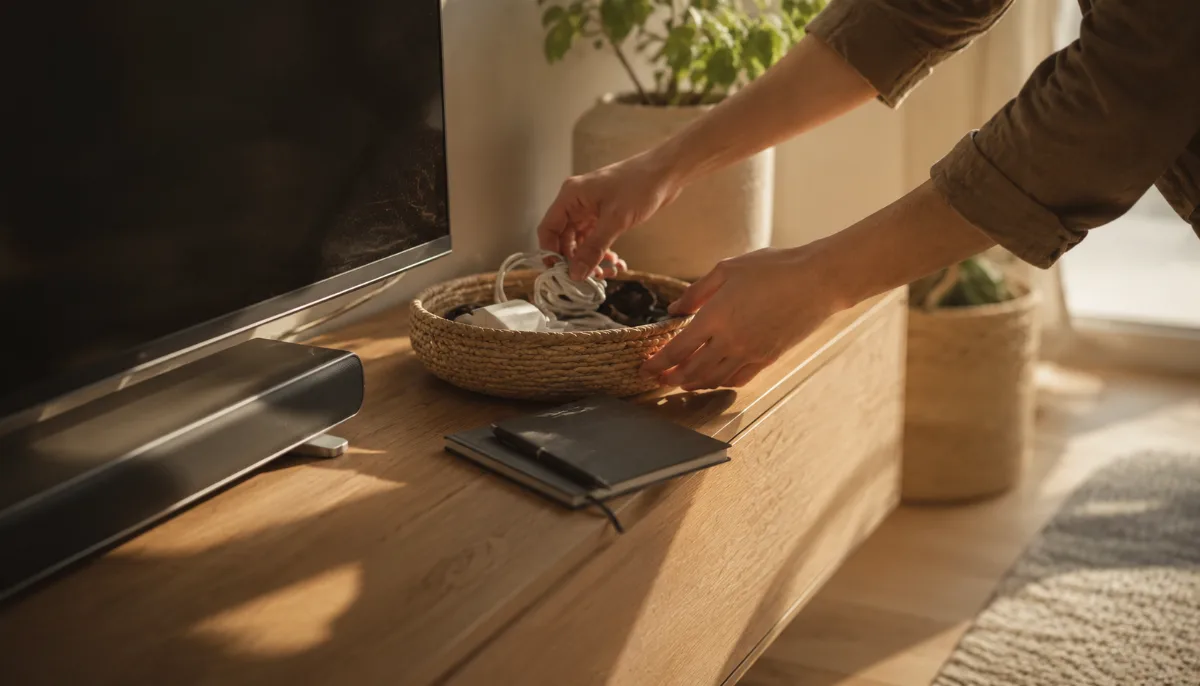
The single structural reason phones stay in bedrooms is the alarm clock. If the phone charges on the nightstand and wakes you at 6:30, it is also one arm-reach away at 11:30 p.m. and again at 2 a.m. if you stir. A basic bedside alarm clock, usually under $20, does that one job reliably and lets the phone charge in another room. The bedroom becomes phone-free by default rather than by willpower.
The convenience objection (multiple alarms, snooze, gradual sunrise wake) doesn't hold up well: most standalone clocks now offer the same features at the same price, and even a real feature gap has to be weighed against the cost of the "quick check" that becomes forty-five minutes. If the phone genuinely must stay in the room for on-call work or a medical reason, "do not disturb" with specific contacts allowed through, plus the phone face-down and charging on the far side of the room, turns a reflexive grab into a deliberate walk across the floor.
Building a Sequence That Holds
Doing the same things in the same order each night trains the brain to read the sequence itself as a sleep cue. A realistic 30-minute version: stop screens and move the phone out of the room, change for bed, finish the bathroom routine, get into bed with the book, lights out. The individual steps matter less than repeating them; within a couple of weeks the opening move starts triggering drowsiness on its own. A fixed wake time, held even on weekends, anchors the whole rhythm, and variable wake times are the most common reason sleep quality swings night to night.

Don't start with a full screen-free hour; that's too large a change to hold. Move the phone out of reach 20 minutes before your intended sleep time, and let the window grow as it earns its place. The test is simple: are you falling asleep faster? If yes, extend it. Most people who run this for two weeks and sleep better don't drift back on purpose.
See also: declutter micro-habits for calmer evenings and morning minimalism for better morning focus.


Comments
No comments yet.