


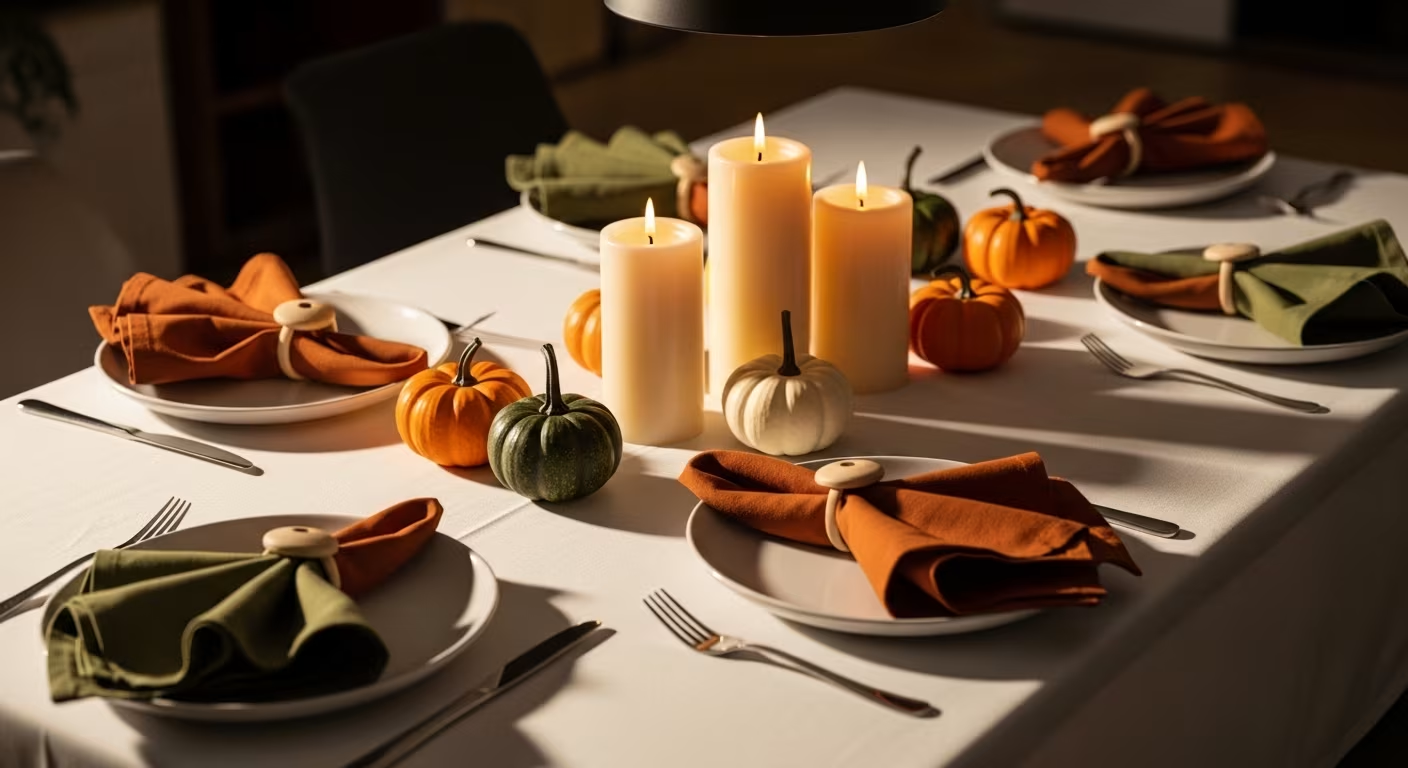
Thanksgiving is the one American holiday that has a built-in philosophical argument against excess — the premise that gratitude, not accumulation, is the point. And yet most Thanksgiving execution involves more food than can be eaten, more dishes than the oven can handle simultaneously, and a level of preparation stress that doesn't fully resolve until sometime in December. The minimalist approach isn't to do less for its own sake; it's to do what's meaningful more deliberately and let the rest go.
Distinguishing the Meal From the Performance
There's a meaningful difference between enjoying Thanksgiving and performing it. Performing means making every traditional dish because tradition requires it: turkey, stuffing, green bean casserole, sweet potato casserole, cranberry sauce, mashed potatoes, rolls, two kinds of pie. Enjoying means making the dishes that the people at the table would actually miss if absent, and eating them unhurried.
A Thanksgiving table with five or six dishes executed well produces a better meal than one with twelve assembled under pressure, where three arrive cold, two were made from obligation rather than enthusiasm, and the table is so crowded that passing anything requires logistics. The question for each potential dish: would someone at this table specifically want this, or is it there because it belongs on a Thanksgiving table?
Identifying the non-negotiable dishes for a specific household — the ones that would genuinely constitute a loss if absent — anchors the menu. The remainder of the table fills itself from what the cooking capacity actually allows, without requiring everything else.
Shared Cooking Done Well

Shared cooking — each guest bringing a dish — distributes both the workload and the decision-making, but requires explicit coordination to work. "Bring something" as an instruction produces an unpredictable collection, often weighted heavily toward desserts and lighter sides while leaving proteins underrepresented. "Bring a vegetable side that serves eight" produces a meal.
For households that find coordination challenging, assigning one category per person or family unit — one starch, one vegetable, one salad, one dessert — works better than open invitations and eliminates duplication. The hosting household focuses on the turkey or main protein and one side of their choosing; guests handle the rest. Everyone contributes something and the cooking load is genuinely shared.
Shared cooking also distributes the cleanup, which Thanksgiving produces in extraordinary quantities. A household that cooks the entire meal alone also cleans up alone, which can make a long day significantly longer.
Auditing the Guest List
Thanksgiving guest lists accumulate the same way Christmas obligations do: the person who would be alone otherwise, the extended family member who expects inclusion, the friend who was invited two years ago and has since become a standing invitation. Some of these guests are genuinely welcome and add to the day. Others create obligations that constrain the conversation and comfort of everyone present.
An explicit guest list — decided in September or early October rather than the week before — allows for genuine deliberateness rather than accretion by social gravity. A smaller Thanksgiving with a group that actually wants to spend the day together is better by most measures than a larger one where a portion of the table is satisfying an obligation.
This doesn't require cutting anyone off. It may mean being honest that a different form of connection — a lunch the week before, a phone call on the day — serves certain relationships better than a holiday dinner does.
The Four-Day Weekend Without Black Friday

Thanksgiving in the United States comes with a four-day weekend for many households, and this window has become culturally colonized by Black Friday — both in-store and online — in a way that redirects post-Thanksgiving energy from rest toward consumption. The transition from gratitude to purchasing happens within twelve hours of the holiday.
The four-day window is one of the few times in the year when the schedule genuinely clears for several consecutive days. Using it for rest, a specific outdoor activity, a project with the people already present, or simply unscheduled time produces more lasting value than browsing sales and processing purchases.
Not participating in Black Friday or Cyber Monday requires no equipment and produces the same outcome as participating — except with fewer purchases. For households with specific items identified and a genuine deal available, the sale weekend is worth using. As a general occasion for browsing without a specific need driving it, it primarily produces spending in response to opportunity rather than in response to genuine want.
Practicing Gratitude on a Gratitude Holiday

Gratitude practices — naming specifically what you're grateful for — have genuine, documented effects on wellbeing. A Thanksgiving that includes some version of this practice, however briefly, is using the holiday for what it names. A Thanksgiving focused primarily on logistics and recovery from them is not.
The practice doesn't need to be elaborate. Going around the table with one specific thing each person is grateful for takes three minutes and produces a moment of genuine attention across the table. A brief written note at the start of the day, naming what the past year produced that was worth having, costs nothing. A conversation over dishes about what surprised each person in the past twelve months is both a gratitude practice and a natural extension of a meal.
After the Meal
The hours after the Thanksgiving meal are often the best part of the day — the pressure of preparation is gone, the food is settling, and there's nowhere to be. This is where actual conversation happens, games get played without anyone having planned them, and the day produces the low-key connection that holiday preparation is supposedly in service of.
The instinct to immediately start cleaning up, or to turn on a game, or to disperse to separate rooms deserves some resistance. An hour of post-meal time with everyone present and no particular agenda — that's often the Thanksgiving moment that persists in memory, not the food itself.
Planning the Holiday in November's First Week

The most useful Thanksgiving habit change tends to be decided in early November rather than the week before the holiday. What three dishes are genuinely essential to this household? Who do we want at the table and why? How do we want to use the four-day weekend? These questions have better answers with three weeks of runway than with three days.
A brief conversation in the first week of November — fifteen minutes over coffee — produces a Thanksgiving designed around what the household actually values rather than one that replicates the previous year by default. The holiday worth having is one you planned to have, not one that happened to you while you were managing logistics.
The Morning of Thanksgiving
Thanksgiving morning is often the most overlooked part of the day — a time consumed by preparation, managing the kitchen timeline, and preemptively exhausting the host before the guests arrive. An hour or two of protected morning time, before the cooking begins in earnest, changes the quality of the entire day.
What to do with that time is specific to the household: a walk, a quiet breakfast together, a specific tradition that precedes the meal preparation. Some households watch a parade. Some read. Some take a run. Some make a particular breakfast that appears only on Thanksgiving morning. The activity matters less than the fact of having some unhurried time before the day becomes about logistics.
Hosts who begin cooking before they've had any time for themselves tend to arrive at the meal already depleted, which affects their experience of the day even when everything on the table turns out well. Building morning buffer into the Thanksgiving timeline is a structural change that requires no purchasing and produces consistent results.



Comments