
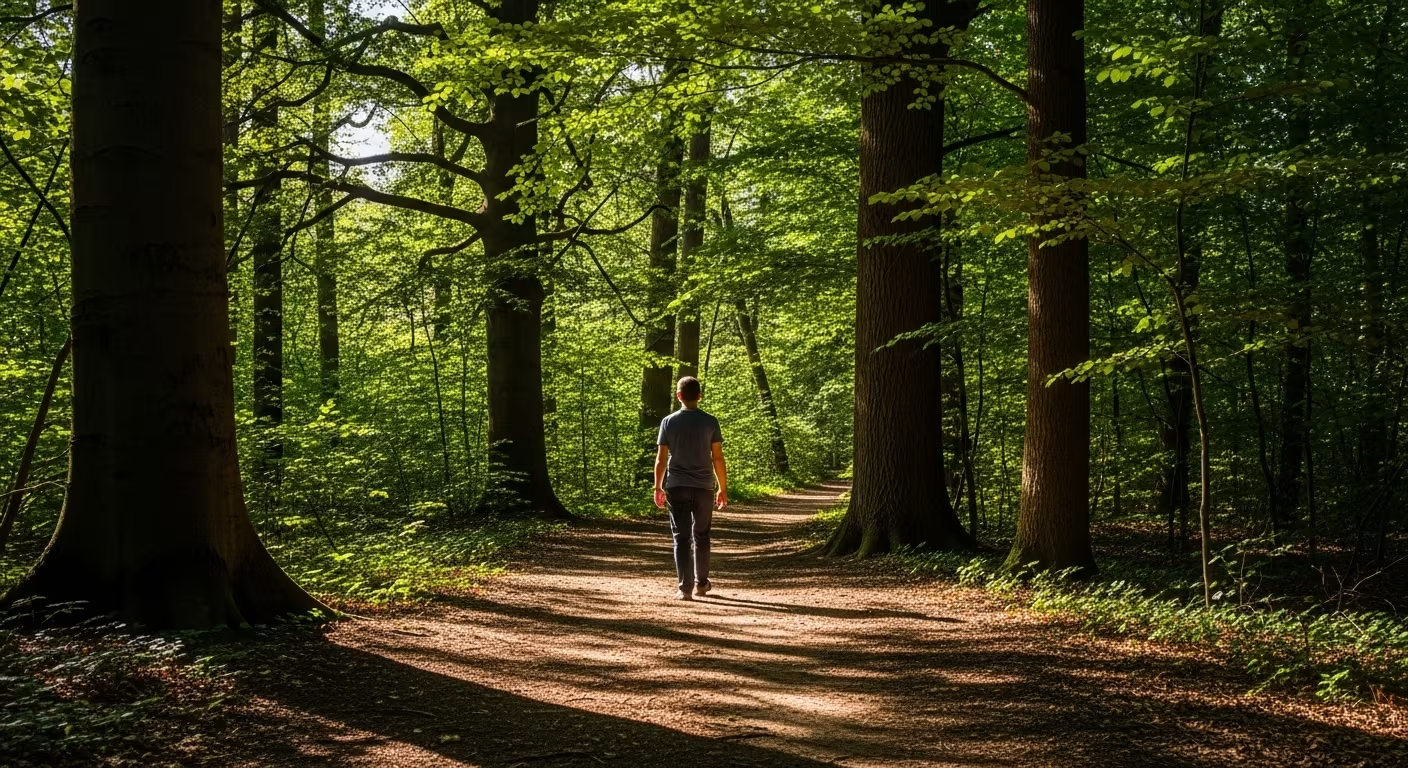

Why Humans Feel Better Outside
The research on nature and human wellbeing is unusually consistent for behavioral science. Time spent in natural environments — parks, forests, coastlines, even tree-lined urban streets — reliably produces reductions in cortisol, blood pressure, and heart rate. It reduces activity in the part of the brain associated with rumination. It improves attention, mood, and subsequent cognitive performance.
The most widely cited explanation is evolutionary. Human brains spent hundreds of thousands of years in natural environments. The visual patterns, sounds, and spatial organization of natural settings appear to match something fundamental in how the brain processes environment. Built environments — particularly dense urban ones with high visual complexity, noise, and crowding — require sustained directed attention. Natural environments engage a softer, more involuntary form of attention that allows the directed attention system to rest.
This explanation, associated with attention restoration theory, predicts that natural environments should be restorative specifically for the directed attention system depleted by cognitive work. The research largely supports this prediction: people who spend time in natural settings perform better on subsequent attention-demanding tasks than those who spend equivalent time in urban environments.
The Attention Restoration Effect

Directed attention — the kind used for focused work, reading, planning, and managing competing demands — is a limited resource. Extended periods of directed attention use produce the subjective experience of mental fatigue: difficulty concentrating, increased distractibility, reduced capacity for complex decisions.
Recovery from directed attention fatigue requires a period during which directed attention is not demanded. Sleep provides this recovery; so does time in environments that engage involuntary rather than directed attention. Natural settings do this particularly well because they contain patterns that are engaging without requiring sustained focused processing: moving water, shifting light through leaves, animal movement, irregular organic forms.
The implication for practical life is that time in natural settings after cognitively demanding work is more restorative than equivalent time in built environments. A walk in a park after a demanding morning produces more attention recovery than an equivalent walk through an urban commercial area.
What Counts as Nature

A common barrier to nature-based restoration is the belief that meaningful natural environments require travel — wilderness, national parks, remote destinations. The research does not support this restriction. Street trees, neighborhood parks, community gardens, urban waterways, and suburban green spaces produce measurable restoration effects, though often smaller than wilder settings.
The defining feature of restorative natural settings appears to be the presence of natural patterns — organic forms, natural sound, natural light — rather than any particular scale or remoteness. A small city park with mature trees provides different stimulation than a surrounding urban street even if it is surrounded by buildings.
For most urban residents, genuinely natural environments are closer than the assumption of wilderness suggests. A fifteen-minute walk to a nearby park, a canal path, or a tree-lined area provides the attentional restoration that behavioral science identifies, without any significant travel.
Walking Without a Destination
The mode of the walk matters as much as the setting. A walk with a destination and a time constraint keeps the directed attention system partially engaged: navigating, tracking time, thinking about the destination. A walk without these constraints allows the attentional shift that makes natural settings restorative.
Walking without a destination does not mean wandering without awareness. It means attending to what is present rather than tracking what comes next. The path taken, the sounds encountered, the light quality, the temperature, the smell of the environment — these are available to notice when attention is not primarily directed elsewhere.
This is mindfulness in its simplest form: present-moment awareness of actual sensory experience, without the requirement of a cushion, a guided voice, or a specific technique. The walk provides the setting; attention to what is present in the walk is the practice.
Making It Consistent

The benefits of nature exposure are cumulative and frequency-dependent. A daily twenty-minute walk in a natural setting produces more benefit over a month than a single long walk per week, even if the total time is similar. The regular return to the restorative setting prevents the accumulation of directed attention fatigue rather than addressing large deficits once a week.
Consistency develops more easily when the walk is tied to an existing routine rather than scheduled as a separate commitment. A morning walk before other activities begin, a lunch walk in a nearby park, or an evening walk as a transition from work are all entry points that attach to existing time structures rather than requiring the creation of new ones.
No equipment is required. Weather becomes less of a barrier after the first few weeks of a consistent habit. The return from even a brief walk in natural settings is disproportionate to the investment, which makes it one of the most accessible wellbeing practices available.
The Dose and Frequency Question

The research on nature exposure and wellbeing has attempted to identify dose-response relationships — how much time, how often, produces how much benefit. The findings are not precise but suggest that twenty minutes in a natural environment produces measurable stress reduction, and that benefits continue to increase with duration up to around two hours, with diminishing returns beyond that.
For practical purposes: a daily walk of twenty to thirty minutes in a green setting produces substantially more cumulative benefit over a month than a single two-hour weekly walk, even if the weekly time totals are similar. The daily contact with natural stimulation provides consistent access to the attentional restoration that prevents accumulation of fatigue.
This makes the habit accessible. Twenty minutes per day requires less scheduling than an occasional longer excursion and produces more consistent benefit.
The figure most often cited from research on time in nature is roughly 120 minutes a week, and — usefully — how it is distributed appears to matter less than the total. That can be one long walk at the weekend or 20 minutes on six days, and both seem to work.
Practical shapes for that total: 20 minutes daily on a route from your own front door; 30 minutes three times a week in a local park; or a single 2-hour walk somewhere larger at the weekend. The version that survives is the one with the shortest travel time, since a walk requiring a 40-minute drive happens far less often than one starting at the door — which is the whole reason the local option outperforms the more scenic one.
Technology and the Walk
The restorative effect of natural environments is diminished when the walk is accompanied by divided attention. A walk taken while listening to a podcast or audiobook is not the same neurologically as a walk taken with attention available for the environment. The input from the audio device engages the directed attention system that the walk is intended to rest.
Music is somewhat different — instrumental music that does not require active attention produces less directed attention engagement than spoken word. Some people find instrumental music during a walk compatible with environmental noticing; most find spoken content is not.
The simplest version of the nature walk — no audio, no visible screen, attention available for whatever is present in the environment — is also the most restorative. Starting the walk with a phone in a pocket rather than in a hand changes the probability of this kind of full attention considerably.
The evidence for attention restoration turns on the walk being undirected, which podcasts and calls interfere with. A practical compromise for people who find silence difficult: leave the headphones out for the first 10 minutes, which is roughly how long the restlessness lasts, and decide after that.
Two settings remove most of the interruption without leaving the phone behind: turn on a focus or do-not-disturb mode for the duration, and take the phone out of the pocket only to photograph something. Tracking distance and pace turns the walk into an exercise session with a target, which is a different activity — useful, but not the one this is about.
The 120-minute prescription:
| Shape | Math |
|---|---|
| Weekly target | ~120 minutes in nature — split freely |
| Daily version | 20 min from your own front door |
| 3× weekly version | 30 minutes |
| Survival rule | shortest travel time wins; the 40-min-drive walk stops happening |
| Headphone compromise | first 10 minutes silent |



Comments
No comments yet.